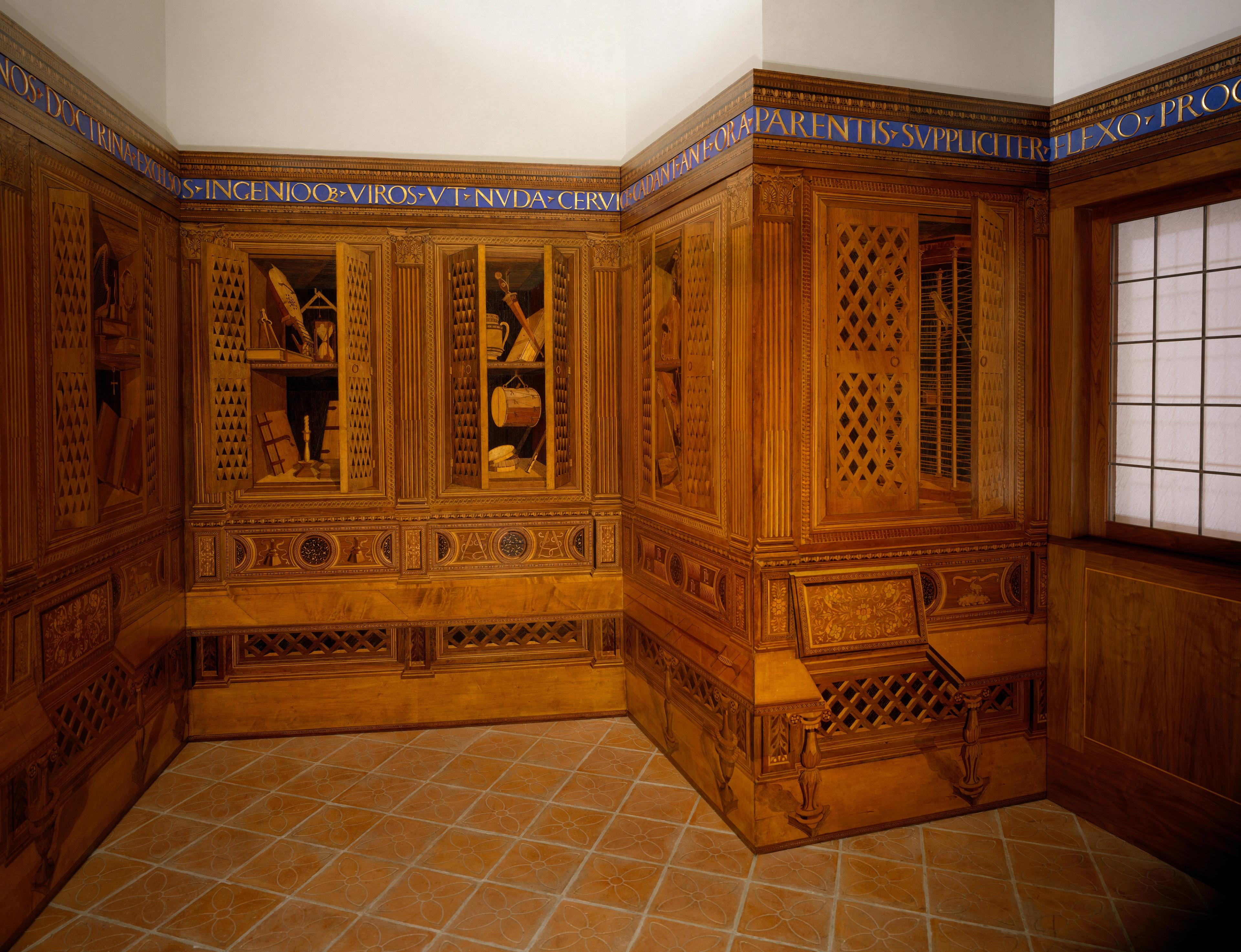
Studiolo from the Ducal Palace in Gubbio, ca. 1478–82. Designed by Francesco di Giorgio Martini (Italian, 1439–1501), Executed under the supervision of Francesco di Giorgio Martini (Italian, 1439–1501), Executed in the workshop of Giuliano da Maiano (Italian, 1432–1490) and Benedetto da Maiano (Italian, 1442–1497). Walnut, beech, rosewood, oak, and fruitwoods in walnut base, 15 ft. 11 in. x 16 ft. 12 in. x 12 ft. 7 1/4 in. (485 x 518 x 384 cm). The Metropolitan Museum of Art, New York, Rogers Fund, 1939 (39.153)
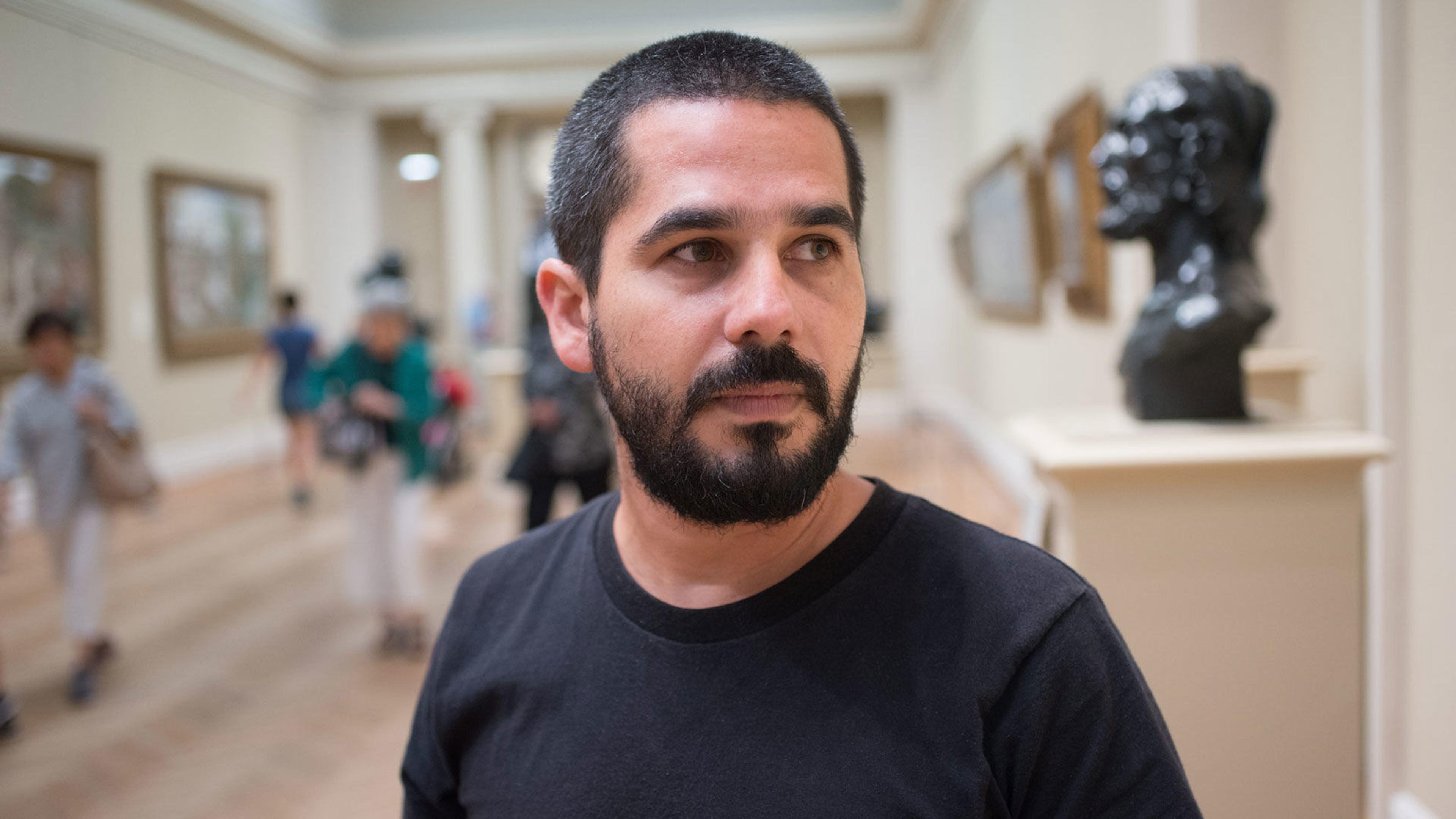
My name is Thomas Demand. I’m an artist.
I make life-sized sculptures of spaces and rooms entirely made out of cardboard, which I photograph. What I’m after in my photographs very often is showing a space and its potential, or a space and its character. It’s about human presence represented by something else, like the coincidental array of things or a half-opened door, where you have a glimpse of a moment. That’s what I see in the studiolo, you know, just like—bam!—what a moment. And the moment is completely frozen into veneer. All you see is actually flat wood. It’s a translation of the real world into geometrical shapes, which I find quite amazing.
The count from Gubbio had this built and it’s a highly allegorical space. Every object means something, and it means a high sense of culture. Earlier kings would have a big crown, they would have lots of gold, and that would be the representation of his power, and here we have the representation with a book. And the book has a little paper divider, which you even see the shadow of on the side of the book. And so it’s not a book because “I like books,” or “I want you to know that I have books,” or something. It’s “I read the book and I just left it on the corner there.”
The room is full of wonders and full of mastership. One of my favorite parts is a mazzochio on the bench. It’s this little ring with all the angles. It’s enormously difficult to do this right. It’s a sign of total mastership of the media. And it just sits on the side.
But then there’s little vignettes that seem to be completely abstract, so they’re aware of the illusionistic character of the whole thing. It goes beyond the point of just being the fact that I can trick your eye. It represents a state of mind and a way of thinking about humanistic ideals.
In the early Renaissance central perspective is a very new tool at the time. And the trick here is that the whole perspective is complete when you step into the room—only then. But then you go to the window and you see how distorted the bench on the side is. You have one viewpoint and it’s actually very un-human. Not inhuman, but un-human, because our head is moving all the time. So our reception of the world is actually one of a moving eye. Central perspective totally works, but it’s too clean. You have this translation of the real world, which is not clean, into geometry, into mathematics. It’s the promise that with the genius of the human brain one can somehow cage the horrors of the daily life. It’s a real utopian proposition at the time, the idea of a virtual space. You can still feel the modernity in it.
Art, if it’s good, it can bridge centuries. When I see it, I see it now and I don’t see it 500 years ago, so my brain works on it now. It lets me have my own observations; it lets me have my own ideas about it and that’s what I love about art. And then if I have it displayed in a 360-degree, panoramic way like this, it makes me just plain happy.