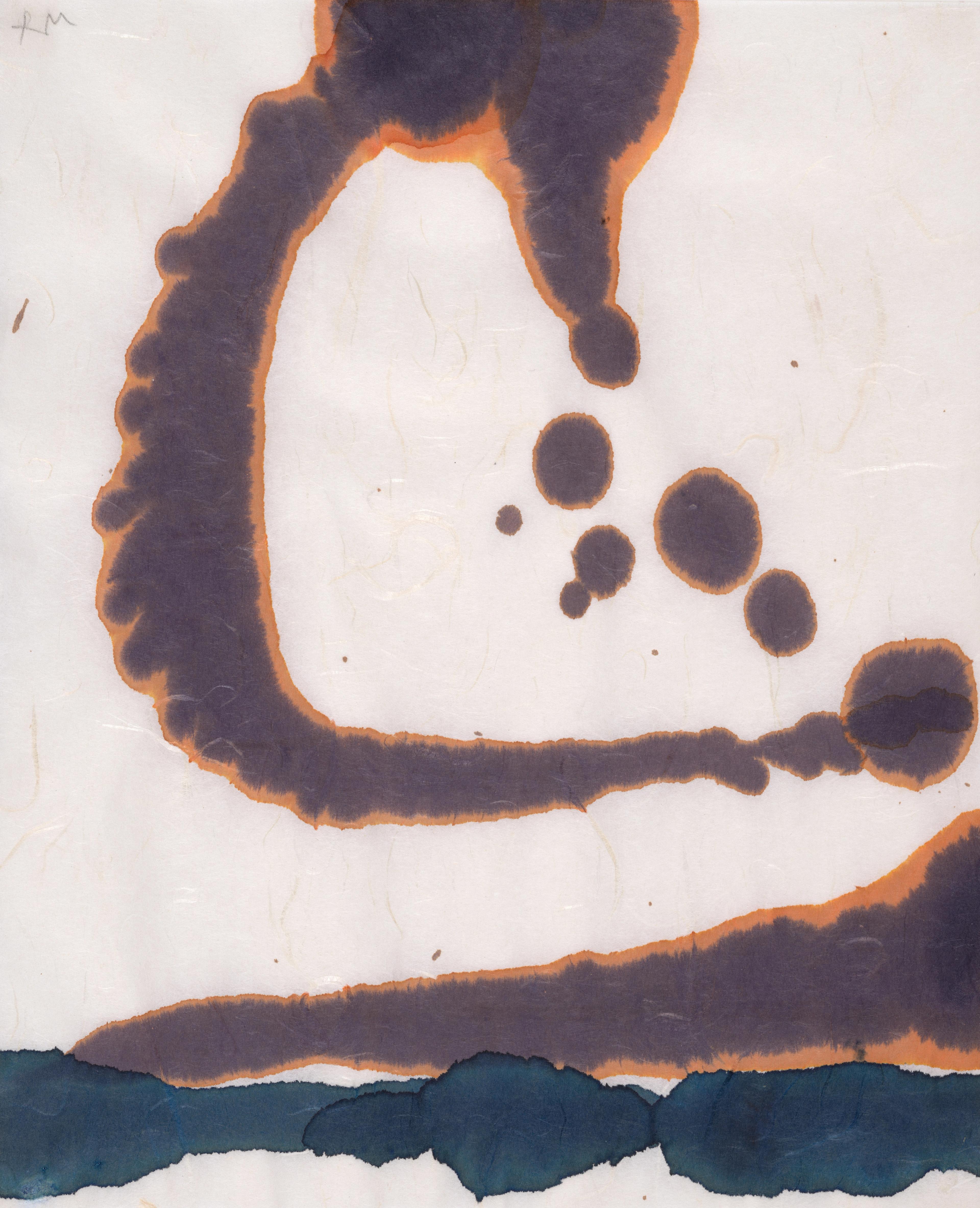
Robert Motherwell (American, Aberdeen, Washington 1915–1991 Provincetown, Massachusetts). Lyric Suite, 1965. Colored inks on paper. 11 1/8 × 9 1/8 in. (28.1 × 23 cm). The Metropolitan Museum of Art, New York, Anonymous Gift, 1966 (66.233.1). © 2026 Artists Rights Society (ARS), New York
My name is Wenda Gu.
As an artist I merge the scholarly tradition and the Western contemporary art. I trained in the classical landscape tradition and calligraphy. I was a student when Motherwell's work came to China. It widened the perspective of what ink and what rice paper can do. It's a kind of spontaneous expression.
I'm not sure how much influence he got from the Asian culture. When he created these pieces he must of had some imagination different than when he created the big canvas. It's kind of bleeding. You have to control the color, tone, the water volume. It's all about control; otherwise it will be a total mess.
It's not totally abstract like his oil paintings. I feel there is some realistic gesture in it—the sky, landscape. His simplicity is beautiful. He's not sophisticated in the scholarly painting techniques. He used his own creativity applied to something raw and new. It's more playful. It's kind of live. It continues to evolve—another shape, another experiment—so there's a kind of life.
A good scholarly painting is all about ink and speed and your inner motion control. In China, Buddhism has two chapters one school is 'by accident,' the other school is accumulation. You need daily practice.
I think it's a kind of contradiction, and the impact is the Asian material, but the Western idea. Any different culture cannot be precisely translated into another culture. It's not possible. Misunderstanding is creation. Two things can merge and become something else.