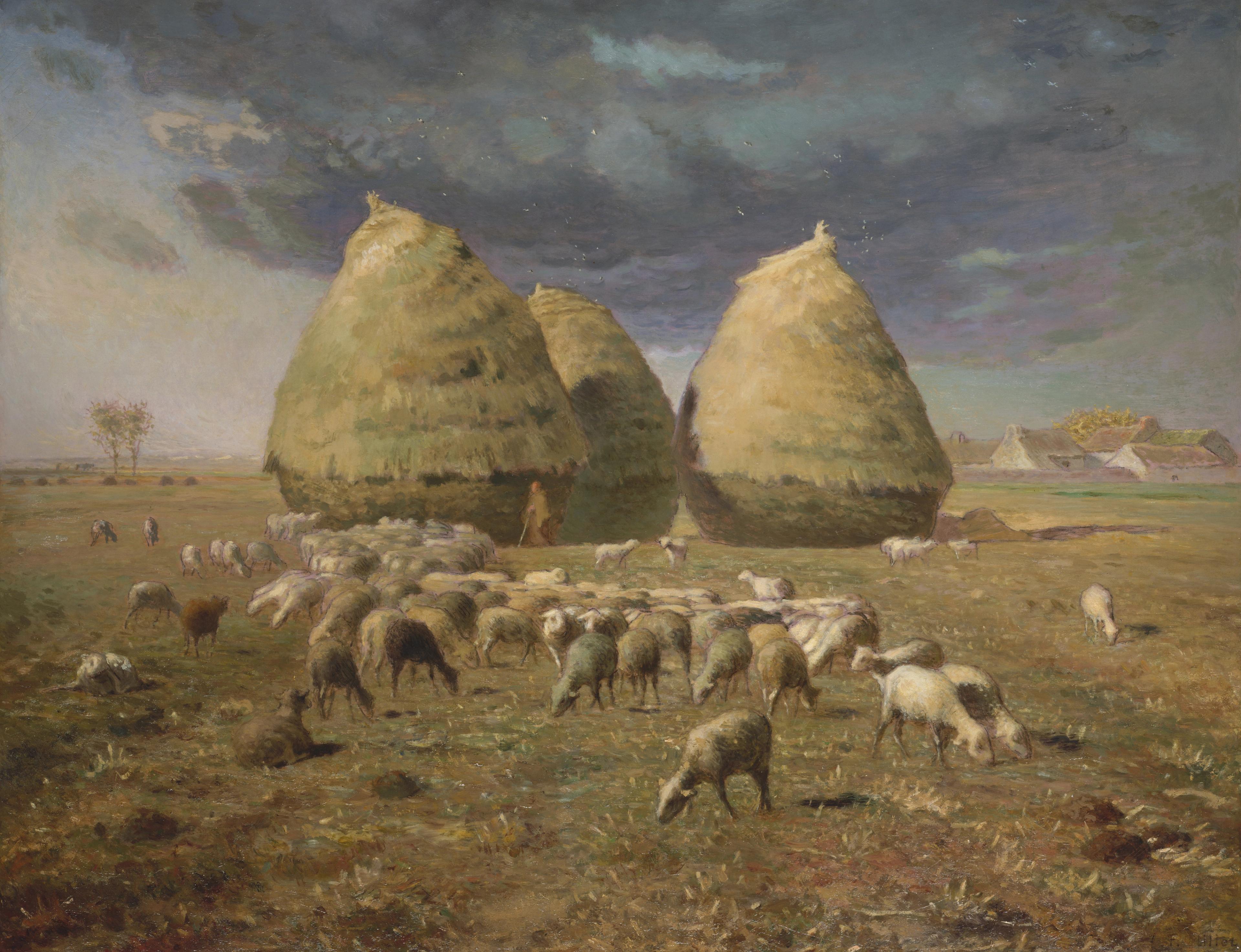
Jean-François Millet (French, 1814–1875). Haystacks: Autumn, ca. 1874. Oil on canvas, 33 1/2 x 43 3/8 in. (85.1 x 110.2 cm). The Metropolitan Museum of Art, New York, Bequest of Lillian S. Timken, 1959 (60.71.12)
My name is Xu Bing. I come from China.
I've actually painted many landscapes and I don't really like to paint people. Painting people is very specific. I like those landscapes that people have in their everyday life but don't take notice of, but have traces of human activity and human life.
When most urban dwellers see a painting like this by Millet, their thoughts might run towards, "oh, so this is how peasants lived." But for me, I go back to the scene that's depicted—a scene that I experienced in my life for three years in the countryside.
I received my arts education in China. Part of our training was to go into the rural parts of China, into factories, to live alongside workers and peasants, experience their lives, and paint from that.
One of the things I find so admirable about Millet's painting is that he paints the human subject, the animal world, haystacks, and farmhouses with equality. We see a passion and a respect for the farmer, for the peasant, and that passion and respect is actually a passion and respect for nature. That comes from Millet's real understanding of their lives. It's almost like you've been injected into this very dramatic scene with emotion and you’re feeling these natural changes that are about to take place.
In the autumn, you have to do all the work of the harvesting before the expected arrival of rain. You see these clouds and if you understand the life and the rhythms of a farm and of a farmer, you share their anxiety. And you can see that the farmhouses in the background are still captured in the warmth of this very pure light. It's a really interesting expression both of the warmth of farm life and the difficulties of being a farmer.
That connection between man and the natural environment is something that had been dismissed or not really had proper attention paid to in the past. A lot of art has been about the relationship between man and God or between aristocracy, between power, between politics and the people. He was looking at something that is lacking in the past. Unlike many artists and painters who use the farmer or the peasant or even just the human figure as a prop, Millet's farmers are farmers that, in living with them, I know that I would experience that really genuine connection with nature.