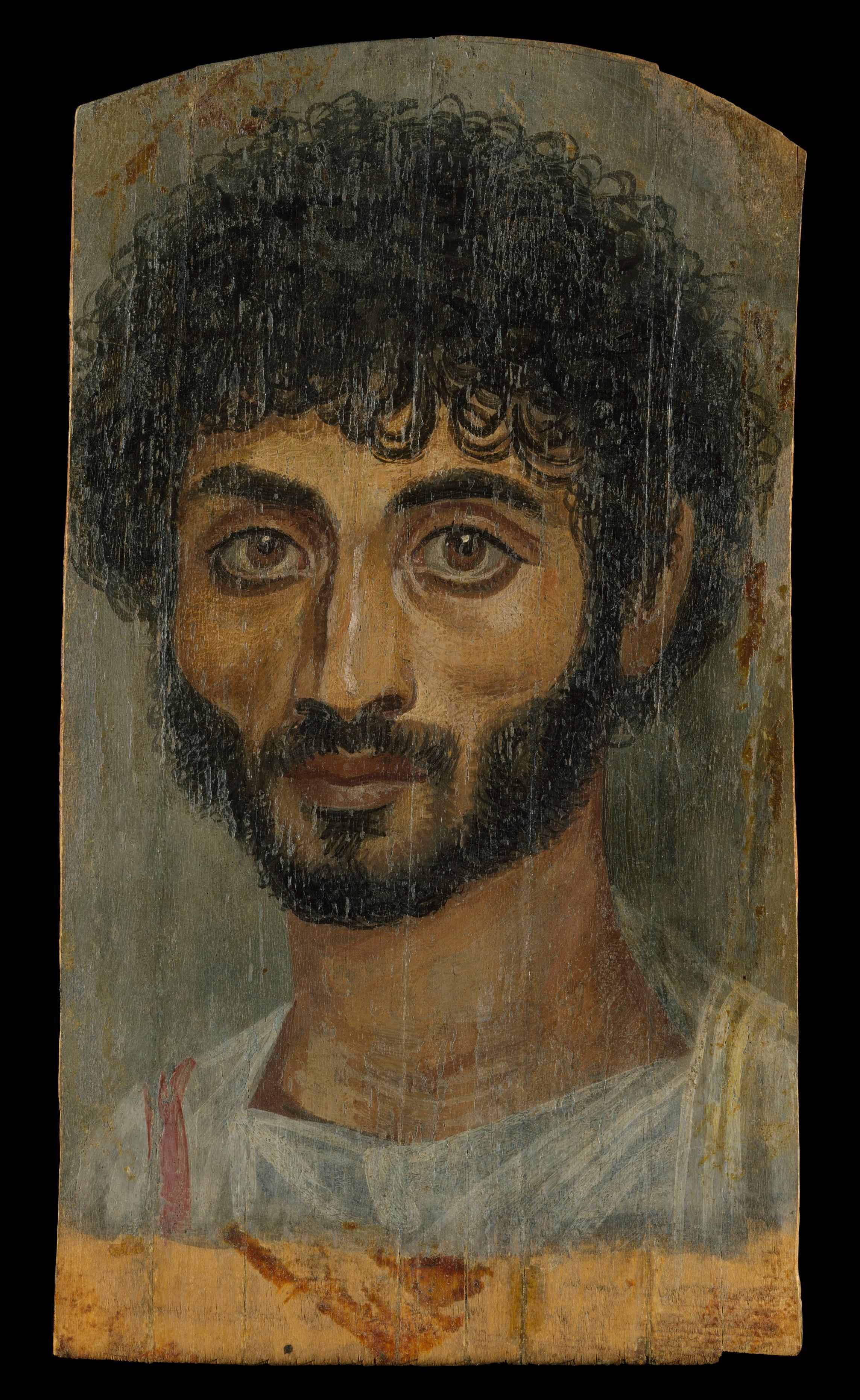
Portrait of a thin-faced, bearded man. Egyptian, Roman period (160–180 CE). Encaustic on limewood, 15 x 8 1/2 in. (38.1 x 21.6 cm). The Metropolitan Museum of Art, New York, Rogers Fund, 1909 (09.181.1)
I'm Y.Z. Kami and I'm a painter.
My painting is mostly portraits. My mother was a portrait painter in Iran, where I come from, and I grew up painting portraits.
I remember very well my first encounter with Fayum portraits. They were not like anything that I had seen. What I remember struck me as a young painter was the eyes that were so exaggerated, so large, but at the same time so real and so convincing. They're soulful, I mean, as if they're giving us information about another dimension or something.
Altogether there must be around seven–eight hundred Fayum portraits in different parts of the world, and we know nothing about the painters. The only thing that we know is that this technique and this style was used in a region in Egypt called Fayum, which is an oasis on the west side of the Nile.
When you encounter them for the first time, you think this is post-Renaissance, but it is painted two thousand years ago. This is the first century. The aesthetic comes from Greek, Roman tradition—it's classical art. But the function is Egyptian: they were all painted to be put on top of the mummy of the deceased.
They used to commission the artist to paint the portrait and then they would hang the portrait in their home, and when the person died they'd cut it to accommodate the mummy. So they all have this narrow, odd shape.
They are painted with encaustic, which is a mixture of wax and pigment. You have to heat it in order to use it. These were painted for eternity, that's why it's painted with encaustic. Everything is preserved after two thousand years.
Each is the story of one human being. It's not just something generic. The transparent white that they use, and the backgrounds—they're all painted in a light grey—but the palette of the faces don't have a formula. Each is individualized.
This boy with the injured eye, with the little mustache that shows that he's an adolescent, or this woman with her blue mantle: they are so real.
Always in front of a human face you have an emotional reaction. Fayums are as immediate to us as an actual photograph. People relate to these paintings. Maybe this is a cliché to say, but a true work of art that comes from a depth does not have a cultural boundary. It’s timeless.