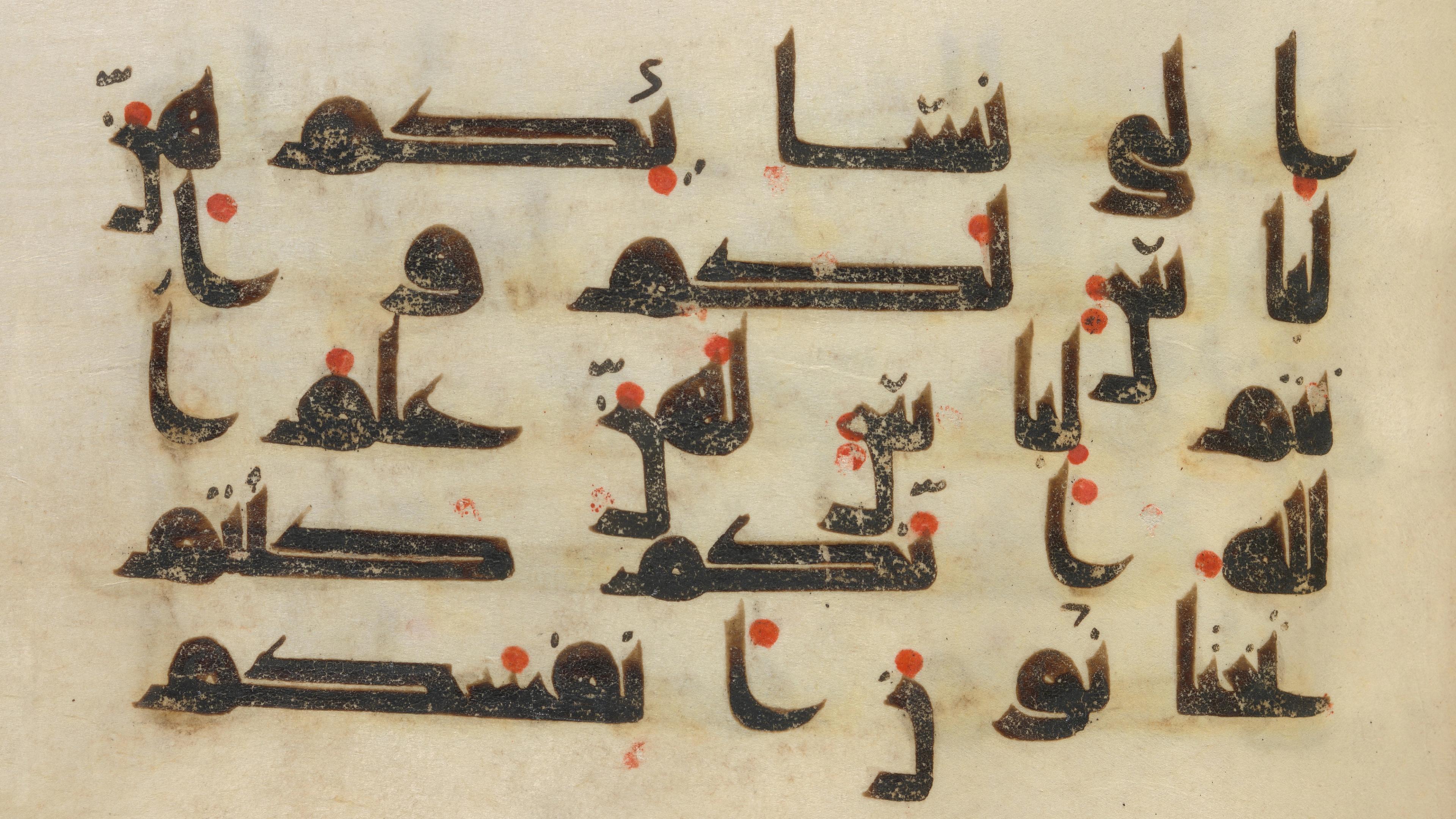
Qur'an Manuscript (detail), late 9th–early 10th century, attributed to Syria or Iraq. Ink, opaque watercolor, and gold on parchment, 4 1/8 x 6 7/8 in. (10.5 x 17.5 cm). The Metropolitan Museum of Art, New York, Gift of Philip Hofer, 1937 (37.142)
My name is Zarina Hashmi.
I feel very embarrassed saying I'm an artist. I think "artist" is sort of a little pompous. I often say I'm a teacher.
I come to museums; I just go around. I didn't know anything about this, but it caught my eye because I'm into calligraphy. My work is very much connected to writing, to calligraphy, you know, because I don't use color.
I didn't realize that somebody could carve like this. And then I researched it a little bit, what it says. It comes from Bengal. It's not easy to carve this marble, and it's very finely carved. I think that the top is totally decorative. The vertical lines: they're aliph, the first letter of the Arabic alphabet, and also Farsi and Urdu. And also the significance of aliph is it's how you write "Allah."
As a Muslim child they teach you to write Arabic when you are four years and four days old, and there's a little ceremony. And the first letter you learn to write is aliph. There's this whole philosophy around the straight path. This is, you know, part of a prayer. You repeat this line: "God, show me the straight path." It's really the center of Qur'an, and most of the people know it by heart.
At the bottom is an inscription from the Prophet Muhammad. But it's not Qur'anic. It says that anybody who constructs a mosque, Allah will give him a house in the heaven. It sounds very beautiful and it's very beautifully written.
It overlaps so it's hard to read. I can read "Muhammad," I can read letters, but I can't read the whole sentence because I don't know Arabic. I know the alphabet. The way I was taught Qur'an, I didn't know what it said. The person who taught me didn't teach me the translation. I would memorize the prayers and I could pray, but I didn't know what I was saying.
I do read and write Urdu, which is the same alphabet. I've lived outside India almost fifty years, but I have kept up with my language because there is a cultural connection. Once you are separated from language, it's a great loss. You don't have access to your own scriptures, your poetry, your literature.
So that's why, emotionally, I'm attached to this. I didn't even have to know what it says. Instinctively, it touched something in me.