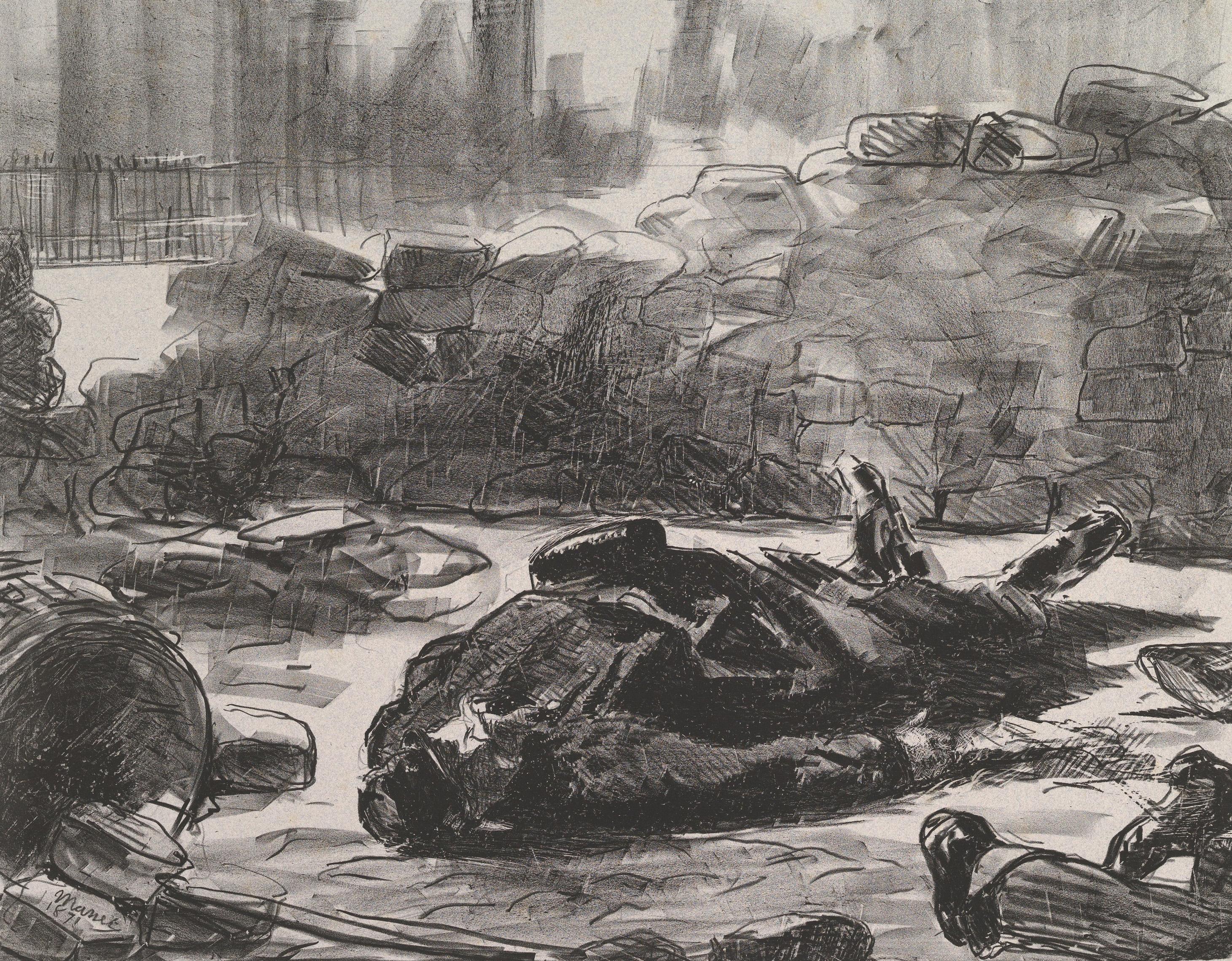
Edouard Manet (French, 1832–1883). Civil War (Guerre Civile), 1871–73 [published 1874]. Lithograph on chine collé; second state of two, image: 15 5/8 × 20 in. (39.7 × 50.8 cm), sheet: 19 1/8 × 24 3/4 in. (48.6 × 62.9 cm). The Metropolitan Museum of Art, New York, Rogers Fund, 1922 (22.60.18)
My name is Zoe Beloff. My artwork focuses on moving images and drawing.
I'm very interested in looking to the past to help us think about the future. For me, Manet can help me think about what's going on in our world right now that we have to deal with. He was an artist that was very engaged with ideas: what it means to be a modern citizen under modern capitalism. He was painting the world around him. You see one of the dead working people at the barricade, out of something like 20,000 who were massacred by the French army.
Manet is engaging in history painting from below: the ordinary working people, people whose names we will never know. What Manet is telling us is that the people that matter in history are not so much the politicians and the leaders but the people on the street. These are people that we have to memorialize.
The Paris Commune is the first great occupation where the working people took over their own city, and formed community that was based on social justice. After three months the government marched into Paris and they basically slaughtered people. When people are shot down in the street, it's just random. To put it in a funeral or something like that, that kind of sanitizes it.
Those ungainly legs also suggest that kind of haphazardness. It's very direct. All the lines are really tough: they're hard, they have something to say. It's not an abstract thing—I admire that. Beautiful or not beautiful, that's not really the point. Does it clearly convey an idea? That's its beauty.
It's also, I think, interesting because it's a detail. That's a very photographic kind of thing, you know. He can't show us everything. The way it's cropped, it makes it a detail of a world. I see our world, because it's happening right now in the United States—maybe not by the army but by the police—and we are still fighting their fight. And that's what touches me: it's not over. And that's why I'm interested in history—it's like, that gives me hope because I feel like I have someone to share my anguish with. He's saying, "we need to spend time with these people, because these people are heroes and they need to be memorialized."