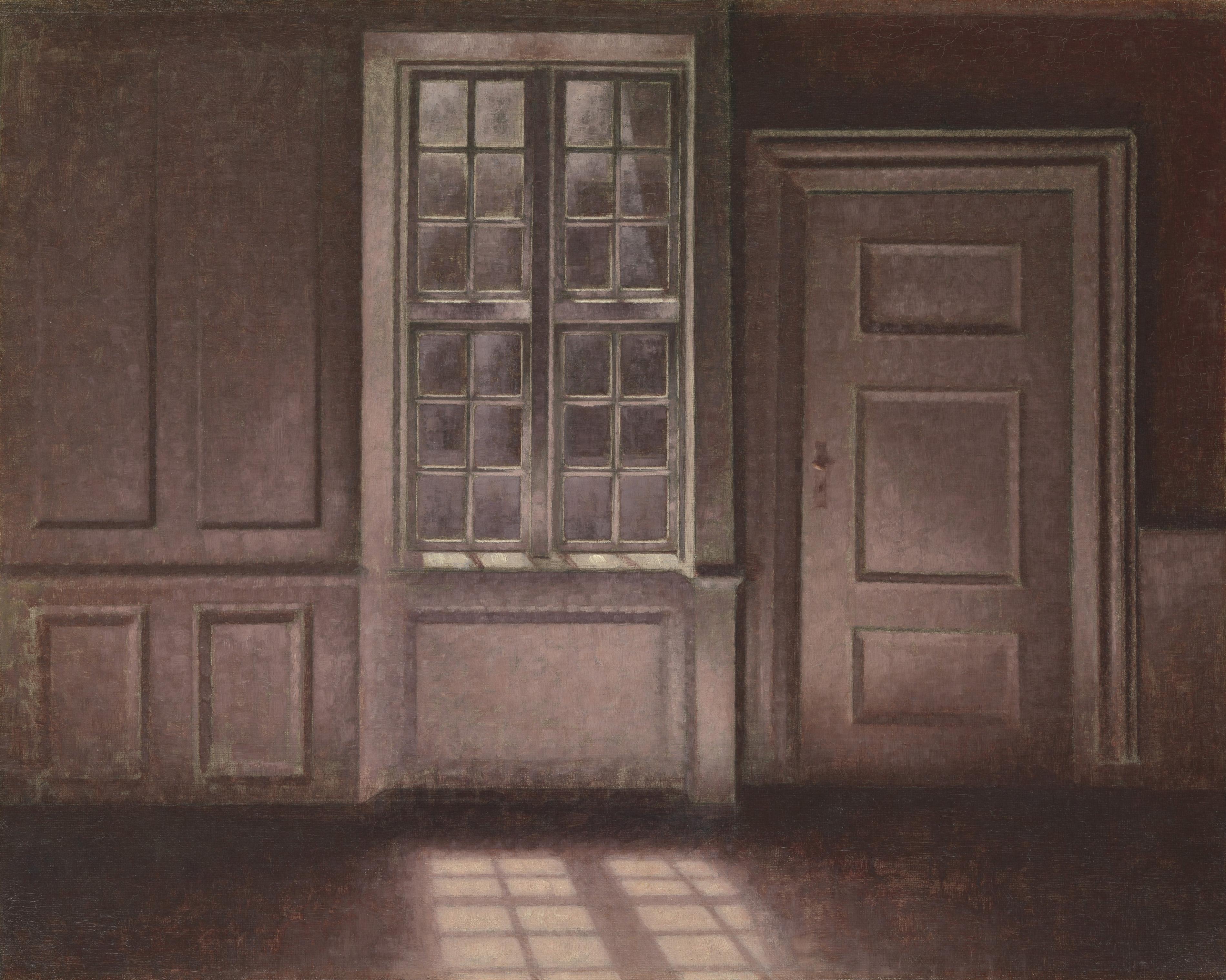
Vilhelm Hammershøi (Danish, 1864–1916). Moonlight, Strandgade 30, 1900–1906. Oil on canvas, 16 1/8 x 20 1/8 in. (41 x 51.1 cm). The Metropolitan Museum of Art, New York, Purchase, European Paintings Funds, and Annette de la Renta Gift, 2012 (2012.203)
My name is Barbara Bloom and I’m a visual artist.
I have a particular interest in depictions of absence. How can you depict something which is not there?
I’m not a painter, but I’m drawn to Hammershøi’s paintings because they’re so enigmatic. They’re very rigorously composed scenes of the apartment where he and his wife Ida lived in Copenhagen. And he paints that apartment over and over and over again. Your first inclination is not to think about what was happening in that room. You are observing a room in the same way that you might observe something which is three-dimensional.
Hammershøi’s paintings make Vermeer look cluttered. It feels sparse but it doesn’t feel spartan. You don’t let the glow of light fall over a door if it’s spartan. It’s so loving and beautifully, tenderly rendered. These don’t feel deprived. They feel sensuous. It resists adjectives. It feels empty but not lacking, it’s lonely but not melancholy—it’s this but not that. It’s almost like a philosophical argument.
As an artist, you think about, “what was he setting out to do?” Are they depictions of a state of mind? There’s something egalitarian about it. He’s allowing us to equally care about everything that we’re seeing. It’s almost as though the light that falls on everything grants it its importance. It falls on the floor and it falls on the walls and it passes by the door and it hits the doorknob.
Many, many cultures have depictions of death—the death mask or the devil or angels or a halo—and they stand in for something that we don’t know. But this actually is a depiction of something that we don’t know, that’s right there all the time. He’s inducing this state of not knowing what you’re looking at. How rare that is.
And all of the musing and all of the questions that come up by looking at it are exciting. They seem to be some kind of melancholic, mysterious depiction of something that's not there. And I don’t like the word “ghostly”—there’s nothing ominous about it. It’s very ordinary. And so if as an artist your job is to show people something that they haven’t seen before, the great gift is that you can walk out of here and you don’t need the painting anymore, because you start seeing the world as a Hammershøi.