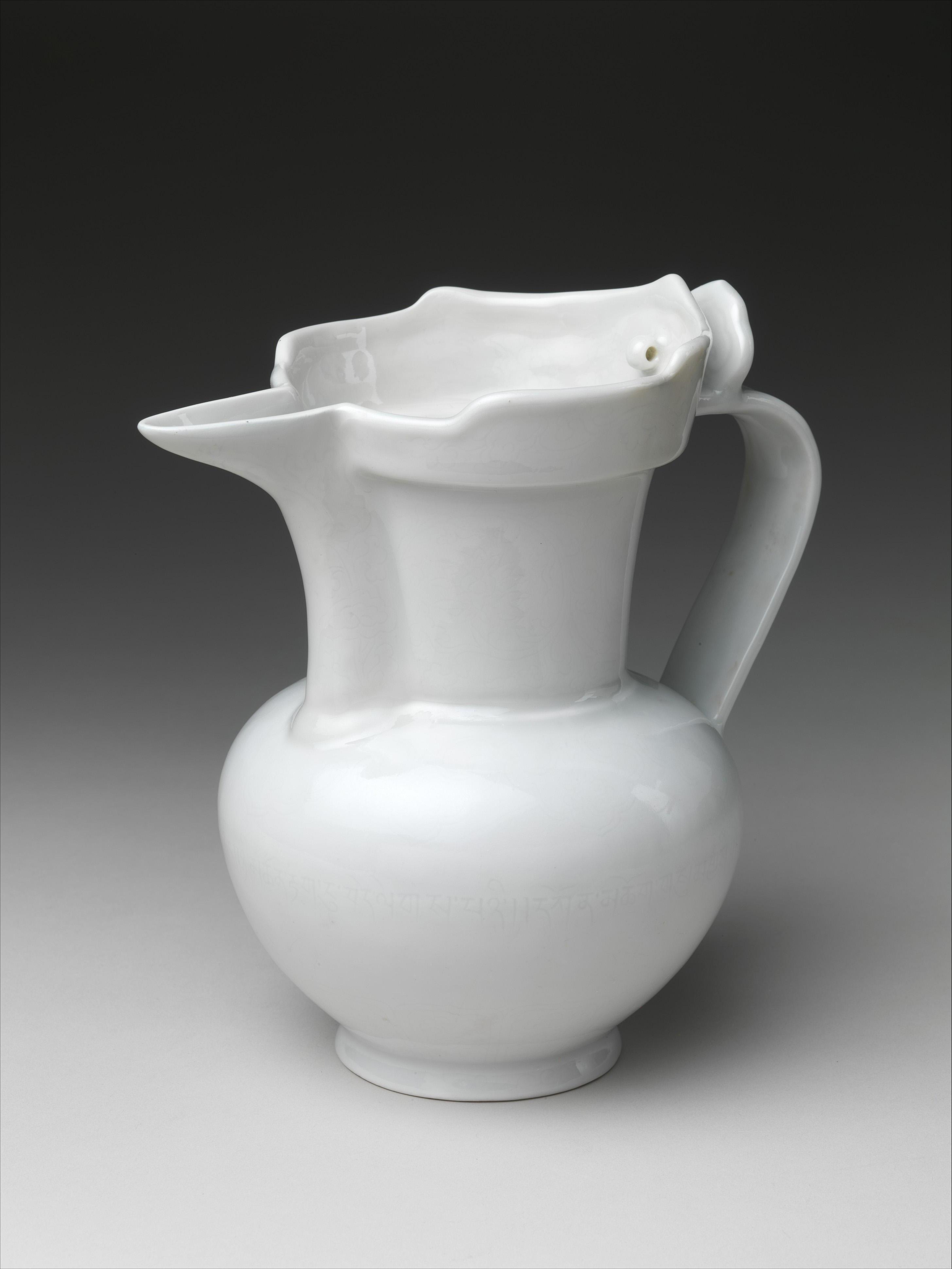
Monk’s cap ewer, early 15th century. Chinese, Ming dynasty (1368–1644). Porcelain with incised hidden (anhua) decoration under transparent glaze (Jingdezhen ware), H. 8 in. (20.3 cm); W. at spout 8 in. (20.3 cm); Diam. of foot 3 in. (7.6 cm). The Metropolitan Museum of Art, New York, Gift of Stanley Herzman, in memory of Adele Herzman, 1991 (1991.253.36)
My name's Edmund de Waal. I'm a potter and I also sometimes write.
I spend my life thinking about white. I mean I make porcelain, for God's sake. And I'm trying to work out why people—throughout millennia—why do people not decorate things? It's a very profound choice.
This particular ewer is the whitest object. I mean, there is nothing whiter than this object. It was so white when it was made that there was a special term given to this particular white: they called it "sweet white ware." This pot was made at the same time that sugar was discovered. But when you look at it, it looks so extraordinarily contemporary. It looks like it's something from the 1920s. It could have been made by a Russian radical or it could have been made in the Bauhaus or it could be a kind of bit of post-war American functionalism, but actually it's 600–500-years-old Chinese porcelain.
Trying to join two bits of porcelain together is very very difficult. I mean, that's the kind of thing that goes wrong all the time in porcelain. This ludicrous, wide, lyrical handle; then you've got this huge, bulbous belly of the pot; and then these angular series of shapes going right up to the rim.
It's called a Tibetan monk's cap ewer. Why would you make a ewer that looked like a Tibetan monk's cap? Well, it's a great story. These particular objects were made for the Yong-le emperor. He comes to the throne in a sea of blood in order to gain the throne. When he gets the throne he has this strange relationship with Buddhism in a kind of penitential way. He tries to purify himself by bringing sacred art into the middle of the Chinese court.
The ability for white to simultaneously hold mourning—which it absolutely does in Chinese culture; at the same time it's utterly about erasure, you know: the white page, the sense of empty space on a scroll. More empty space than you would ever find in any bit of Western art. The power of white, of leaving something be, speaks to us of revolution, of modernity, of taking everything away, raising everything, and starting again. And nothing out of all those shapes should be coherent. Exactly the kind of formal puzzle that's modernism: how can you bring strange things into connection and make them work?
The things that really matter to me always have some kind of kinship with the contemporary. They feel necessary. They feel like they are something that I come back to. They provoke and this is a quite provocative object. For me, it's profoundly contemporary because I'm trying to work out what making pure objects in this impure world means. You know, that's a really big question for me: what does it mean?