Paddle Doll
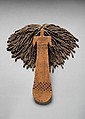
Paddle dolls were popular in the Middle Kingdom, especially during Dynasties 11 and 12 (ca. 2030–1802 B.C.). Most paddle dolls – including this one and others in the Museum's collection – come from an area in the Theban necropolis around the mortuary temples of Mentuhotep II and Hatshepsut. Only a few examples of paddle dolls come from other sites.
“Paddle doll” is the Egyptological name for this type of female figure. They were not toys but instead are believed to have been objects used in ritual settings. The shape of their bodies echoes the counterpoises of menat necklaces – percussive instruments used in ceremonies associated with the goddess Hathor. When shaken, the beads of the menat would produce a soothing noise meant to summon or placate the deity. The beaded hair attached to paddle dolls furthers their resemblance to menats, however it is unclear whether they were actually used as instruments. It has also been suggested that paddle dolls were representations of female khener dancers, who invoked Hathor and revived the king through sexually arousing performances. Paddle dolls might have been included in funerary assemblages to take the part of khener dancers and aid in the rebirth of the deceased.
Artwork Details
- Title: Paddle Doll
- Period: Middle Kingdom
- Dynasty: Dynasty 11
- Reign: reign of Mentuhotep III
- Date: ca. 2000–1988 B.C.
- Geography: From Egypt, Upper Egypt, Thebes, Khokha, Tomb MMA 828 (H4), In rubbish in front of tomb with 7A 1067, MMA excavations, 1911
- Medium: Wood, faience, mud, linen string
- Dimensions: Body: H. 21.2 × W. 5.8 × Th. 0.5 cm (8 3/8 × 2 5/16 × 3/16 in.); Hair: L. 13.5 cm (5 5/16 in.)
- Credit Line: Rogers Fund, 1915
- Object Number: 15.10.90
- Curatorial Department: Egyptian Art
More Artwork
Research Resources
The Met provides unparalleled resources for research and welcomes an international community of students and scholars. The Met's Open Access API is where creators and researchers can connect to the The Met collection. Open Access data and public domain images are available for unrestricted commercial and noncommercial use without permission or fee.
To request images under copyright and other restrictions, please use this Image Request form.
Feedback
We continue to research and examine historical and cultural context for objects in The Met collection. If you have comments or questions about this object record, please contact us using the form below. The Museum looks forward to receiving your comments.
Content Notice
The Metropolitan Museum of Art presents over 5,000 years of art from around the world, and our online collection reflects ongoing work conducted over the course of our more than 150-year history. You may encounter objects or images that may be inappropriate for some viewers or information that may be outdated.