Guia de áudio
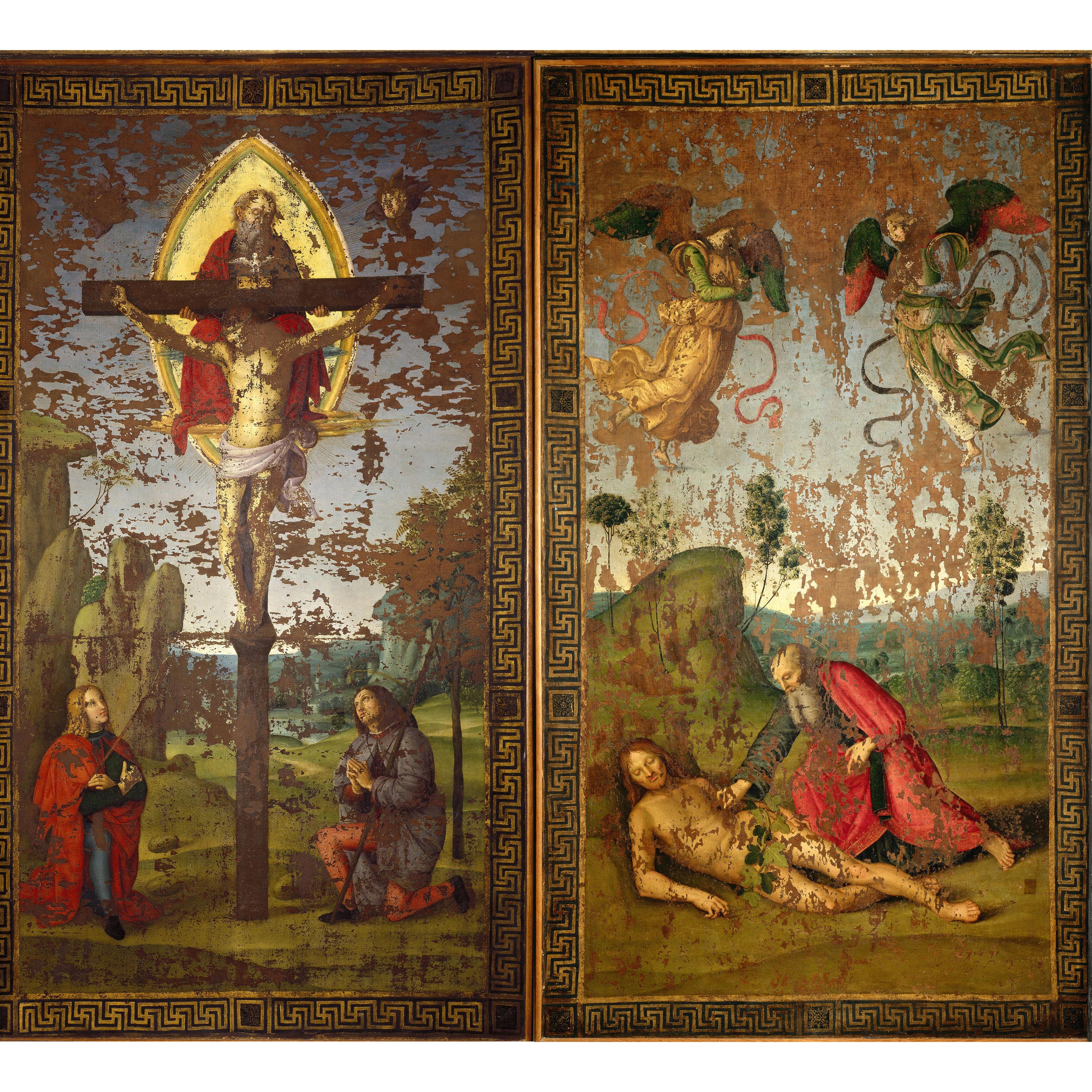
601. The Young Raphael
How does Raphael rise from student to master under Perugino?
ISABELLA ROSSELLINI (NARRATOR): Raphael’s first teacher was his father, a poet and a painter. But he really found his way in the studio of Perugino.
CARMEN BAMBACH: By 1500, Perugino is called the best artist in the Italian peninsula by his contemporaries. So, he was the teacher to have.
ROSSELLINI: In this gallery, you’ll see work by both Perugino and his precocious student. During this period, Raphael improved his technical skills as a painter and a draftsman. Research associate Caroline Elenowitz-Hess:
CAROLINE ELENOWITZ-HESS: But also he learns about the studio system and learns how Perugino is able to be such a successful artist. Being someone who can run your own studio, is a skill that he learns there, as well.
ROSSELLINI: Raphael was such a quick study that he soon became Perugino’s collaborator. And then he struck out on his own. Curator Carmen Bambach:
BAMBACH: The passage of Raphael the student to Raphael the independent master is very quick. This is really somebody who basically gets the ideas before they come out of the teacher’s mouth.
ROSSELLINI: Look for the largest work in this gallery: two paintings, framed side-by-side.
The piece’s present fragile condition relates to the way it was used in the small and earthquake-prone town of Città di Castello. Originally, Raphael made these two paintings for the front and back of a processional banner.
BAMBACH: And so it was on canvas, fully flexible, and it would have been taken around in the streets for the processions.
And here what’s important is that this banner would have been produced at a time when the Plague was occurring in Città di Castello and Umbria around 1497, 1498, 1499. And so this banner is a kind of votive offering.
ROSSELLINI: Its two sides depict the Holy Trinity with Saints Sebastian and Roch, and the Creation of Eve. In this early work, we can see how Raphael is already doing things very differently from his teacher—and developing his own style.
BAMBACH: So, in Perugino’s two altarpieces, you will see that the saint or the Virgin Mary are enormous in size. What Raphael does instead is that regardless of who is represented, so whether it’s, you know, God the Father, Christ, or the saints, or Eve on the other side, it’s still the same human scale.
Raphael is trying to bring in a sense of believability here, of credibility, which is really interesting.