Jar with cover
The decorative and ornamental wares made at Worcester with dark-blue grounds usually bore elaborate gilding, especially those with the gros bleu grounds. The large expanses of the deep, saturated blue were relieved visually by the gilt designs that both framed the reserves and overlay areas of the ground. This combination of the blue ground with extensive gilding created an extremely rich visual impact, and Worcester’s products decorated in this manner were intended to appeal to the luxury market that had been dominated by Chelsea. However, the blue-ground vases made at Worcester were significantly simpler in form than most of the vases produced at Chelsea during the Gold Anchor period (1758–69) (entry 84),[2] making them less expensive to fabricate and hence affordable to a larger clientele. In addition, Worcester employed the blue ground on a wide range of useful wares that had not been produced at Chelsea, further expanding its market beyond the upper strata that had been Chelsea’s focus.
Much of the accomplished enamel painting done at Worcester is found on vases decorated with the gros bleu ground and ambitious gilding, and the reserves on these vases are commonly painted either with figural scenes and European subject matter or with large exotic birds in landscapes. Two painters at the factory are associated in particular with vases bearing European scenes, and rare, signed examples of their work often allow attributions to one hand or the other. The best known of these painters is Jefferyes Hamett O’Neale (Irish, 1734–1801), who had worked at Chelsea before being employed by Worcester. His fable scenes, usually based on tales from Aesop’s Fables, are found on both Chelsea and Worcester porcelain and constitute the subject matter with which he is most closely identified.[3] However, three vases that bear his signature depict multifigure hunt scenes, and the presence of his abbreviated signature in each reserve suggests particular pride in these works.[4] The other prominent painter working at Worcester in this genre was John Donaldson (British, 1737–1801). Like O’Neale, he was a miniaturist and worked at Chelsea before arriving at Worcester, although his involvement with Chelsea was less extensive than that of O’Neale’s. At Worcester, Donaldson specialized in compositions after works by François Boucher (French, 1703–1770),[5] but he also painted scenes in the style of David Teniers the Younger (Flemish, 1610–1690).[6]
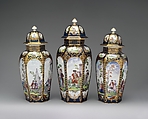
This covered hexagonal vase in the Museum is decorated with tall reserves that include characters from the commedia dell’arte, a relatively uncommon source of subject matter for the English porcelain factories in contrast to those on the Continent (entry 32). The two-figure compositions of each reserve are skillfully conceived with each pairing of figures actively engaged in some sort of negotiation or activity, which is communicated by their expressive poses. The costumes of the figures are closely observed, and the landscapes in which they are placed are rendered with great precision. The extremely fine painting on this vase may be the work of either O’Neale[7] or Donaldson.
The Museum’s vase entered the collection with two slightly smaller Worcester vases with very similar decorative schemes (fig. 57). It was long thought that the three vases had been conceived as a garniture based on these similarities, but this assumption is open to question due to slight differences in their gilded decoration and to the absence of commedia dell’arte figures from the figural compositions on the two smaller vases.[8] In addition, each reserve on the large vase floats above an area of porcelain left white with only gilded decoration, whereas the reserves of the smaller vases fill the entire panel. It is not clear if this discrepancy is an indication that these vases did not originally accompany the larger one.[9] On the other hand, the rarity of the elongated oval form of the reserves suggests that the vases were, in fact, produced as a garniture.[10] The painted decoration on the three vases appears to be by the same hand, although the decoration on the larger vase is more finely executed. Whether or not the three vases were intended to form a set, the richness and quality of their decoration reflect the Worcester factory’s success in competing with the best of Chelsea’s Gold Anchor production.
Footnotes
(For key to shortened references see bibliography in Munger, European Porcelain in the Metropolitan Museum of Art. NY: The Metropolitan Museum of Art, 2018)
1 For more information about this aspect of Worcester’s decoration, see Spero and Sandon 1996, pp. 255–59.
2 Ibid., p. 256.
3 For example, see Spero 1995, p. 132, no. 131.
4 Dawson 2007, pp. 110–12, no. 40, pp. 116–17, no. 42.
5 Spero and Sandon 1996, p. 261, no. 309. See also Sandon 1993, p. 134.
6 Dawson 2007, pp. 106–9, no. 39.
7 O’Connell 2010, p. 137, fig. 7.
8 Prior to the three vases being sold in 1948 as the property of Humphrey W. Cook (Christie’s, London, March 18, 1948, no. 22), the taller vase had been owned by Alfred Trapnell and then Ralph E. Lambton, and was combined with the two smaller vases
“acquired by [Albert] Amor from Mrs. Cox”; Hackenbroch 1957, pp. 232–33, fig. 303, pls. 113–15.
9 To further complicate this issue, there is a Worcester vase of the same model with extremely similar deco-ration that includes commedia dell’arte figures at Cité de la Céramique, Sèvres, though the gilded decoration does not exactly match that on the Museum’s vase.
10 The three vases are referred to as a garniture by Sheila O’Connell (2010, p. 137, fig. 7). It is possible, however, that O’Connell is simply repeating the terminology used by Yvonne Hackenbroch (see note 8). I am grateful to Meredith Chilton for her observations regarding these vases.
Artwork Details
- Title: Jar with cover
- Factory: Worcester factory (British, 1751–2008)
- Decorator: Decoration attributed to Jeffreyes Hammet O'Neale (Irish, 1734–1801)
- Date: ca. 1770
- Culture: British, Worcester
- Medium: Soft-paste porcelain decorated in polychrome enamels, gold, underglaze blue ground
- Dimensions: Overall (confirmed): 16 11/16 × 7 5/16 × 6 9/16 in. (42.4 × 18.6 × 16.7 cm)
- Classification: Ceramics-Porcelain
- Credit Line: Gift of Irwin Untermyer, 1964
- Object Number: 64.101.786a, b
- Curatorial Department: European Sculpture and Decorative Arts
More Artwork
Related Content
 Free to download
Research Resources
The Met provides unparalleled resources for research and welcomes an international community of students and scholars. The Met's Open Access API is where creators and researchers can connect to the The Met collection. Open Access data and public domain images are available for unrestricted commercial and noncommercial use without permission or fee.
To request images under copyright and other restrictions, please use this Image Request form.
Feedback
We continue to research and examine historical and cultural context for objects in The Met collection. If you have comments or questions about this object record, please contact us using the form below. The Museum looks forward to receiving your comments.
Content Notice
The Metropolitan Museum of Art presents over 5,000 years of art from around the world, and our online collection reflects ongoing work conducted over the course of our more than 150-year history. You may encounter objects or images that may be inappropriate for some viewers or information that may be outdated.