Moon flask
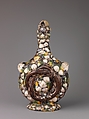
The blue decoration was transfer printed, and stencils cut with the same patterns were used for the gilt ornament. Around the cylindrical neck we see in gold the same fruit as appear on one side in blue, and the border around the willow-pattern plate design is echoed in gilt on the raised strap that demarcates the boundaries of the two sides. The four feet, although contracted in form, are derived from those of prehistoric Chinese bronzes.
The piece has on the bottom a barely legible, impressed mark, apparently for Pinder Bourne and Company of Burslem, Staffordshire. This interesting company exhibited in international exhibitions before it was merged with Doulton's of London in 1878, and this flask is presumably an example of the continuance of some successful Pinder Bourne designs for a period after the merger. The same form in smaller sizes, however, was used from the early 1880s through the early 1890s in the art studios of Doulton's in Lambeth, where it was decorated by such hand painters as Hannah Barlow, Esther Lewis, and Mary Denley.
Many of the features of this vase are assembled in a unique manner and never appeared in either Japanese or Chinese arts in exactly the same way. For instance, moon flasks were normally flat sided, with a rectangular base and tall, narrow neck. Our piece is eclectic in form and design and is an expression of the continuing fascination for Japanese art.
Artwork Details
- Title: Moon flask
- Designer: Designed by Henry Slater
- Manufactory: Pinder, Bourne & Co.
- Decorator: Doulton Manufactory (British)
- Date: ca. 1878–82
- Culture: British, Burslem, Staffordshire
- Medium: Lead-glazed earthenware, transfer-printed and gilt
- Dimensions: Height: 13 5/8 in. (34.6 cm)
- Classification: Ceramics-Pottery
- Credit Line: Purchase, Robert L. Isaacson Gift, 1988
- Object Number: 1989.7
- Curatorial Department: European Sculpture and Decorative Arts
More Artwork
Related Content
Publications
Books, guides, and catalogues published by The Met.
 Free to download
Research Resources
The Met provides unparalleled resources for research and welcomes an international community of students and scholars. The Met's Open Access API is where creators and researchers can connect to the The Met collection. Open Access data and public domain images are available for unrestricted commercial and noncommercial use without permission or fee.
To request images under copyright and other restrictions, please use this Image Request form.
Feedback
We continue to research and examine historical and cultural context for objects in The Met collection. If you have comments or questions about this object record, please contact us using the form below. The Museum looks forward to receiving your comments.
Content Notice
The Metropolitan Museum of Art presents over 5,000 years of art from around the world, and our online collection reflects ongoing work conducted over the course of our more than 150-year history. You may encounter objects or images that may be inappropriate for some viewers or information that may be outdated.