Panel
The Japanese occupation had a profound impact on Java. Wartime shortages, economic depression, and the flight of the Dutch colonial officials and settlers who had ruled the archipelago for more than three centuries deprived batik producers of customers and raw materials. The supply of high-quality cotton cloth from mills in the Netherlands, used to produce most Javanese batiks, was cut off and existing stockpiles quickly began to run low. Ever innovative, Javanese artists responded to these conditions by creating a new batik style, known as batik Hokokai.
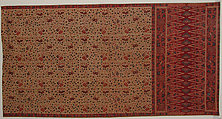
Named for Djawa Hokokai, a Japanese political organization that sought to channel Indonesian labor and resources towards the war effort, batik Hokokai brought the art form to new heights of ornateness. Faced with limited supplies of cloth, batik artists began to devote far more time to decorating each individual textile, creating complex compositions in which there are almost no areas of solid color and virtually the entire surface is covered in minutely detailed designs. Although batik Hokokai was often marketed to Japanese customers, its imagery shows little direct influence from Japanese art. Instead, the cloths reflect a continuation of the blending of Javanese, European, and Chinese influences that began in the batik centers of Java’s north coast in the late nineteenth century.
In this example European-inspired butterflies and flowers appear against a background of diagonal bands composed of indigenous motifs, including the four-lobed kawung -- one of the oldest batik motifs, once restricted solely to the royal courts of central Java. The result is a striking composition as colorful and exuberant as the war years were grim.
Artwork Details
- Title: Panel
- Date: ca. 1920s
- Geography: Indonesia, Java, Pekalongan
- Culture: Pekalongan
- Medium: Cotton
- Dimensions: W. 100 3/4 x H. 41 1/2 in. (255.91 x 105.41 cm)
- Classification: Textiles-Woven
- Credit Line: Gift of Delia Tyrwhitt, 1965
- Object Number: 65.38.1
- Curatorial Department: The Michael C. Rockefeller Wing
More Artwork
Research Resources
The Met provides unparalleled resources for research and welcomes an international community of students and scholars. The Met's Open Access API is where creators and researchers can connect to the The Met collection. Open Access data and public domain images are available for unrestricted commercial and noncommercial use without permission or fee.
To request images under copyright and other restrictions, please use this Image Request form.
Feedback
We continue to research and examine historical and cultural context for objects in The Met collection. If you have comments or questions about this object record, please contact us using the form below. The Museum looks forward to receiving your comments.
Content Notice
The Metropolitan Museum of Art presents over 5,000 years of art from around the world, and our online collection reflects ongoing work conducted over the course of our more than 150-year history. You may encounter objects or images that may be inappropriate for some viewers or information that may be outdated.