Diviner’s figure
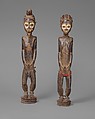
The owner of a figure like this would have inherited the carving or commissioned it from a carver and kept it in a special shrine room along with other objects, many of which were related to sacrifices made for spirits. It would be kept alongside sacrificial objects such as an egg, traces of blood offerings from sacrificed chickens, empty gin bottles, a cow-tail whisk, and other amulets. All of these objects, especially the carving, would be covered with a white cloth. Spirits can come in and reside in the figure or possess the trance diviner. When the diviner is consulted, he or she would allow the spirit to come into his or her body through trance. The diviner could also perform in public for the benefit of the client or the whole community. Those performances take the form of dances in a courtyard with the sculpture placed nearby, under a white cloth. The diviner’s special abilities give him or her prestige, power, and some income from clients who come for help.
This graceful and elongated example is further elaborated with beaded necklaces, anklets, and traces of white kaolin around the eyes. After a diviner dies, his or her objects will be wiped with kaolin and water and protected in a cotton bag. A member of the family may inherit the sculpture but only when he or she is chosen by the asye usu as the successor. Diviner figures are closely related to Baule spirit spouse figures, made by the same artists, but the traces of kaolin suggest that this figure would have been used in divination.
Enid Schildkrout, 2025
Curator Emerita, American Museum of Natural History
Artwork Details
- Title: Diviner’s figure
- Artist: Baule artist
- Date: 19th–mid-20th century
- Geography: Côte d'Ivoire, central Côte d'Ivoire
- Culture: Baule peoples
- Medium: Wood, pigment, beads, cord
- Dimensions: H. 25 15/16 x W. 4 1/4 x D. 3 7/8 in. (65.9 x 10.8 x 9.8 cm)
- Classification: Wood-Sculpture
- Credit Line: The Michael C. Rockefeller Memorial Collection, Bequest of Nelson A. Rockefeller, 1979
- Object Number: 1979.206.113
- Curatorial Department: The Michael C. Rockefeller Wing
More Artwork
Related Content
Research Resources
The Met provides unparalleled resources for research and welcomes an international community of students and scholars. The Met's Open Access API is where creators and researchers can connect to the The Met collection. Open Access data and public domain images are available for unrestricted commercial and noncommercial use without permission or fee.
To request images under copyright and other restrictions, please use this Image Request form.
Feedback
We continue to research and examine historical and cultural context for objects in The Met collection. If you have comments or questions about this object record, please contact us using the form below. The Museum looks forward to receiving your comments.
Content Notice
The Metropolitan Museum of Art presents over 5,000 years of art from around the world, and our online collection reflects ongoing work conducted over the course of our more than 150-year history. You may encounter objects or images that may be inappropriate for some viewers or information that may be outdated.