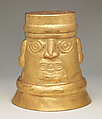
Beaker with frontal figure
As sometimes seen in Lambayeque works of art, this beaker exhibits the digestion of different artistic traditions found across Peru. The front-facing anthropomorphic figure—repeated on both “sides” of the beaker—stands with heels brought together, feet pointing away from the body, and holds in each hand a long staff-like implement. Such details are reminiscent of a figure known as the Staff God that appears prominently in the work of Wari and Tiwanaku artists (c. 500-1000 CE) in the south-central highlands and the altiplano (high plain). The repeating bird-like motifs along the bottom of the beaker, however, likely draw from earlier norcosteño designs of stylized animals found further north, as do the facial features of the standing figure, whose crescent-shaped face and pointed eyes resemble those seen in late Moche fineline paintings (c. 500-800 CE).
Lambayeque artists subsumed such visual traditions into their own practices by 1000 CE, during which time the Lambayeque polity was quickly coalescing into a powerful force in the region. The staff-like objects shown on this beaker, for example, are visual aggregates of two common Moche motifs, the triangular mace head and the rounded shield. These objects of warfare, which are typically associated with ritual violence in Moche depictions, allude to a different kind of notion when melded together and seen in Lambayeque works, namely ceremonial power that more directly invokes divine or ancestral authority. Such adaptations reflect how the Lambayeque cultivated a unique artistic identity, one that combined and transformed existing motifs to denote new meanings and values.
Ji Mary Seo, Andrew W. Mellon Fellow, The Michael C. Rockefeller Wing, 2023-2024
References
Carcedo Muro de Mufarech, Paloma. “Los vasos en la orfebrería sicán.” In Cultura Sicán: Esplendor preincaico de la costa norte, edited by Izumi Shimada, 107-146. Lima: Fondo Editorial del Congreso del Perú, 2014.
Carcedo Muro de Mufarech, Paloma, and Izumi Shimada. “Behind the Golden Mask: Sicán Gold Artifacts from Batán Grande, Peru.” In The Art of Precolumbian Gold: The Jan Mitchell Collection, edited by Julie Jones, 60-75. New York: The Metropolitan Museum of Art, 1985.
Donnan, Christopher, and Donna McClelland. Moche Fineline Painting: Its Evolution and Its Artists. Los Angeles: UCLA Fowler Museum, 1999.
Shimada, Izumi. “El proyecto arqueológico de Sicán: Una caracterización.” In Cultura Sicán: Dios, riqueza y poder en la Costa Norte del Peru, edited by Izumi Shimada, 17-36. Lima: Fundación del Banco Continental para el Fomento de la Educación y la Cultura, 1995.
Trever, Lisa. Image Encounters: Moche Murals and Archaeo Art History. Austin: University of Texas Press, 2022.
Artwork Details
- Title: Beaker with frontal figure
- Artist: Lambayeque (Sicán) artist(s)
- Date: 900–1100 CE
- Geography: Peru, North Coast
- Culture: Lambayeque (Sicán)
- Medium: Gold
- Dimensions: H. 6 × W. 4 1/4 × D. 4 in. (15.2 × 10.8 × 10.2 cm)
- Classification: Metal-Containers
- Credit Line: Jan Mitchell and Sons Collection, Gift of Jan Mitchell, 1991
- Object Number: 1991.419.63
- Curatorial Department: The Michael C. Rockefeller Wing
More Artwork
Related Content
 Free to download
Research Resources
The Met provides unparalleled resources for research and welcomes an international community of students and scholars. The Met's Open Access API is where creators and researchers can connect to the The Met collection. Open Access data and public domain images are available for unrestricted commercial and noncommercial use without permission or fee.
To request images under copyright and other restrictions, please use this Image Request form.
Feedback
We continue to research and examine historical and cultural context for objects in The Met collection. If you have comments or questions about this object record, please contact us using the form below. The Museum looks forward to receiving your comments.
Content Notice
The Metropolitan Museum of Art presents over 5,000 years of art from around the world, and our online collection reflects ongoing work conducted over the course of our more than 150-year history. You may encounter objects or images that may be inappropriate for some viewers or information that may be outdated.