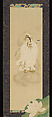
Maiko (Female Performer)
Paintings such as these, sympathetically depicting young women with relatable facial expressions, helped establish Tsunetomi’s reputation as an innovator of a new type of bijin painting. In Maiko, the artist succeeds in connoting a sense of the corporeal body underneath the kimono, indicating his grasp of realistic techniques of Western-style painting. The eye-catching juxtaposition of black and red in this composition is a feature of many of his Taishō-period paintings. As was the custom of many Nihonga artists, Tsunetomi often created multiple works with essentially the same composition. For instance, another nearly identical version of Maiko is found in the collection of Nara Prefectural Museum (see Hashizume Setsuya, Kitano Tsunetomi ten (2003), pl. 27).
Born in Kanazawa, from an early age Tsunetomi trained as an engraver for newspaper printing. He moved to Osaka and became successful at newspaper illustration, while continuing to study painting. His early submissions to the government sponsored Bunten exhibitions of the early 1910s were high sensual paintings of geisha and courtesans and revealed his earlier study of Western-style oil painting. In 1917, Tsunetomi became a member of the Japan Art Institute (Nihon Bijutsuin) and his painting style gradually changed into a more introspective, idealized renditions of women. As one of the first Nihonga painters from Osaka to achieve national recognition, he played a major role in energizing Osaka painting circles and became a mentor to many local artists.
Artwork Details
- 北野恒富筆 「舞妓」
- Title: Maiko (Female Performer)
- Artist: Kitano Tsunetomi (Japanese, 1880–1947)
- Period: Taishō period (1912–26)
- Date: ca. 1915
- Culture: Japan
- Medium: Hanging scroll: ink, color, gold, and silver on silk
- Dimensions: Image: 49 5/8 × 19 13/16 in. (126 × 50.4 cm)
- Classification: Paintings
- Credit Line: Purchase, Sachiko and Lawrence Goodman Gift, 2023
- Object Number: 2023.6
- Curatorial Department: Asian Art
More Artwork
Research Resources
The Met provides unparalleled resources for research and welcomes an international community of students and scholars. The Met's Open Access API is where creators and researchers can connect to the The Met collection. Open Access data and public domain images are available for unrestricted commercial and noncommercial use without permission or fee.
To request images under copyright and other restrictions, please use this Image Request form.
Feedback
We continue to research and examine historical and cultural context for objects in The Met collection. If you have comments or questions about this object record, please contact us using the form below. The Museum looks forward to receiving your comments.
Content Notice
The Metropolitan Museum of Art presents over 5,000 years of art from around the world, and our online collection reflects ongoing work conducted over the course of our more than 150-year history. You may encounter objects or images that may be inappropriate for some viewers or information that may be outdated.