Храм Дендур будет закрыт с воскресенья, 26 апреля, по пятницу, 8 мая. Метрополитен-музей на Пятой авеню будет закрыт в понедельник, 4 мая.

Спланируйте свой визит
Мы работаем над переводом этой страницы как можно скорее. Спасибо за понимание.

Search / All Results

3,571 results for Shepherd's crook

Image for The Croome Court Tapestry Room, Worcestershire
Essay

The Croome Court Tapestry Room, Worcestershire

May 1, 2009

By William Rieder and Department of European Sculpture and Decorative Arts

Although Adam had only recently established his practice in London, his new Neoclassical style found a ready and eager audience with the nobility and gentry.
Image for Corot
Publication

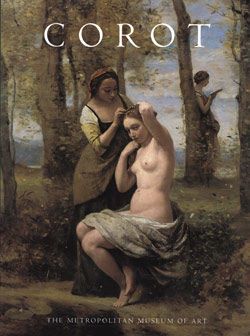
Corot

Two hundred years after the birth of Jean-Baptiste-Camille Corot (1796–1875), 163 of the French artist's finest paintings have been brought together in an important exhibition that allows a public on both sides of the Atlantic to rediscover the riches and pleasures of his art. Corot, an original painter who produced a body of work of exceptional range, has been many things to many viewers. His silvery landscapes were adored by nineteenth-century collectors, and his sparkling sketches painted in plein air were later hailed as precursors of Impressionism. Art lovers have prized his figures paintings, the least well known and perhaps the most modern of all his works. Corot's long and prolific career coincided with major artistic developments: the flourishing of Neoclassical, Romantic, and Realist tendencies; the Barbizon school; the rise of Impressionism. Although he has been claimed at various times for each of these movements, Corot defies categorization. His art was fueled by a profound love of the natural world, and the vision he pursued was his own. This catalogue of the exhibition recounts the engrossing progress of his life and art. Corot's traditional education took him to Italy, where he painted crystalline outdoor oil studies and dedicated himself to mastering the art of classical landscape painting—a fascinating apprenticeship that is here carefully described. On his return to France he sought out views of great diversity and was among the first artists to frequent the forest of Fontainebleau. Working from his open-air studies he composed ambitious historical and mythological landscapes to exhibit at the Salons, but for some time these drew little favorable response. Undaunted, Corot continued to paint landscapes and to people them with figures of his own imagining, evolving a distinctive, poetic style. Both the critics and the public eventually grew enthusiastic, and in his later years Corot was a revered master, inundated by requests for pictures and instruction. A more private part of his oeuvre consists of the remarkable figure paintings, often depicting women in pensive attitudes, that the artist produced during this late period. Their purity and power have been admired by subsequent generations of artists. Hearty, generous, beloved, Corot was a man of good cheer but a painter of deep emotion and delicacy. Each painting catalogued in this book is accompanied by a full art-historical discussion. Three major essays chronicle Corot's life and the development of his art; additional essays elucidate the vexed subject of forgeries and describe the collecting of his works. The volume contains much original new scholarship, a full review of the scholarly literature, a chronology, and a concordance, and it is meticulously documented throughout. This book is published in conjunction with the exhibition "Corot," held at the Grand Palais, Paris, from February 27 to May 27, 1996; at the National Gallery of Canada, Ottawa, from June 21 to September 22, 1996; and at The Metropolitan Museum of Art, New York, from October 22, 1996, to January 19, 1997.
Image for French Longcase Clock | MetCollects
video

French Longcase Clock | MetCollects

January 17, 2017

By Daniëlle Kisluk-Grosheide

“Who controls time?” Daniëlle Kisluk-Grosheide on a longcase clock by Ferdinand Berthoud and Balthazar Lieutaud.
Image for Proof: Maxime Du Camp’s Photographs of the Eastern Mediterranean and North Africa
Past Exhibition

Proof: Maxime Du Camp’s Photographs of the Eastern Mediterranean and North Africa

23 октября 2023 г.–21 января 2024 г.
In October 1849, twenty-seven-year-old Maxime Du Camp—an aspiring journalist with big ambitions—left Paris to photograph sites across the eastern Mediterranean. Officially encouraged to exploit photography’s “uncontestable exactitude,” he returned …
Image for Wisteria Dining Room, Paris
Essay

Wisteria Dining Room, Paris

November 1, 2009

By Jared Goss

Because the Wisteria dining room is preserved entirely furnished as it stood when completed, even the rug especially made for it, and because contemporary documentation provides us with the names of the team of craftsmen responsible, this Art Nouveau room is unique in an American museum.
Image for Protecting the Crown of the Andes
Essay

Protecting the Crown of the Andes

April 10, 2020

By Matthew Cumbie and Linda Borsch

A Met conservator, scientist, and curator restored the "Crown of the Andes" to ensure its stability and survival for future generations.
Image for Cool Books
editorial

Cool Books

January 24, 2018

By Tony White

Florence and Herbert Irving Associate Chief Librarian Tony White discusses some of the "cool books" acquired by Thomas J. Watson Library in 2017.
Image for African Rock Art
Essay

African Rock Art

October 1, 2000

By Department of Arts of Africa, Oceania, and the Americas

Rock paintings and engravings are Africa’s oldest continuously practiced art form.
Image for Simon Bening's _Book of Hours_ | Met Collects
video

Simon Bening's Book of Hours | Met Collects

June 16, 2016

By Barbara Drake Boehm

"How do you measure dedication?" Barbara Boehm on Simon Bening’s Book of Hours.
Image for The Transforming Book
editorial

The Transforming Book

August 16, 2023

By Lydia Aikenhead

Conservation of a “Blow Book”
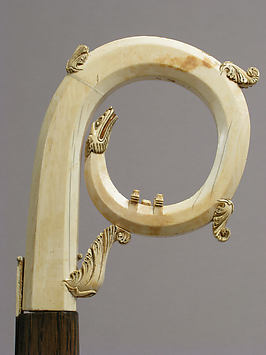
Image for Head of a Crozier

Date: ca. 1175–1225
Accession Number: 17.190.232

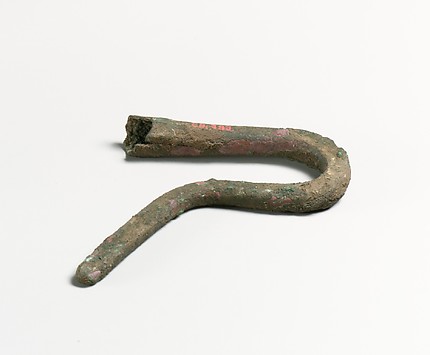
Image for Shepherd's crook

Accession Number: 74.51.5626

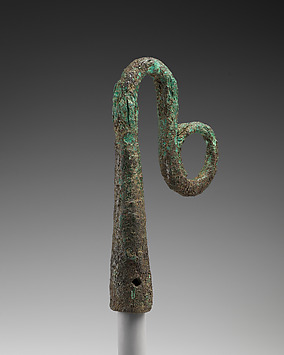
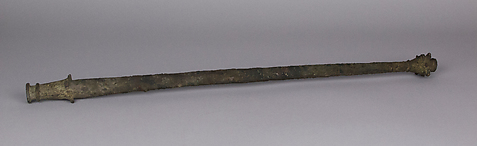
Image for Bronze shepherd's crook

Date: ca. 1200–1050 BCE
Accession Number: 74.51.5570

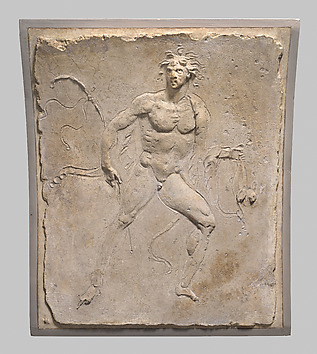
Image for Stucco relief panel

Date: 2nd half of 1st century CE
Accession Number: 92.11.3

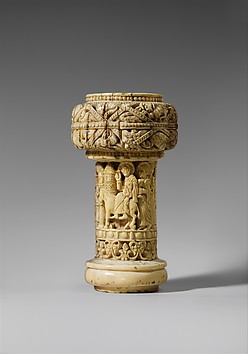
Image for Knob from a Crozier with the Entry into Jerusalem

Date: ca. 1200
Accession Number: 13.46a

Image for Shepherd's crook or staff

Accession Number: 41.160.738

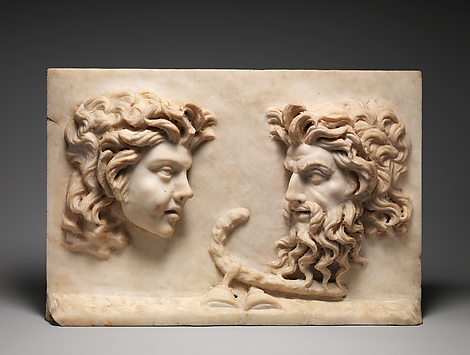
Image for Marble two-sided relief

Date: 1st century CE
Accession Number: 2012.479.11

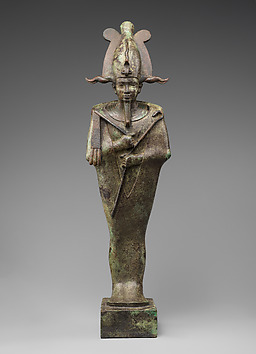
Image for Statuette of Osiris

Date: 664–332 BCE
Accession Number: 61.45

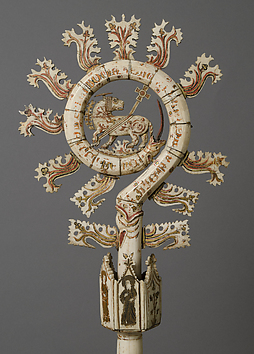
Image for Crozier with Lamb of God

Date: ca. 1360–1400
Accession Number: 53.63.4