Search / All Results

27,495 results for japan

Image for Japan: A History of Style
Past Exhibition

Japan: A History of Style

March 8, 2021–April 24, 2022
This exhibition celebrates how gifts and acquisitions of the last decade have transformed The Met’s ability to narrate the story of Japanese art by both expanding and deepening the range of remarkable artworks that can meaningfully elucidate the pa…
Image for The Shah Jahan Album
Essay

The Shah Jahan Album

April 1, 2010

By Rashmi Viswanathan

This spectacular album, which contains intimate nature studies, portraits of the royal family and various dignitaries, and fine examples of illuminated folios of calligraphy by renowned calligraphers, offers a glimpse into the courtly life and diverse interests of its patrons.
Image for More Than a Honeymoon: The Influence of Japan on Adolf de Meyer's Photographs
Curator Beth Saunders explores two of Adolf de Meyer's great muses: the arts and culture of Japan, and his wife, Olga.
Image for Second Division: Early Modernism in Japan
editorial

Second Division: Early Modernism in Japan

October 28, 2015

By Holly Phillips, Diane De Fazio, and Margaret Borozan

Associate Manager for Acquisitions Holly Phillips, Volunteer Diane De Fazio, and Intern Margaret Borozan look at some of the rare Japanese modernist books in Watson Library.
Image for Turning Point: Oribe and the Arts of Sixteenth-Century Japan
The warrior-tea master Furuta Oribe (1543/44–1615) played a seminal role in establishing a unique set of aesthetics for the tea ceremony that had profound implications for Japanese art. Oribe's new concepts of tea led to the creation of ceramic wares bearing his name that possess originality and afford delight; these in turn helped bring forth a new canon of beauty for paintings, lacquerware, and textiles in the milieu of rapid social and political change that characterized the Momoyama period (1573–1615). Japan's first exposure to European culture also took place in this tumultuous time. "Turning Point: Oribe and the Arts of Sixteenth-Century Japan" is the first major exhibition examining the nature and extent of Oribe's influence ever to be held in the West. His life signified a turning point in the arts of Japan. This exhibition and its accompanying catalogue likewise mark a turning point in the study of Japanese art in the time of Oribe. They draw not only on decades of pioneering research but also on fortuitous discoveries that began in the mid-twentieth century: of kiln sites where ceramic wares reflecting the new aesthetic were produced; of consumer sites in Kyoto from which the wares were distributed; and of Oribe's Kyoto residence. These finds are particularly important because the extent of Oribe's impact on the ceramic ware that carries his name had been a subject of intense debate long before the modern era, with scholars reluctant to give the master credit in the absence of solid documentary evidence. Now, however, examination of the recently excavated ceramics and careful reexamination of old records of tea gatherings and of Oribe's own writings on tea utensils suggest that he was largely responsible for promoting the development of Oribe wares. These vessels, which are sometimes irregular or deformed in shape and are expansively and colorfully decorated with brushed designs, have a startlingly modern appearance. Bursting into the largely monochromatic world of Japanese ceramics that was the standard before Oribe, these strangely shaped and brilliantly colored wares must have made a striking impression on the sedate tea aficionados of the time. The new aesthetic that Oribe promoted, as this exhibition demonstrates, was expressed not only in ceramics but in all the arts of the period; paintings, lacquerware, and textiles exhibit a similar explosion of energy and introduce a host of modern, even outlandish design ideas. No other period in Japanese history has witnessed such closely related achievements in different sphere of the arts.
Image for Samurai Splendor: Sword Fittings from Edo Japan
Past Exhibition

Samurai Splendor: Sword Fittings from Edo Japan

March 21, 2022–March 23, 2025
After almost a century and a half of near-constant civil war and political upheaval, Japan unified under a new ruling family, the Tokugawa, in the early 1600s. Their reign lasted for more than 250 years, in an era referred to as the Edo period, aft…
Image for Joan Miró (1893–1983)
Essay

Joan Miró (1893–1983)

July 1, 2018

By Rachel Boate

Though often pigeonholed as a Surrealist, the Catalan modernist Joan Miró considered his art to be free of any “ism.”
Image for Armor (<i>Gusoku</i>)

Helmet signed by Bamen Tomotsugu (Japanese, Echizen province, Toyohara, active 18th century)

Date: 18th century
Accession Number: 2001.642

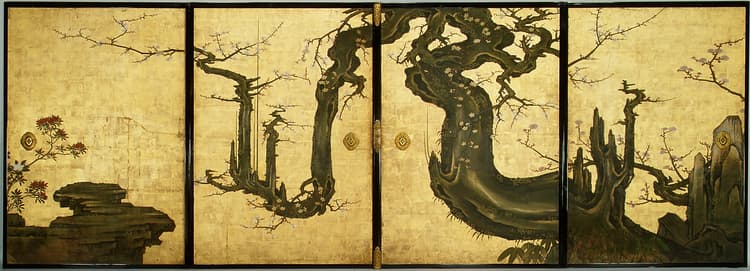
Image for Old Plum

Kano Sansetsu (Japanese, 1590–1651)

Date: 1646
Accession Number: 1975.268.48a–d

Image for The Bodhisattva Jizō

Intan (Japanese, active 13th century)

Date: 1291
Accession Number: 2023.640a–c

Image for Desk and bookcase

Date: 1700–1720
Accession Number: 39.184.1a, b

Image for High chest of drawers

Date: 1740–60
Accession Number: 40.37.1

Image for Shino Tea Bowl with Bridge and Shrine, Known as “Bridge of the Gods” (Shinkyō)

Date: late 16th–early 17th century
Accession Number: 2015.300.271

Image for Covered Vessel (Futamono) with Plum Tree

Date: early 17th century
Accession Number: 2023.731a, b

Image for Small Dish (Kozara) with Three Jars

Date: 1680–90s
Accession Number: 1975.268.563

Image for The Handmade Papers of Japan

Tindale, Thomas & Harriet R.

Date: 1952
Accession Number: 270.52 T49

Image for Japan
Art

Japan

Edward R. Miller

Date: 1950s–60s
Accession Number: 65.580.3