Saber with Scabbard
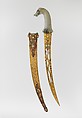
The sword was probably assembled by a court jeweler, using a seventeenth-century Iranian blade, an eighteenth-century Indian jade grip, and gem-studded gold and gilt-brass mounts of contemporary workmanship. The emerald near the top of the scabbard opens to reveal a secret compartment containing a gold coin marked with the name of Süleyman the Magnificent (1494–1566), the most powerful Ottoman ruler of the sixteenth century. The underside of the emerald is inscribed with the phrase "According to God's will."
Artwork Details
- Title: Saber with Scabbard
- Date: grip, 18th or 19th century; guard and scabbard, 19th century; blade, dated A.H. 1099/1688 CE; decoration on blade, 19th century
- Culture: grip, Indian; guard, scabbard, and decoration on blade, Turkish; blade, Iranian
- Medium: Steel, gold, silver, jade (nephrite), diamonds, emeralds, pearls
- Dimensions: sword: L. 39 1/4 in. (99.8 cm); L. of blade 33 in. (83.7 cm); Wt. 2 lb. 8 oz. (1129 g); scabbard: L. 34 5/8 in. (88 cm); Wt. 2 lb. 4 oz. (1023 g)
- Classification: Swords
- Credit Line: Gift of Giulia P. Morosini, in memory of her father, Giovanni P. Morosini, 1923
- Object Number: 23.232.2a, b
- Curatorial Department: Arms and Armor
Audio
4416. Saber with Scabbard
NARRATOR: Curator Stuart Pyhrr.
STUART PYHRR: This sword is a saber dating from the nineteenth century, which is believed to have been made for the coronation of Sultan Murad the V who was to be enthroned in 1876 but was deposed by his brother before that occasion and was locked away in prison for the next several decades until his death.
Murad ruled only for several months, and this sword reflects the opulence of the late Ottoman court, with its diamond and emerald studded scabbard and hilt. The grip is of Indian nephrite ,or jade, and inset with delicate scrolls filled with diamonds and emeralds. The guard is also set with stones, and the grip wrapped with a chain of pearls with this decorative tassel. The blade is a Persian blade, perhaps of the seventeenth century, and is decorated in Ottoman style and with a Koranic inscription on the blade. The inscription actually is upside down. While the other swords in the case are shown so you can read the inscriptions with the cutting edge up. This sword is shown with cutting edge down in the more traditional way, as it would be worn.
NARRATOR: This sword contains a secret compartment that was recently discovered by the Museum. Press PLAY to hear more about it.
More Artwork
Press the down key to skip to the last item.
Related Content

 Free to download
Research Resources
The Met provides unparalleled resources for research and welcomes an international community of students and scholars. The Met's Open Access API is where creators and researchers can connect to the The Met collection. Open Access data and public domain images are available for unrestricted commercial and noncommercial use without permission or fee.
To request images under copyright and other restrictions, please use this Image Request form.
Feedback
We continue to research and examine historical and cultural context for objects in The Met collection. If you have comments or questions about this object record, please contact us using the form below. The Museum looks forward to receiving your comments.
Content Notice
The Metropolitan Museum of Art presents over 5,000 years of art from around the world, and our online collection reflects ongoing work conducted over the course of our more than 150-year history. You may encounter objects or images that may be inappropriate for some viewers or information that may be outdated.