Snuffbox
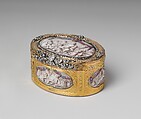
Ducrollay was among the first of the Parisian goldsmiths to make use of Japanese lacquer, which he bought from the marchands-merciers or retailers of luxury goods. The trade in Oriental lacquer was in the hands of these middlemen of taste; prevented by guild regulations from manufacturing works of art themselves, they successfully marketed some of their goods by promoting, and probably inventing, the tabatière à cage, which, like this example, consisted of a gold frame into which panels of lacquer or other exotic material could be inserted. On this box lacquer panels with figures must have been cut from small panels of boxes or chests. Ducrollay probably obtained them from the marchand-bijoutier Lazare Duvaux from whom he purchased lacquer on several occasions between 1751 and 1755.
Artwork Details
- Title: Snuffbox
- Maker: Jean Ducrollay (French, born 1709, master 1734, recorded 1760)
- Date: 1753–54
- Culture: French, Paris
- Medium: Gold, lacquer, enamel
- Dimensions: 3 3/8 x 2 3/8 in. (8.6 x 6cm)
- Classification: Metalwork-Gold and Platinum
- Credit Line: Gift of J. Pierpont Morgan, 1917
- Object Number: 17.190.1161
- Curatorial Department: European Sculpture and Decorative Arts
More Artwork
Research Resources
The Met provides unparalleled resources for research and welcomes an international community of students and scholars. The Met's Open Access API is where creators and researchers can connect to the The Met collection. Open Access data and public domain images are available for unrestricted commercial and noncommercial use without permission or fee.
To request images under copyright and other restrictions, please use this Image Request form.
Feedback
We continue to research and examine historical and cultural context for objects in The Met collection. If you have comments or questions about this object record, please contact us using the form below. The Museum looks forward to receiving your comments.
Content Notice
The Metropolitan Museum of Art presents over 5,000 years of art from around the world, and our online collection reflects ongoing work conducted over the course of our more than 150-year history. You may encounter objects or images that may be inappropriate for some viewers or information that may be outdated.