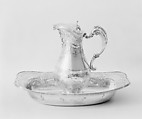
Ewer and basin
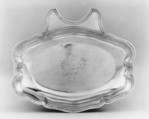
The undulating line of the molded band at the neck of the ewer, the irregularly shaped cartouche beneath the spout, the molded swirling leaves on its cover, and the sinuous lines of the pierced handle show how the formal, highly organized decorative schemes of the preceding Régence period evolved into a new style in which curvilinear forms and the asymmetrical use of motifs derived from nature predominated. The snail on the handle of the ewer, its shell thumbpiece, and the undulating profile of the basin are other elements that reflect the influence of the new Rococo style, which reached its apex in the middle decades of the eighteenth century.
[Jeffrey H. Munger, 2010]
Artwork Details
- Title: Ewer and basin
- Maker: Jean Fauche (ca. 1706–1762, master 1733)
- Date: 1739–42
- Culture: French, Paris
- Medium: Silver
- Dimensions: Overall (ewer .411): 9 5/16 × 6 1/2 × 4 3/4 in. (23.7 × 16.5 × 12.1 cm);
Overall (basin .412): 2 5/8 × 8 9/16 × 13 15/16 in. (6.6 × 21.7 × 35.4 cm) - Classification: Metalwork-Silver
- Credit Line: Bequest of Catherine D. Wentworth, 1948
- Object Number: 48.187.411, .412
- Curatorial Department: European Sculpture and Decorative Arts
More Artwork
Related Content
 Free to download
Research Resources
The Met provides unparalleled resources for research and welcomes an international community of students and scholars. The Met's Open Access API is where creators and researchers can connect to the The Met collection. Open Access data and public domain images are available for unrestricted commercial and noncommercial use without permission or fee.
To request images under copyright and other restrictions, please use this Image Request form.
Feedback
We continue to research and examine historical and cultural context for objects in The Met collection. If you have comments or questions about this object record, please contact us using the form below. The Museum looks forward to receiving your comments.
Content Notice
The Metropolitan Museum of Art presents over 5,000 years of art from around the world, and our online collection reflects ongoing work conducted over the course of our more than 150-year history. You may encounter objects or images that may be inappropriate for some viewers or information that may be outdated.