Armchair (Bergère à la reine) (one of a pair) (part of a set)
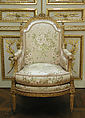
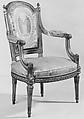
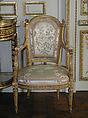
Made around 1785, these bergères were executed in carved and gilded beechwood and are emblematic of the neoclassical style. The top rail of the back is arched in the center en anse de panier (basket handle) and carved with a floral wreath, sprays of laurel, and oak leaves. The two curving arms break forward from each end of the top rail where they are surmounted by a pinecone finial reminiscent of the famous pigna in the Belvedere Court at the Vatican palace. The acanthus scrolls, fluted half columns, guilloches and pearls which decorate the frames are frequently used during Louis XVI’s reign.
Artwork Details
- Title: Armchair (Bergère à la reine) (one of a pair) (part of a set)
- Maker: Jean-Baptiste-Bernard Demay (1759–1849, master 1784)
- Date: ca. 1785
- Culture: French
- Medium: Carved and gilded walnut, modern silk lampas
- Dimensions: 40 3/8 × 27 × 24 1/8 in. (102.6 × 68.6 × 61.3 cm)
- Classification: Woodwork-Furniture
- Credit Line: Purchase, Mr. and Mrs. Charles Wrightsman Gift, 1973
- Object Number: 1973.305.3
- Curatorial Department: European Sculpture and Decorative Arts
More Artwork
Research Resources
The Met provides unparalleled resources for research and welcomes an international community of students and scholars. The Met's Open Access API is where creators and researchers can connect to the The Met collection. Open Access data and public domain images are available for unrestricted commercial and noncommercial use without permission or fee.
To request images under copyright and other restrictions, please use this Image Request form.
Feedback
We continue to research and examine historical and cultural context for objects in The Met collection. If you have comments or questions about this object record, please contact us using the form below. The Museum looks forward to receiving your comments.
Content Notice
The Metropolitan Museum of Art presents over 5,000 years of art from around the world, and our online collection reflects ongoing work conducted over the course of our more than 150-year history. You may encounter objects or images that may be inappropriate for some viewers or information that may be outdated.