English
DonateMembershipTickets

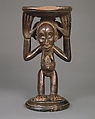
Prestige seat

Mid–late 19th century
On view at The Met Fifth Avenue in Gallery 344
Beginning in the sixteenth century, the coastal Duala rose to great regional prominence as intermediaries in trade networks that extended into the interior. This expertly crafted work, among the first by a Duala artist to be featured in a public U.S. collection, belongs to a small corpus of stools with curvilinear seats created in the 19th century for prominent elders. The open latticework of imagery characteristically features an avian form with prominent tail plumage and long beak. The unusual biped with curved tail and rows of triangular teeth may represent a crocodile-avian hybrid. The crocodile was among the ultimate symbols of regional authority for its association with danger and power on land and in the water.

Artwork Details

Object Information
  • Title: Prestige seat
  • Artist: Duala artist
  • Date: Mid–late 19th century
  • Geography: Cameroon, Sanaga River region
  • Culture: Duala peoples
  • Medium: Wood
  • Dimensions: H. 11 5/8 × W. 18 7/8 × D. 9 1/4 in. (29.5 × 47.9 × 23.5 cm)
  • Classification: Wood-Furniture
  • Credit Line: Fletcher Fund, 1972
  • Object Number: 1972.4.31
  • Curatorial Department: The Michael C. Rockefeller Wing
More Artwork
Ashetu prestige cap, Grassfields artist, Cotton, other material (?)
Grassfields artist
early 20th century
Lupona (royal seat), Ngongo ya Chintu, formerly known as the "Buli Master"  Democratic Republic of Congo, Wood, metal studs, Luba or Hemba peoples
Ngongo ya Chintu, formerly known as the "Buli Master"
ca. 1840–1870
Ceremonial Palm Wine Vessel, Grassfields artists, Gourd, glass beads, cloth, cane, wood, Grassfields region
Grassfields artists
late 19th–early 20th century
Folding stool, Oak decorated with marquetry including walnut, bog oak, maple, green-stained poplar, and other woods, Northern German or Polish
Northern German or Polish
early 17th century
Nkisi (power figure), Kongo artist and nganga (ritual specialist), Wood, pigment, resin, iron, brass, tin, cloth, plant fiber cord, beads, cowrie shells, bone or ivory, arrows, leather, seeds, animal horn, Kongo peoples
Kongo artist and nganga (ritual specialist)
19th–first half of 20th century

Research Resources

The Met provides unparalleled resources for research and welcomes an international community of students and scholars. The Met's Open Access API is where creators and researchers can connect to the The Met collection. Open Access data and public domain images are available for unrestricted commercial and noncommercial use without permission or fee.

To request images under copyright and other restrictions, please use this Image Request form.

Feedback

We continue to research and examine historical and cultural context for objects in The Met collection. If you have comments or questions about this object record, please contact us using the form below. The Museum looks forward to receiving your comments.

Send feedback

Content Notice

The Metropolitan Museum of Art presents over 5,000 years of art from around the world, and our online collection reflects ongoing work conducted over the course of our more than 150-year history. You may encounter objects or images that may be inappropriate for some viewers or information that may be outdated.