Face Mask
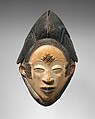
Scholars have admired the Dan style for masking since the end of the 19th century. The social anthropologist M.C. Jedrej most notably described that Dan masks have become, in the minds of reputable collectors and dealers, the “archetypal African mask” (Jedrej 1986, 72). Most agree that it rests on a shared and articulated standard of beauty. The Belgian art historian P. J. L. Vandenhoute, who worked among the Dan and Wè of western Côte d’Ivoire in 1938 and 1939, called it an idealized realism (Vandenhoute 1948, 7–8). The ethnologist Eberhard Fischer worked sculptors in the Liberian village of Nyor Diaple from 1960 with named sculptors who could identify the qualities they sought in such masks: symmetry, a high narrow nose, filed teeth, a vertical mark on the forehead, and long narrow eyes, all of which appear here (Fischer 1976, 10). That ideal was neither timeless nor anonymous. Up to this day, mask sculptors claim they are inspired by beautiful women around them, but never portray them.
The same carved face can serve several roles, and Dan audiences tell them apart by dress and occasion rather than by the wood. A deangle leaves the boys’ initiation camp with an interpreter to ask the village women for food, and the women answer with teasing (Fischer and Himmelheber 1984, 11; Himmelheber 1979, 20). A tankagle, close in appearance but more elaborately dressed, is invited to festivals to dance and sing (Fischer 1978, 21; Jedrej 1986, 72). In the Man region of Côte d’Ivoire, comparable faces appear as Guénnoneu, distinguished by the kaolin applied to the mask’s surface before each appearance and by the the costume. They open large ceremonies by blessing audience members and dancing.
A gentle mask can also rise in standing over decades. In Liberia in 1967 the art historian Robert Farris Thompson watched a mask of this kind judge a land dispute (Thompson 1974, 161–63). Fischer later identified it as a deangle that had grown into a judge (Fischer 1978, 22). Without the pigments, headdress, cloth, and skirt once fastened through the rectangular holes around its rim, this mask presents an ideal of beauty. In its current state, it lacks critical signs relating to its past roles.
Yann Petit, 2026
Jane and Morgan Whitney Fellow
Artwork Details
- Title: Face Mask
- Artist: Dan artist
- Date: 19th–mid-20th century
- Geography: Côte d'Ivoire, western region; Liberia, northeastern region
- Culture: Dan peoples
- Medium: Wood, pigment
- Dimensions: H. 8 3/4 in. × W. 4 7/8 in. × D. 3 in. (22.2 × 12.4 × 7.6 cm)
- Classification: Wood-Sculpture
- Credit Line: The Michael C. Rockefeller Memorial Collection, Gift of Nelson A. Rockefeller, 1964
- Object Number: 1978.412.303
- Curatorial Department: The Michael C. Rockefeller Wing
Audio
991. Kids: Face Mask
More Artwork


Research Resources
The Met provides unparalleled resources for research and welcomes an international community of students and scholars. The Met's Open Access API is where creators and researchers can connect to the The Met collection. Open Access data and public domain images are available for unrestricted commercial and noncommercial use without permission or fee.
To request images under copyright and other restrictions, please use this Image Request form.
Feedback
We continue to research and examine historical and cultural context for objects in The Met collection. If you have comments or questions about this object record, please contact us using the form below. The Museum looks forward to receiving your comments.
Content Notice
The Metropolitan Museum of Art presents over 5,000 years of art from around the world, and our online collection reflects ongoing work conducted over the course of our more than 150-year history. You may encounter objects or images that may be inappropriate for some viewers or information that may be outdated.