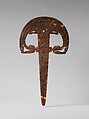
Drum
Drums in the Trobriand Islands are used to accompany traditional singing and dancing. Generically known as kasosau or kaesosau, Trobriand drums come in two sizes, the smaller katunenia and the larger kaesosau. Smaller katunenia drums are struck with the thumb, producing a more high-pitched tone or voice than the larger kaesosau. A typical set up used in traditional Trobriand dances would have only one small katunenia and several large kaesosau. Sometimes, kaesosau drums are beaten in a less energetic manner, changing their register of voice to a softer one known as kaibela (as opposed to the usual, louder kaiula voice of large kaesosau drums). In the Trobriand Islands, there can only be one katunenia and one kaiula voices per orchestra. Usually, changes in drums’ rhythms and voices signal changes in dance patterns. The hollow part inside the drum has a thicker section towards the middle called laboala kikoni (the house of the mice) that is said to improve the resonance of a good drum. Okabulula Village in Kiriwina Island (the main island in the Trobriand group) is renowned for its tradition in drum-making.
Drums are prized possessions in the Massim region of Papua New Guinea. They often have individual names (sometimes even engraved on the smooth body of the drum) and are passed on as heirlooms within a dala matriclan. Since each drum has a specific tone that distinguishes it from others and can be recognized by Massim locals, they are at times considered to be the voice of an ancestor within the lineage, hence the importance of preserving them.
Sergio Jarillo de la Torre, Sylvan C. Coleman and Pam Coleman Memorial Fund Fellow, 2017
Further reading
Norick, Frank A. 1976. An Analysis of the Material Culture of the Trobriand Islands Based on the Collection of Bronislaw Malinowski. Berkeley: Ph.D Thesis, University of California.
Shack, William A. 1985. The Kula. A Bronislaw Malinowski Centennial Exhibition. Berkeley (CA): Robert H. Lowie Museum of Anthropology.
Artwork Details
- Title: Drum
- Date: early to mid-20th century
- Geography: Papua New Guinea, Massim region, Milne Bay Province
- Culture: Massim people
- Medium: Wood, lizard skin, fiber, lime
- Dimensions: H.11 1/2 x W. 3 in. (29.2 x 7.6 cm)
- Classification: Wood-Musical Instruments
- Credit Line: The Michael C. Rockefeller Memorial Collection, Bequest of Nelson A. Rockefeller, 1979
- Object Number: 1979.206.1768
- Curatorial Department: The Michael C. Rockefeller Wing
More Artwork
Research Resources
The Met provides unparalleled resources for research and welcomes an international community of students and scholars. The Met's Open Access API is where creators and researchers can connect to the The Met collection. Open Access data and public domain images are available for unrestricted commercial and noncommercial use without permission or fee.
To request images under copyright and other restrictions, please use this Image Request form.
Feedback
We continue to research and examine historical and cultural context for objects in The Met collection. If you have comments or questions about this object record, please contact us using the form below. The Museum looks forward to receiving your comments.
Content Notice
The Metropolitan Museum of Art presents over 5,000 years of art from around the world, and our online collection reflects ongoing work conducted over the course of our more than 150-year history. You may encounter objects or images that may be inappropriate for some viewers or information that may be outdated.