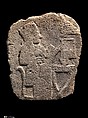
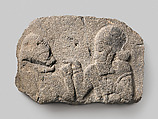
Relief: bearded figure holding staff; hieroglyphic inscription
The text is written in Luwian, a form of hieroglyphic writing that dates to the early first millennium B.C. and was used by the Neo-Hittite kings. Their kingdoms were located in southeastern Turkey and northern Syria, regions that had been ruled by the powerful Hittite and Mitanni empires from about 1600-1200 B.C. After the collapse of the great imperial powers at the end of the Late Bronze Age, these lands were divided into small states ruled by local populations as well as by nomadic groups from the Syrian-Arabian steppe who had migrated north. These small kingdoms produced a wealth of carved stone steles (freestanding monuments) and orthostats (slabs which covered the interior or exterior wall of a structure), which borrowed from the distinctive imagery and styles of their Hittite and Mitanni predecessors. The long inscription on this stele allows us to identify the figure as Laramas, king of Gurgum (modern Marash), who reigned sometime between 1000-950 B.C. The text lists the king’s ancestors and seems to describe his deeds, although it is difficult to understand. Vineyards and granaries are mentioned, perhaps referring to a time of abundance under Laramas’ rule. The text ends with a curse against those who would erase his name. It reads, in part:
I am Laramas, Astuwaramanzas's
grandson, Muwatalis's son.
[...]
He who shall erase my name,
if he is a king,
let him surrender his kingdom,
but he who is a country-lord,
let him surrender his power
and...his head, house, wife, child...
Artwork Details
- Title: Relief: bearded figure holding staff; hieroglyphic inscription
- Period: Neo-Hittite
- Date: ca. early 1st millennium BCE
- Geography: Anatolia, probably from Marash
- Culture: Hittite
- Medium: Basalt
- Dimensions: 45 × 23 × 3 1/8 in., 206 lb. (114.3 × 58.4 × 7.9 cm)
- Credit Line: Gift of Mrs. Henry Marden, in memory of Rev. Henry Marden, 1890
- Object Number: 90.21
- Curatorial Department: Ancient West Asian Art
More Artwork
Research Resources
The Met provides unparalleled resources for research and welcomes an international community of students and scholars. The Met's Open Access API is where creators and researchers can connect to the The Met collection. Open Access data and public domain images are available for unrestricted commercial and noncommercial use without permission or fee.
To request images under copyright and other restrictions, please use this Image Request form.
Feedback
We continue to research and examine historical and cultural context for objects in The Met collection. If you have comments or questions about this object record, please contact us using the form below. The Museum looks forward to receiving your comments.
Content Notice
The Metropolitan Museum of Art presents over 5,000 years of art from around the world, and our online collection reflects ongoing work conducted over the course of our more than 150-year history. You may encounter objects or images that may be inappropriate for some viewers or information that may be outdated.