Model Ear of Ramessumerysutekh
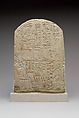
Model ears are conceptually related to so-called ear stelae. Such stelae often depict pairs of ears, but their numbers vary, reaching as many as 376. These amounts suggest that rather than depicting a deity’s ears, the representations evoke the act of hearing itself. Ear stelae were deposited in temples throughout Egypt. In Memphis, for example, a large number were in a chapel dedicated to the god Ptah, who bears the epithet "One Who Hears Prayers." Alongside Ptah, other gods—such as Amun- Re, Thoth, Hathor, Nebethetepet, and the deified queen Ahmose Nefertari—also received ear stelae. These stelae show a variety of forms and styles, and many are crudely made and uninscribed. This suggests they could have been donated by a broad circle of society. Similarly, Ramessumerysutekh’s ear is rudimentarily sculpted, and underneath its deeply carved hieroglyphs is an uneven replication.
These ear models and ear stelae, which envision unmediated access to the divine, are mostly dated to the New Kingdom and later, an era when personal piety took central stage well beyond the royal court.
Artwork Details
- Title: Model Ear of Ramessumerysutekh
- Period: New Kingdom, Ramesside Period
- Dynasty: Dynasty 19
- Date: ca. 1300–1200 BCE
- Geography: From Egypt
- Medium: Stone
- Dimensions: H. 29.4 × W. 16.8 × D. 11.1 cm, 5.9 kg (11 9/16 × 6 5/8 × 4 3/8 in., 13 lb.)
- Credit Line: Rogers Fund, 1959
- Object Number: 59.99.1
- Curatorial Department: Egyptian Art
More Artwork
Related Content
Research Resources
The Met provides unparalleled resources for research and welcomes an international community of students and scholars. The Met's Open Access API is where creators and researchers can connect to the The Met collection. Open Access data and public domain images are available for unrestricted commercial and noncommercial use without permission or fee.
To request images under copyright and other restrictions, please use this Image Request form.
Feedback
We continue to research and examine historical and cultural context for objects in The Met collection. If you have comments or questions about this object record, please contact us using the form below. The Museum looks forward to receiving your comments.
Content Notice
The Metropolitan Museum of Art presents over 5,000 years of art from around the world, and our online collection reflects ongoing work conducted over the course of our more than 150-year history. You may encounter objects or images that may be inappropriate for some viewers or information that may be outdated.