Fragmentary Lotiform Chalice
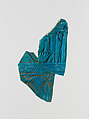
Here, the rim is decorated with a distinctive block border above an incised hieroglyphic inscription. A fragment of this chalice in the Myers Museum (Eton 1608-2010) preserves the first half of the cartouche of a king who could be either Smendes (Dynasty 21) or Sheshonq I (Dynasty 22), while MMA 30.8.154 preserves part of a formulaic text.
As reconstructed, the primary band of decoration, executed in raised relief, depicts a series of figures of the child god Horus (of which only the drawn-up knees of one figure are preserved) seated on a Nymphaea caerulea lotus (blue water lily) blossom. Each figure would have been flanked by pairs of winged cobras wearing red or white crowns and wound around papyrus stalks(?). In the background, ducks tend to their nests, balanced atop papyrus umbels in a marshy landscape. A band of zigzags representing water separates the main scene from the lotus, palmette, and papyrus umbel ornament that would have adorned the bowl, stem, and base.
Based on its similarity in decoration and quality to The Met’s fragments, Geoffrey Tait (1963) suggested that a fragment in the Petrie Museum of Egyptian Archaeology(UC14557), found at Lahun, belongs to this vessel.
Artwork Details
- Title: Fragmentary Lotiform Chalice
- Period: Third Intermediate Period
- Dynasty: Dynasty 21 or 22
- Reign: reign of Smendes or Sheshonq I
- Date: ca. 1080–1054 BCE or ca. 945–924 BCE
- Geography: From Egypt; Possibly from Fayum Entrance Area, Lahun
- Medium: Faience
- Dimensions: H. 5 × W. 4 × Th. 0.4 cm (1 15/16 × 1 9/16 × 3/16 in.)
- Credit Line: Theodore M. Davis Collection, Bequest of Theodore M. Davis, 1915 (30.8.154); Purchase, Lila Acheson Wallace Gift, 1985 (1985.163.3); Purchase, Nathaniel Spear, Jr. Gift, 1986 (1986.18.1)
- Object Number: 30.8.154
- Curatorial Department: Egyptian Art
More Artwork
Research Resources
The Met provides unparalleled resources for research and welcomes an international community of students and scholars. The Met's Open Access API is where creators and researchers can connect to the The Met collection. Open Access data and public domain images are available for unrestricted commercial and noncommercial use without permission or fee.
To request images under copyright and other restrictions, please use this Image Request form.
Feedback
We continue to research and examine historical and cultural context for objects in The Met collection. If you have comments or questions about this object record, please contact us using the form below. The Museum looks forward to receiving your comments.
Content Notice
The Metropolitan Museum of Art presents over 5,000 years of art from around the world, and our online collection reflects ongoing work conducted over the course of our more than 150-year history. You may encounter objects or images that may be inappropriate for some viewers or information that may be outdated.