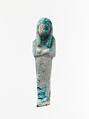
Shabti of Isetemkheb (D), wife of Painedjem II
The funerary figures known as shabtis can be seen as avatars of the deceased. Some, like Isetemkheb's shabti here, are inscribed with part of Chapter 6 from the Book of the Dead, promising to act on behalf of her owner should she be called upon to perform manual labor in the afterlife. By the 21st Dynasty, as many as 401 shabtis (a worker for each day of the year plus an overseer for each 10-day week) could be included with burials. They were often placed in wooden boxes near their owner’s coffins. Worker shabtis can be identified by the farming tools they hold, whereas overseer shabtis typically wear a skirt and carry a whip.
This shabti was presumably discovered in the “First Royal Cache” in Western Thebes, in a valley just south of the Temple of Hatshepsut. This hidden tomb contained the re-burials of a number of kings and queens of the New Kingdom (about 1550 to 1100 B.C.E.), along with the burials of 21st Dynasty dignitaries like Isetemkheb, Painedjem II, and several generations of their family.
A set of coffins initially created for Isetemkheb appears to have been used to bury another wife of Painedjem II named Nesikhonsu. Isetemkheb was eventually buried in the First Royal Cache in coffins that are stylistically later than Nesikhonsu's. Thus, Isetemkheb is assumed to have outlived Nesikhonsu.
Artwork Details
- Title: Shabti of Isetemkheb (D), wife of Painedjem II
- Period: Third Intermediate Period
- Dynasty: Dynasty 21
- Date: ca. 1000–979 BCE
- Geography: From Egypt
- Medium: Faience
- Dimensions: H. 16.7 cm (6 9/16 in.)
- Credit Line: Gift of James Douglas, 1890
- Object Number: 90.6.264
- Curatorial Department: Egyptian Art
More Artwork

Research Resources
The Met provides unparalleled resources for research and welcomes an international community of students and scholars. The Met's Open Access API is where creators and researchers can connect to the The Met collection. Open Access data and public domain images are available for unrestricted commercial and noncommercial use without permission or fee.
To request images under copyright and other restrictions, please use this Image Request form.
Feedback
We continue to research and examine historical and cultural context for objects in The Met collection. If you have comments or questions about this object record, please contact us using the form below. The Museum looks forward to receiving your comments.
Content Notice
The Metropolitan Museum of Art presents over 5,000 years of art from around the world, and our online collection reflects ongoing work conducted over the course of our more than 150-year history. You may encounter objects or images that may be inappropriate for some viewers or information that may be outdated.