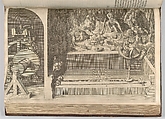
Problem XXIIII: A Machine for a Moveable Galatea in a Grotto, in: Les Raisons des Forces Mouvantes, plate 32
The print illustrated here shows one of de Caus's contrivances, consisting of a moving sculpted vessel with a figure of Galatea drawn by dolphins, which would greatly surprise—and probably completely soak—the innocent bystander. This and similar mechanical marvels were generated by concealed pipes creating forceful water jets and included acoustic devices which copied sounds of animals (chirping birds), as well as thunder, wind, and rain.
Artwork Details
- Title: Problem XXIIII: A Machine for a Moveable Galatea in a Grotto, in: Les Raisons des Forces Mouvantes, plate 32
- Designer: Designed by Salomon de Caus (French, Dieppe 1576?–1626 (active Germany))
- Publisher: Jan Norton (British, 1556/7–1615 or after)
- Published in: Frankfurt am Main
- Date: 1615
- Medium: Engraving
- Dimensions: Book: 15 3/8 × 10 7/16 × 1 15/16 in. (39 × 26.5 × 5 cm)
Sheet: 15 1/16 × 9 7/16 in. (38.3 × 24 cm) - Classifications: Books, Ornament & Architecture
- Credit Line: The Elisha Whittelsey Collection, The Elisha Whittelsey Fund, 1949
- Object Number: 49.122(3.32)
- Curatorial Department: Drawings and Prints
More Artwork
Research Resources
The Met provides unparalleled resources for research and welcomes an international community of students and scholars. The Met's Open Access API is where creators and researchers can connect to the The Met collection. Open Access data and public domain images are available for unrestricted commercial and noncommercial use without permission or fee.
To request images under copyright and other restrictions, please use this Image Request form.
Feedback
We continue to research and examine historical and cultural context for objects in The Met collection. If you have comments or questions about this object record, please contact us using the form below. The Museum looks forward to receiving your comments.
Content Notice
The Metropolitan Museum of Art presents over 5,000 years of art from around the world, and our online collection reflects ongoing work conducted over the course of our more than 150-year history. You may encounter objects or images that may be inappropriate for some viewers or information that may be outdated.