English
DonateMembershipTickets

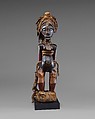
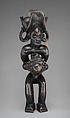
Commemorative female figure

Late 19th century
On view at The Met Fifth Avenue in Gallery 344
By the 19th century, Chokwe chiefs, called mwanangana, or “lords of the land,” had established trade routes to the Atlantic Coast and alliances with the Portuguese. Profiting from commerce in ivory, rubber, wax, and the trade of enslaved people, they emerged as important regional rulers whose prestige and power was reflected in their courtly arts. As chiefs bore a sacred duty to the prosperity of their subjects, objects associated with rituals of enthronement were produced to reinforce the mythical origins of their dynasties. Many figures carved in commemoration of chiefs depict those rulers wearing the distinctive, voluminous headdress of the Chokwe founding hero, a Luba price named Cibinda Ilunga. This portrait most likely represents and commemorates a chief’s leading wife, namata, or a queen mother mwanangana wa pwo. Due to the matrilineal nature of succession in Chokwe society, both positions held great ceremonial significance. Unlike mwanangana figures, including the Met's seated chief with finger piano, which are relatively abundant, female figures of this type are quite rare. As in most commemorative chief figures, the flexed arms and legs, set shoulder blades, and arched lower back of this female counterpart suggest a vitality and strength befitting a royal ancestor.

Artwork Details

Object Information
  • Title: Commemorative female figure
  • Artist: Chokwe artist
  • Date: Late 19th century
  • Geography: Angola
  • Culture: Chokwe
  • Medium: Wood, hair remnants
  • Dimensions: H. 12 5/8 × W. 3 7/8 × D. 4 in. (32.1 × 9.8 × 10.2 cm)
  • Classification: Wood-Sculpture
  • Credit Line: Gift of Ceil Pulitzer, 2022
  • Object Number: 2022.468.4
  • Curatorial Department: The Michael C. Rockefeller Wing
More Artwork
Mwanangana (lord of the land) playing a sanza, Chokwe artist, Wood (uapaca), cloth, plant fiber, beads, dye, resinous coating, Chokwe peoples
Chokwe artist
19th century (before 1869)
Crucifix, Kongo artist, Wood, brass, Kongo peoples
Kongo artist
18th–19th century
Nkishi (community power figure), Songye artist and nganga (ritual specialist), Wood, copper, brass, iron, fiber, snakeskin, leather, fur, feathers, mud, resin, Songye peoples
Songye artist and nganga (ritual specialist)
19th–first half of 20th century
Ngundja (royal seat), Chokwe artist, Wood, brass tacks, leather, pigment, Chokwe peoples
Chokwe artist
19th–mid-20th century
Mbra figure, Baule artist  Baoulé, Wood, paint, plant fiber, hair, feathers, Baule peoples
Baule artist
19th–mid-20th century

Research Resources

The Met provides unparalleled resources for research and welcomes an international community of students and scholars. The Met's Open Access API is where creators and researchers can connect to the The Met collection. Open Access data and public domain images are available for unrestricted commercial and noncommercial use without permission or fee.

To request images under copyright and other restrictions, please use this Image Request form.

Feedback

We continue to research and examine historical and cultural context for objects in The Met collection. If you have comments or questions about this object record, please contact us using the form below. The Museum looks forward to receiving your comments.

Send feedback

Content Notice

The Metropolitan Museum of Art presents over 5,000 years of art from around the world, and our online collection reflects ongoing work conducted over the course of our more than 150-year history. You may encounter objects or images that may be inappropriate for some viewers or information that may be outdated.