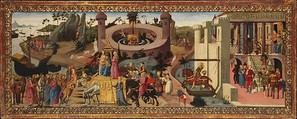
These two paintings likely once adorned a marriage chest (cassone) or served as decorative paneling (spalliera) in a domestic setting. The ancient Greek myth of Jason and the Argonauts unfolds across them in a continuous narrative, the same characters appearing in multiple episodes. At the top left of the first (upper) panel, Jason, rightful king of Thessaly—who wears distinctive gold armor throughout—confronts the usurper Pelias, who agrees to hand over the throne if Jason can retrieve the Golden Fleece. In the second (lower) panel, Jason and his companions work to steal the fleece. For more information about these two paintings, including a complete account of the narrative, visit their collection records at The Met website.
#5216. Scenes from the Story of the Argonauts, Part 1
0:00
0:00
Playlist
5216. Scenes from the Story of the Argonauts, Part 1
5064. Scenes from the Story of the Argonauts, Part 2
This artwork is meant to be viewed from right to left. Scroll left to view more.
This image cannot be enlarged, viewed at full screen, or downloaded.
Fig. 1. Diagram identifying the episodes depicted in 09.136.2
This image cannot be enlarged, viewed at full screen, or downloaded.
Fig. 2. Diagram identifying the episodes depicted in 09.136.1
Artwork Details
Use your arrow keys to navigate the tabs below, and your tab key to choose an item
Title:Scenes from the Story of the Argonauts
Artist:Biagio d'Antonio (Italian, Florentine, active by 1472–died 1516)
Medium:Tempera on wood, gilt ornaments
Dimensions:Overall 24 1/8 x 60 3/8 in. (61.3 x 153.4 cm); painted surface 19 5/8 x 56 in. (49.8 x 142.2 cm)
Classification:Paintings
Credit Line:Gift of J. Pierpont Morgan, 1909
Object Number:09.136.1
This panel and its companion (09.136.2) recount episodes from the story of Jason and the Golden Fleece in vivid detail. They have been considered both cassone fronts and spalliere, or wainscoting, panels. Though their dimensions are consistent with those of many cassone panels, they have independent moldings and show none of the damages characteristic of cassone panels and were, therefore, certainly designed to be installed where they would not have been kicked or accessible to children.
Christiansen and Pope-Hennessy (1980) first pointed out the parallels in spatial construction between Lorenzo Ghiberti's Story of Isaac, from his second set of bronze doors for the Baptistry in Florence, designed in the 1430s, and the Story of the Argonauts panels. Definition of space is especially effective in the articulation of the many subplots in the epic tale of Jason's travels and tribulations in procuring the fleece. Like Ghiberti, the artists here treat the panels like a stage on which several episodes take place at varying distances from the viewer. Setting up architectural and landscape settings for the characters to inhabit is an essential element in this sophisticated narrative strategy.
Many, but not all, of the episodes depicted on these panels come from the classical versions of the story: the epic poem Argonautica by Apollonius of Rhodes, written in the third century B.C., which would have been available in its Latin paraphrase by the Alexandrian poet Valerius Flaccus as well as in numerous Greek manuscript versions that were in Florence by the second half of the fifteenth century and were being studied and translated in Medicean circles, which the unknown patron of these panels likely frequented.
The distribution of the episodes in various parts of the setting suggests that the viewer was expected to be familiar with the story (see figs. 1 and 2 above). The story begins in the upper left of the first panel (09.136.2), with the charge of King Pelias to Jason, his nephew, to retrieve the Golden Fleece from a heavily guarded cave in distant Colchis, on the Black Sea (1). Pelias is later murdered by his daughters, and this is shown in another room of the palace (2). Easily recognizable in golden armor, a pink cloak, and a winged helmet, Jason is shown in the next scene rounding up adventurers to join him on his quest (3). In the center background he finds Orpheus, shown on an island playing his viol (4). Jason and Orpheus are then seen consulting the centaur Chiron atop Mount Pelion (5). Below them is shown the Calydonian boar hunt (6). After the Argonauts' arrival at Mysia, in Asia Minor, Hercules' squire, Hylas, goes in search of fresh water, but is set upon by nymphs (7). Hercules and Polyphemus set off to find him, and the Argonauts unwittingly depart in the middle of the night without the three men (8).
On the left side of the second panel (09.136.1), Jason and the Argonauts arrive in Colchis (9) and are greeted by King Aeëtes, who rides a triumphal chariot flanked by his two daughers, Medea and Chalciope (10). The king explains that in order to obtain the Golden Fleece, Jason must plow the grove of Ares with fire-breathing bulls, sow the furrows with dragon's teeth, and slay the warriors who spring from them. With the magical aid of the sorceress Medea, Jason is able to accomplish all this; Orpheus then plays his viol to put the dragon guarding the Golden Fleece to sleep, Jason slays the dragon, and steals the fleece (11). The right-hand scene may show Aeëtes sending his son in pursuit (12). He is then seen astride his horse, hat flying off as he rides in haste across the castle's drawbridge (13). In the left background Jason and Medea return to Iolcus (14), and Medea’s magic rejuvenates Jason's father with the aid of Diana, who is shown with her dogs as an apparition in white (15).
There has been almost constant controversy about the panels' authorship since they appeared on the art market in the first years of the twentieth century. Sold by the dealer and collector Stefano Bardini in 1899 as by Pesellino, in 1901 Logan tentatively attributed them to Jacopo del Sellaio, and in 1932 Bernard Berenson suggested that they were by Giovanni Battista Utili da Faenza, whose oeuvre eventually became associated with the name of Biagio d'Antonio (Fahy 1989), an artist active in both Florence and Faenza (a later panel by the same artist illustrating the Biblical story of Joseph also belongs to The Met: 32.100.69). Fahy called attention to the fact, first noted by Wehle in 1940, that the two panels are not by the same artist, ascribing 09.136.1 to Biagio and 09.136.2 to the Master of the Argonauts, perhaps to be identified with Francesco Rosselli (1448–before 1513), brother of the better-known Cosimo. Subsequently, the second hand has been identified as that of Jacopo del Sellaio, who in 1472 collaborated with Biagio on a pair of wedding chests (cassoni) for Matteo di Morelli and his betrothed, Vaggia Nerli (Courtauld Institute Galleries, London). That the two are by different hands is supported by a comparison of underdrawings, visible with the aid of infrared reflectography. Collaboration on series of panels such as these was common practice (see, for example, the panels by Granacci in The Met: 1970.134.1, 1970.134.2).
[2017; adapted from Krohn 2008]
Palazzo Torrigiani, Florence; [Stefano Bardini, Florence, until 1899; his sale, Christie's, London, June 5, 1899, no. 360, as by "Pesellino?"]; [Colnaghi, London, 1899]; Leopold II, King of Belgium, Brussels (1899–1909); [Julius Böhler, Munich, 1909]; [Julius Böhler, Munich, and Kleinberger, Paris, 1909; sold for £5,000 to Morgan]; J. Pierpont Morgan, New York (1909)
Westport, Conn. Westport Community Art Association. February 12–24, 1955, no catalogue?
Stamford, Conn. Stamford Museum and Nature Center. "Renaissance Paintings," May 2–17, 1964, no catalogue.
New York. The Metropolitan Museum of Art. "Florentine Paintings in the Metropolitan Museum," June 15–August 15, 1971, no catalogue.
New York. The Metropolitan Museum of Art. "Art and Love in Renaissance Italy," November 11, 2008–February 16, 2009, no. 59b.
Fort Worth. Kimbell Art Museum. "Art and Love in Renaissance Italy," March 15–June 14, 2009, no. 59b.
Werner Weisbach. Francesco Pesellino und die Romantik der Renaissance. Berlin, 1901, pp. 120, 122–25, ill., calls this painting and its companion (MMA 09.136.2) cassone panels, and groups them with battle scenes that he attributes to a follower of Pesellino.
Mary Logan. "Compagno di Pesellino et quelques peintures de l'école (2e article)." Gazette des beaux-arts, 3rd ser., 26 (October 1901), pp. 334–35, calls them cassone panels and tentatively ascribes them to Jacopo del Sellaio.
Attilio Schiaparelli. La casa fiorentina e i suoi arredi nei secoli XIV e XV. Ed. Maria Sframeli and Laura Pagnotta. 1983 ed. Florence, 1908, vol. 1, p. 285; vol. 2, p. 83 n. 250.
B[ryson]. B[urroughs]. "Principal Accessions: Cassone Panels by Pesellino." Metropolitan Museum of Art Bulletin 4 (December 1909), pp. 224–25, ill. p. 222, as cassone panels by the a pupil of Pesellino; dates them to the second half of the fifteenth century.
Morton H. Bernath. New York und Boston. Leipzig, 1912, pp. 71–72, fig. 71, calls them good workshop pieces very close to Pesellino.
Bryson Burroughs. Catalogue of Paintings. 1st ed. New York, 1914, p. 206, states that "these two panels formed part of a chest" and attributes them to the school of Pesellino.
Paul Schubring. Cassoni: Truhen und Truhenbilder der italienischen Frührenaissance. Leipzig, 1915, text vol., pp. 116, 286, nos. 296–97; plate vol., pl. LXXI, attributes them to a follower of Pesellino and dates them about 1470.
Osvald Sirén. A Descriptive Catalogue of the Pictures in the Jarves Collection, Belonging to Yale University. New Haven, 1916, pp. 125–28, ascribes them to the immediate follower of Pesellino who painted a cassone in the Ashmolean Museum, Oxford, and the Virgin Adoring the Christ Child in the Yale University Art Gallery, New Haven.
Osvald Sirén. "Early Italian Pictures at Cambridge." Burlington Magazine 37 (December 1920), pp. 300, 303, as by a follower of Pesellino, active about 1460–70, who also painted two cassoni panels with scenes of the Trojan War in the Fitzwilliam Museum, Cambridge.
Paul Schubring. Cassoni: Supplement. Leipzig, 1923, p. 4, calls the artist the "Meister der Argonautenbilder" after the MMA paintings, attributing to him the two panels in the Fitzwilliam Museum, and, tentatively, another two in the Franchetti collection, Venice.
Paul Schubring. "Cassone Pictures in America: Part One." Art in America 11 (August 1923), pp. 242–43, fig. 8, as by a pupil of Pesellino, active about 1470.
Raimond van Marle. The Development of the Italian Schools of Painting. Vol. 10, The Renaissance Painters of Florence in the 15th Century. The Hague, 1928, pp. 566–67, ascribes them to the school of Pesellino and accepts Schubring's [see Ref. 1915] dating.
Bernhard Berenson. Italian Pictures of the Renaissance. Oxford, 1932, p. 585, lists them as cassone panels by Utili da Faenza.
Bernhard Berenson. Pitture italiane del rinascimento. Milan, 1936, p. 503.
Harry B. Wehle. The Metropolitan Museum of Art: A Catalogue of Italian, Spanish, and Byzantine Paintings. New York, 1940, pp. 35–37, ill., calls them cassone panels by "two different followers, perhaps studio helpers, of Pesellino," observing that this is the more finished of the two.
"Notes on the Cover." Metropolitan Museum of Art Bulletin 2 (February 1944), opp. p. 177, ill. (overall, and color detail on cover).
Millia Davenport. The Book of Costume. New York, 1948, vol. 1, p. 261, no. 730, ill. p. 262.
Allgemeines Lexikon der bildenden Künstler. Ed. Hans Vollmer. Vol. 37, Leipzig, 1950, p. 24, mentions them as the eponymous works of the Master of the Argonaut Panels.
Josephine L. Allen and Elizabeth E. Gardner. A Concise Catalogue of the European Paintings in The Metropolitan Museum of Art. New York, 1954, p. 77.
Hans-Werner Grohn. "Zwei Cassoni mit Darstellungen aus der Erzählung von Amor und Psyche." Staatliche Museen zu Berlin: Forschungen und Berichte 1 (1957), pp. 94, 97, 99, fig. 4, attributes them to the Master of the Argonaut Panels.
Bernard Berenson. Italian Pictures of the Renaissance: Florentine School. London, 1963, vol. 1, p. 211; vol. 2, pl. 1033, lists them with the works of "'Utili' (Biagio di Antonio?)".
Federico Zeri with the assistance of Elizabeth E. Gardner. Italian Paintings: A Catalogue of the Collection of The Metropolitan Museum of Art, Florentine School. New York, 1971, pp. 143–45, ill., give this panel to Biagio d'Antonio and 09.136.2 to an assistant in his shop working from designs by the master; suggest a date about 1465 and call them decorations for two companion marriage chests.
Burton B. Fredericksen and Federico Zeri. Census of Pre-Nineteenth-Century Italian Paintings in North American Public Collections. Cambridge, Mass., 1972, pp. 28, 472, 606.
Everett Fahy. Some Followers of Domenico Ghirlandajo. PhD diss., Harvard University. New York, 1976, p. 207, calls them cassone fronts.
Edward Morris and Martin Hopkinson. Walker Art Gallery, Liverpool: Foreign Catalogue. [Liverpool], 1977, text vol., p. 70, under no. 2809.
Annarosa Garzelli. La Bibbia di Federico da Montefeltro: un'officina libraria fiorentina, 1476-1478. Rome, 1977, p. 105, figs. 69, 71 (details).
John Pope-Hennessy and Keith Christiansen. "Secular Painting in 15th-Century Tuscany: Birth Trays, Cassone Panels, and Portraits." Metropolitan Museum of Art Bulletin 38 (Summer 1980), pp. 16, 29, 33, 35, figs. 27–30 (color, overall and details), state that they were designed by Biagio d'Antonio about 1465, and are "probably from the backrest (spalliera) of a cassone rather than its front"; note that the architectural organization in both derives from that in Ghiberti's Story of Isaac relief on the doors of the Florence Baptistry.
Maria Sframeli and Laura Pagnotta, ed. La casa fiorentina e i suoi arredi nei secoli XIV e XV.. By Attilio Schiaparelli. Florence, 1983, vol. 2, p. 83 n. 250.
Everett Fahy. "The Tornabuoni-Albizzi Panels." Scritti di storia dell'arte in onore di Federico Zeri. Milan, 1984, pp. 236, 241, 244, refers to them as "a pair of cassone fronts dating from about 1465"; ascribes 09.136.2 to an assistant of Biagio d'Antonio.
Cristina De Benedictis inIl Museo Bardini a Firenze. Milan, 1984, vol. 1, p. 122, lists them both as by Biagio d'Antonio.
Everett Fahy. "The Argonaut Master." Gazette des beaux-arts, 6th ser., 114 (December 1989), pp. 285–87, 289, 291, 297 nn. 1, 9–10, figs. 2 and 4 (overall and detail), attributes this panel to Biagio d'Antonio and 09.136.2 to the Argonaut Master, dating them about 1465; believes "they probably were engaged in the wainscoting of a room, or they could have been the 'spalliere,' backrests, of two cassoni"; reconsiders the attributions of panels formerly ascribed to the Argonaut Master, giving many of them to Biagio d'Antonio and citing Konrad Oberhuber's tentative identification of the anonymous artist with Cosimo Rosselli's brother, Francesco.
Roberta Bartoli inMaestri e botteghe: pittura a Firenze alla fine del Quattrocento. Ed. Mina Gregori et al. Exh. cat., Palazzo Strozzi, Florence. Milan, 1992, p. 243, under no. 9.6, refers to it as a work by Biagio, implying a date of about 1469–72.
Colnaghi in America: A Survey to Commemorate the First Decade of Colnaghi New York. Ed. Nicholas H. J. Hall. New York, 1992, p. 131.
Anne B. Barriault. "Spalliera" Paintings of Renaissance Tuscany: Fables of Poets for Patrician Homes. University Park, Pa., 1994, pp. xi, 69, 71, fig. 23.2, illustrates this panel as "design and painting given to Biagio di Antonio" and 09.136.2 as "design given to Biagio di Antonio," dating them about 1465; observes that the size of the panels and the "visualization of the story share the hallmarks of cassone paintings produced by Apollonio di Giovanni in the 1460s"; doubts that they were spalliere for cassoni [see Ref. Pope-Hennessy and Christiansen 1980], stating instead that their scale and formal elements are closer to those of cassone paintings.
Roberto Longhi. Il palazzo non finito: saggi inediti, 1910-1926. Ed. Francesco Frangi and Cristina Montagnani. Milan, 1995, pp. 257, 268–72, 285, 291–92, 294 n. 3, p. 562, fig. 100 (color), attributes them to Utili [see Ref. Longhi 1937], and dates them after 1470.
Katharine Baetjer. European Paintings in The Metropolitan Museum of Art by Artists Born Before 1865: A Summary Catalogue. New York, 1995, p. 29, ill.
Roberta Bartoli inThe Dictionary of Art. Ed. Jane Turner. Vol. 3, New York, 1996, p. 917, dates it about 1465.
Graham Hughes. Renaissance Cassoni, Masterpieces of Early Italian Art: Painted Marriage Chests 1400–1550. Alfriston, England, 1997, pp. 155, 210, 212–13, 232, ill. p. 154 (color detail), calls them cassone panels and thinks both are by the same artist.
Roberta Bartoli. Biagio d'Antonio. Milan, 1999, p. 19 n. 25, pp. 27, 44 n. 30, pp. 147–48, 151, 154, 155, 161, 174–75 nn. 41, 52, pp. 182–85, 230, 235–36, no. 11b, ill. (color, overall and detail), attributes it to Biagio d'Antonio and 09.136.2 to the Master of the Argonauts, identified here as Bernardo di Stefano Rosselli (1450–1526); calls them "spalliera" paintings, and dates them to the end of the 1460s.
Fonds d'or et fonds peints italiens (1300–1560). Exh. cat., G. Sarti. Paris, 2002, pp. 121, 127, attributes this panel to Biagio d'Antonio and 09.136.2 to Bernardo di Stefano Rosselli, dating them about 1470.
Dennis Geronimus. Piero di Cosimo: Visions Beautiful and Strange. New Haven, 2006, p. 322 n. 176.
Caroline Campbell. "Lorenzo Tornabuoni's 'History of Jason and Medea' series: Chivalry and Classicism in 1480s Florence." Renaissance Studies 21 (February 2007), pp. 5–6, fig. 5, states that the pair of panels probably dates to the 1470s and adds that the narrative is clearly based on versions of the story of Jason and Medea by Apollonius of Rhodes and Valerius Flaccus.
Deborah L. Krohn inArt and Love in Renaissance Italy. Ed. Andrea Bayer. Exh. cat., The Metropolitan Museum of Art. New York, 2008, pp. 109, 137–38, 293, no. 59b, ill. (color), dates the two panels about 1465, but also calls them "roughly contemporary with" Jacopo del Sellaio's panel with the story of Cupid and Psyche (private collection, New York) of 1475.
James Grantham Turner inArt and Love in Renaissance Italy. Ed. Andrea Bayer. Exh. cat., The Metropolitan Museum of Art. New York, 2008, p. 181.
Andrea Bayer inArt and Love in Renaissance Italy. Ed. Andrea Bayer. Exh. cat., The Metropolitan Museum of Art. New York, 2008, p. 305.
Alan Chong inThe Triumph of Marriage: Painted Cassoni of the Renaissance. Exh. cat., Isabella Stewart Gardner Museum. Boston, 2008, p. 85, fig. 53 (color).
Nicoletta Pons inVirtù d'amore: pittura nuziale nel Quattrocento fiorentino. Ed. Claudio Paolini et al. Exh. cat., Galleria dell'Accademia. Florence, 2010, p. 128.
Roberta Bartoli inVirtù d'amore: pittura nuziale nel Quattrocento fiorentino. Ed. Claudio Paolini et al. Exh. cat., Galleria dell'Accademia. Florence, 2010, fig. 4 on p. 155, reproduces a photograph of the installation of the Bardini collection in Paris in 1899.
Everett Fahy inThe Renaissance Portrait from Donatello to Bellini. Ed. Keith Christiansen and Stefan Weppelmann. Exh. cat., Bode-Museum, Berlin. New York, 2011, p. 134 [German ed., "Gesichter der Renaissance: Meisterwerke italienischer Portrait-Kunst," Berlin], states that Biagio worked with Jacopo del Sellaio on one of these two panels.
Alessio Formolo inLe opere e i giorni: exempla virtutis, favole antiche, e vita quotidiana nel racconto dei cassoni rinascimentali. Ed. Andrea De Marchi and Lorenzo Sbaraglio. Exh. cat., Museo Stibbert, Florence. Signa, 2015, p. 131.
The panels are in simple gilt modern frames, but the engaged decorative moldings of oak leaves and acorns, which may be heraldic, are original. The panels may have been set into a piece of furniture or the wainscoting of a room.
Fra Filippo Lippi (Italian, Florence ca. 1406–1469 Spoleto)
ca. 1440
Resources for Research
The Met's Libraries and Research Centers provide unparalleled resources for research and welcome an international community of students and scholars.
The Met Collection API is where all makers, creators, researchers, and dreamers can connect to the most up-to-date data and public domain images for The Met collection. Open Access data and public domain images are available for unrestricted commercial and noncommercial use without permission or fee.
Feedback
We continue to research and examine historical and cultural context for objects in The Met collection. If you have comments or questions about this object record, please complete and submit this form. The Museum looks forward to receiving your comments.