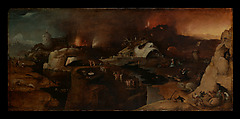
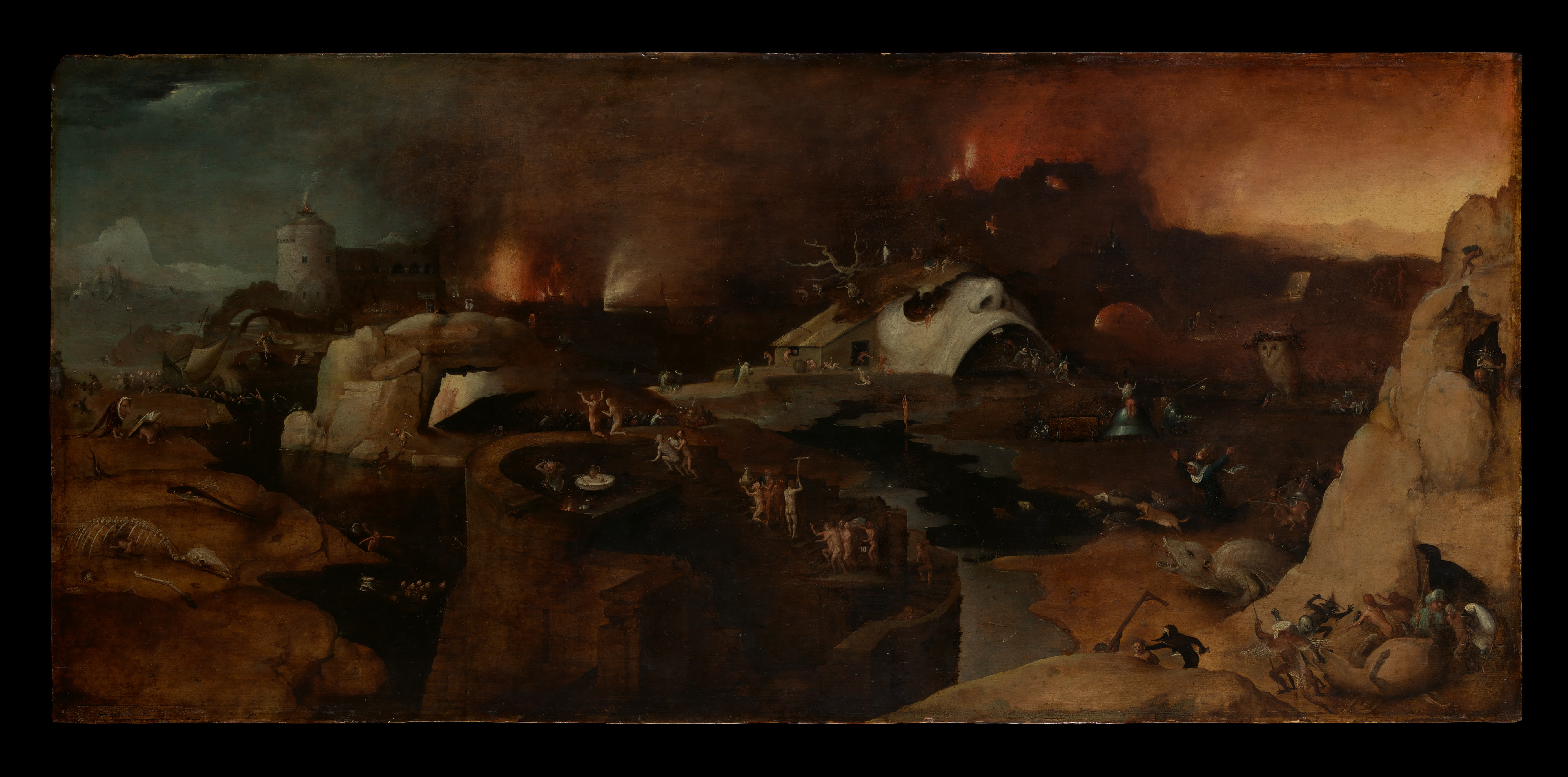
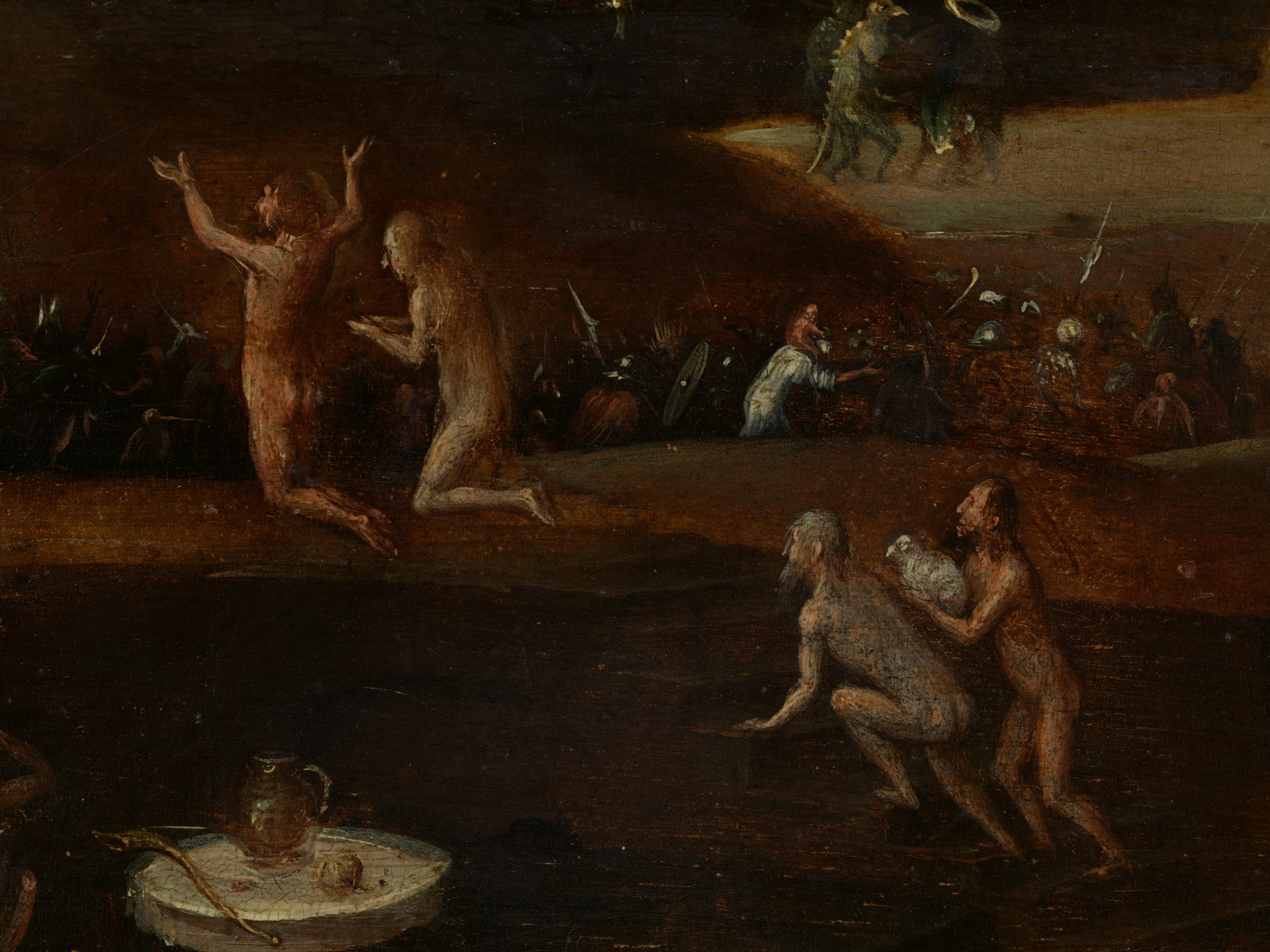
The Painting: This vividly populated panorama of the underworld presents Christ’s descent into the first circle of Hell (limbo) between his death on the cross and his Resurrection in order to redeem the souls of the Just of the Ancient Law. The Harrowing of Hell, as this event is often called, is outlined in the Gospel of Nicodemus in the
Apocryphal New Testament (16:1–13) and was incorporated into Jacobus de Voragine’s
Legenda Aurea (Golden Legend), which was widely spread in fifteenth and sixteenth-century Northern Europe. The accounts report that Christ demanded with a voice like thunder and wind, "Lift up your gates, O ye princes [of Hell] . . . and the King of Glory shall come in." Accordingly, Christ emerges in the painting through the gate of hell, illuminated by a divine light, appearing with a red mantle on his shoulders and a victory banner, while armed demons try to prevent the gate from opening. The surrounding landscape is defined by fires, which silhouette buildings and hills that are separated by a meandering dark river, recalling Styx, Hades’ river in Greek mythology.
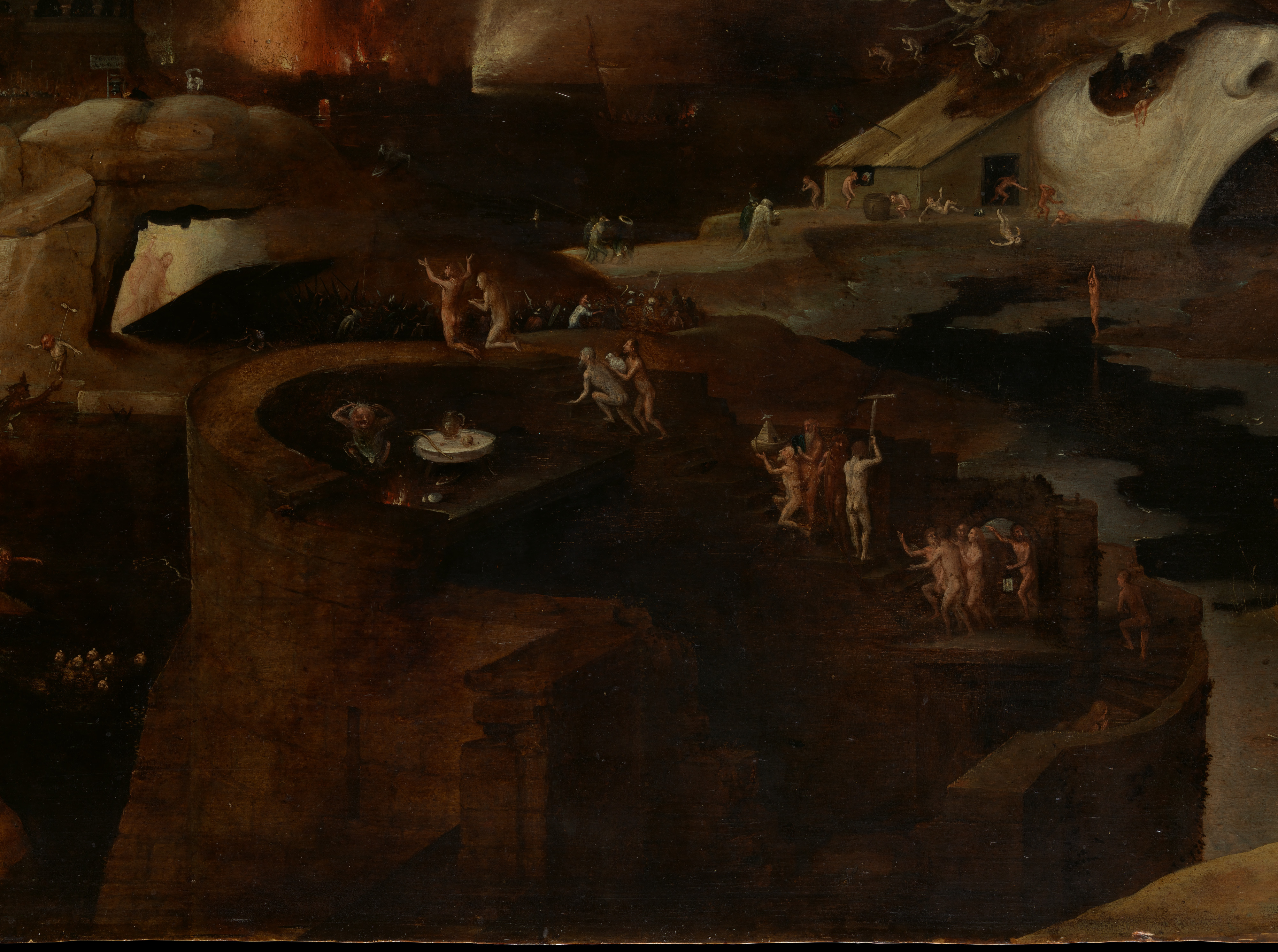
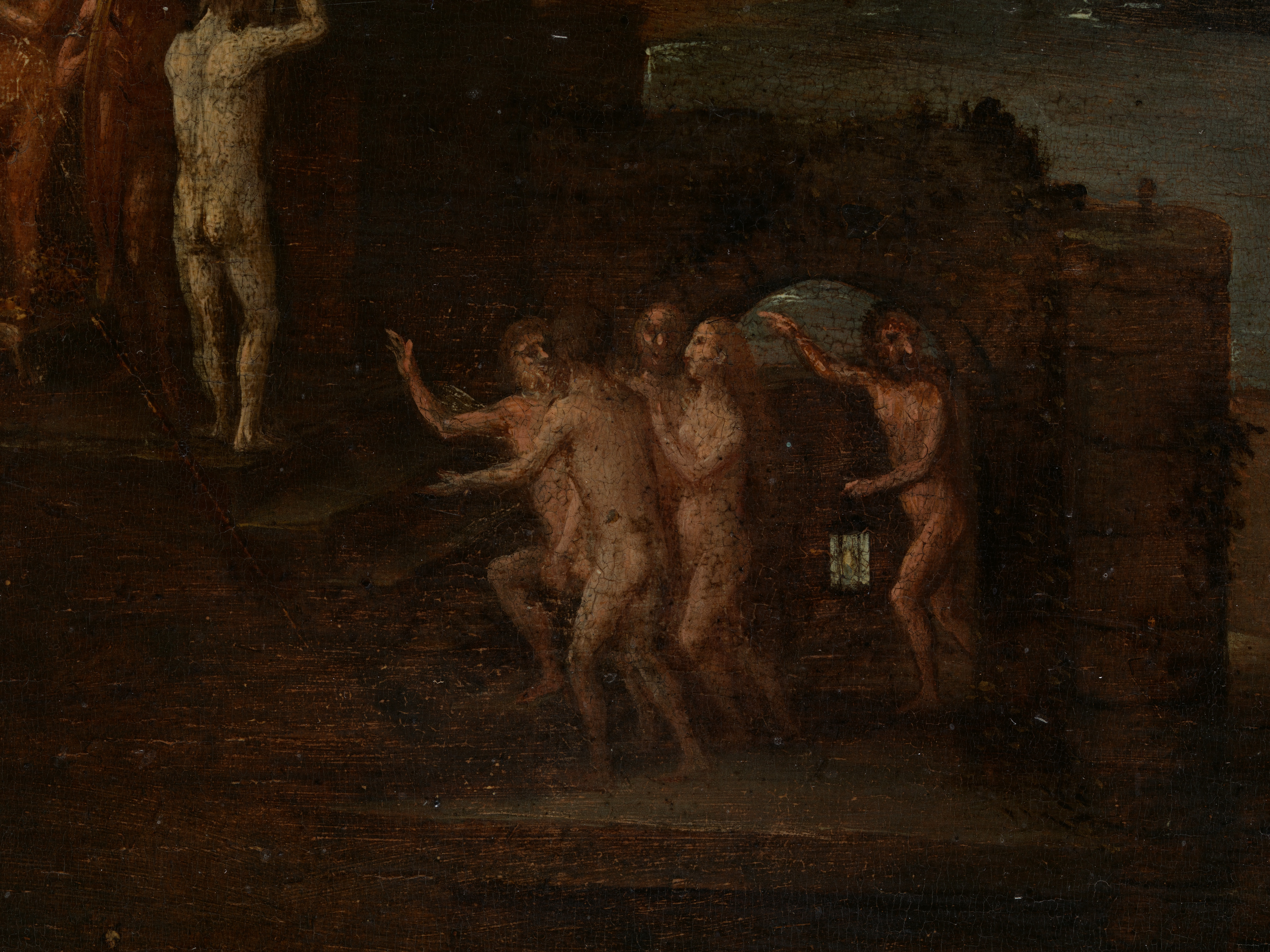
In anticipation of the Savior, the Old Testament patriarchs and prophets populate a massive ruin in the painting’s foreground, evoking the Tower of Babel (see fig. 1 above). Besides Adam and Eve, the tower is climbed by Abraham and Isaac with the expiatory ram, Noah with a model of the Ark, Moses with the Tablets of the Law, David with his harp, the Repentant Thief from the Crucifixion with his cross, and presumably Lot accompanied by his daughters. The figure at the rear carrying a lantern and pointing the way was identified as Diogenes by Bergmans (1963) (fig. 2). However, new investigations by Thürlemann (letter in departmental files) suggest that the figure might represent the ninth of the twelve Minor Prophets of the Canon of the Old Testament, Zephaniah, known in Greco-Latin (in the Vulgate and the Septuagint) as Sophonias. Similarly to Diogenes, Zephaniah is depicted in Christian art with the lantern referring to Zephaniah I:12: "I will search Jerusalem with lamps."
Besides the main narrative, Saint Christopher, who, carrying the Christ Child on his shoulders and attracting our attention by wearing a white garment, can be spotted in the tumult of the devil’s legion behind the tower (fig. 3). As the
Golden Legend tells, Saint Christopher served the devil’s army in his search for the greatest and most powerful ruler in the world before finding his lord in Christ. The depiction of Saint Christopher as part of the devil’s legion is unconventional, but not his appearance in a demonic, hellish environment. The representation of the saint in paintings and prints experienced new iconographic portrayals and reached a high point in Northern Europe around 1550. Depicted in combination with demonic motifs, images of the Christian saint could carry an apotropaic meaning due to his overcoming Satan. At the same time his legend also could be read as an allegory for the human pilgrimage to Christ challenged by trials of mischief and temptation (Unverfehrt 1980). The Met’s painting specifically evokes this latter allegorical meaning.
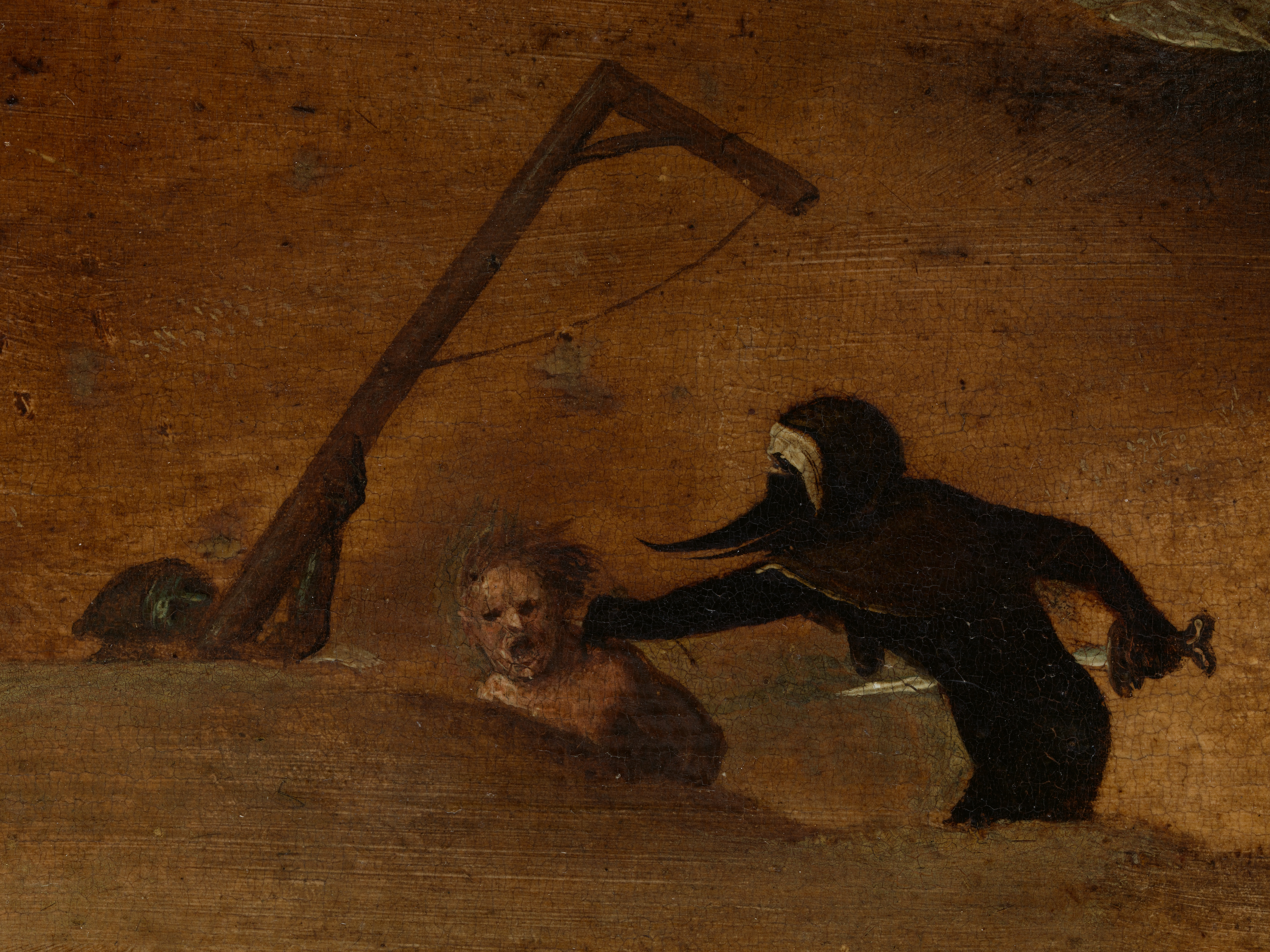
In contrast, the painting confronts its viewer with Judas, prominently holding his moneybag at the base of the right rock (fig. 4). Planning to slip off with the Old Testament figures, he is stopped by devilish creatures and prevented from seeking redemption, for he committed suicide by hanging, a deed strongly repudiated by the Church in the sixteenth century. The gallows and hanging scene, flanking the group to the left, buttresses this implication (fig. 5). The figure of Judas in such a pictorial context was emphasized by Karel van Mander in his description of a painted Hell that he had seen in Amsterdam and attributed to Hieronymus Bosch in his
Schilder-Boek (1604). Van Mander’s description might refer to an authentic panel by Bosch, which is lost today, or to The Met’s painting, as Büttner suggested (2014).
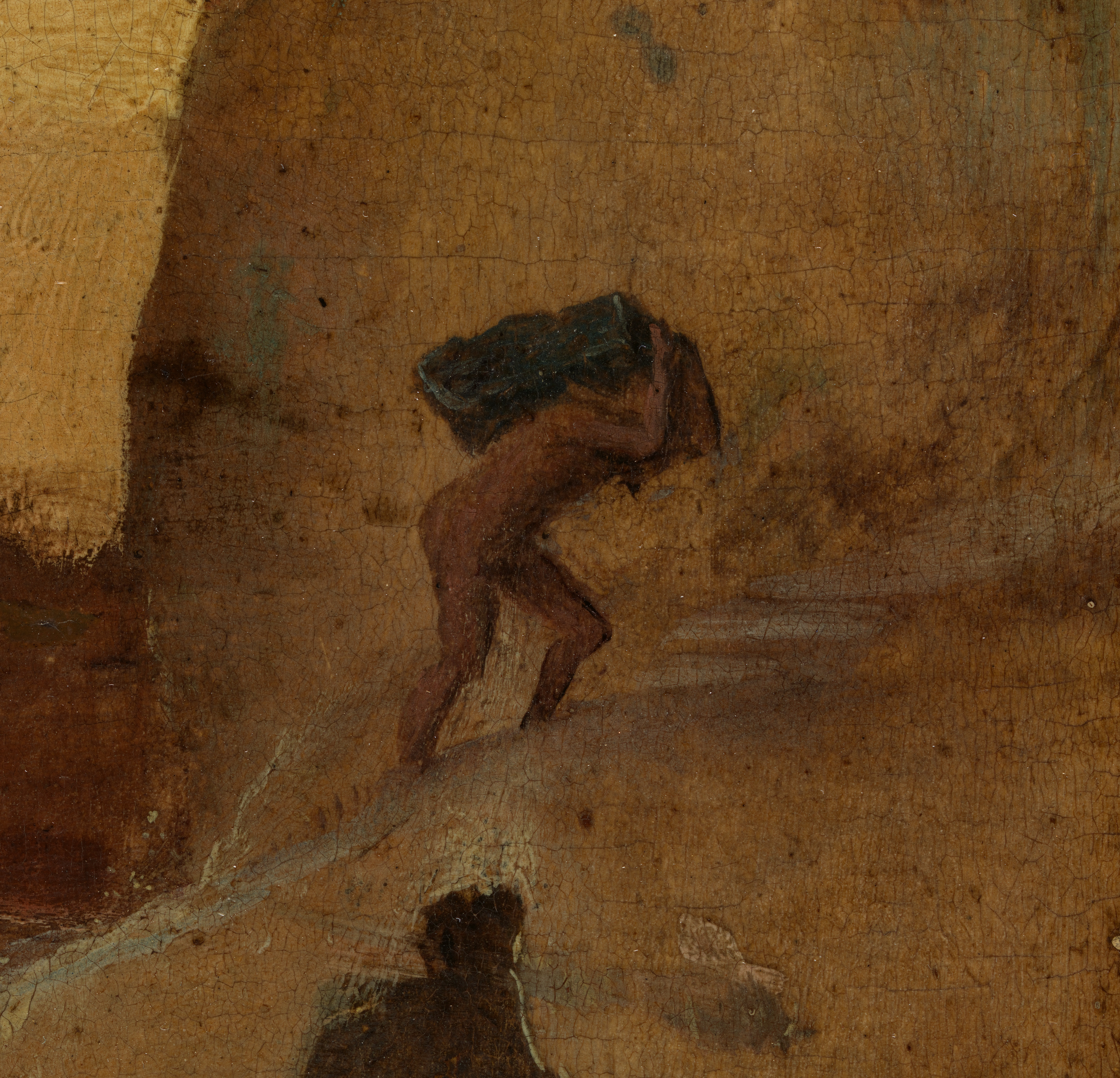
Moreover, Sisyphus, who climbs to the top of the right rock, first identified and to this day only mentioned by Donath (1926), plays a pivotal role for the image’s subtext (fig. 6). In Greek mythology, Sisyphus was punished for his self-aggrandizing deceitfulness by being forced to roll an immense boulder up a hill in the underworld, only to watch it roll back down, repeating his action for eternity. In Christian thought and in contradiction to such saints as Saint Christopher, Sisyphus became the epitome of vain effort and senseless life. On the other hand, his endless aspiration to reach the rock’s summit was received in humanist literature since Petrarch as an encouraging moral metaphor for the human struggle to overcome a sinful lifestyle (see Elliott M. Simon,
The Myth of Sisyphus: Renaissance Theories of Human Perfectibility, Madison [N.J.], 2007). An allusion to immoral living is also ascribed to the burning ship and shipwreck in the painting’s background. This recalls the image of the Christian community as a ship, inverted to serve as a satire on folly and vice in Sebastian Brant’s Ship of Fools (1494), in whose conception the latter is ultimately an image of the followers of the Antichrist (see Larry Silver,
Hieronymus Bosch, New York/London, 2008).
Together, the painting’s interwoven narratives offer a deep eschatological subtext for its audience, providing them with an encouragement to devote their lives to Christ and renounce immoral living in anticipation of the Last Judgment.
The Bosch Revival and the Painting’s Versions: This dystopian vision of the underworld is closely related to the visual vocabulary of Hieronymus Bosch (ca. 1450–1516), who was born and active in ‘s-Hertogenbosch in the Northern Netherlands (see The Met,
13.26). Countless sixteenth-century prints after and in the spirit of Bosch as well as copies and imitations on panel and canvas testify to the artist’s popularity and the increasing interest in the demonic aspects of his work, which was appreciated by both local and foreign collectors. Apocalyptic Hell landscapes were popular due to a belief held by many in Northern Europe that the end of the world was imminent, reflected in contemporary literature. Consequently, a number of sixteenth-century paintings depicting Christ’s descent into Hell in Bosch’s manner have come down to us. However, despite Van Mander’s description of a "Hell […] in which patriarchs are released, and Judas, who is planning to slip off with them is hauled up and hanged with a noose," no representation of the subject, which might have functioned as a direct model for The Met's painting, can be identified in Bosch’s painted or drawn oeuvre (see Karel van Mander,
The Lives of the Illustrious Netherlandish and German Painters . . . , ed. by H. Miedema, vol. 1, Doornsijk, 1994). Moreover, there is no known source in Bosch for the picture type of a long horizontal format, which more likely arises from developments in Netherlandish landscape painting. Nevertheless, many of The Met paintings' motifs are reminiscent of Bosch’s triptych
The Last Judgment (Groeningemuseum, Bruges).
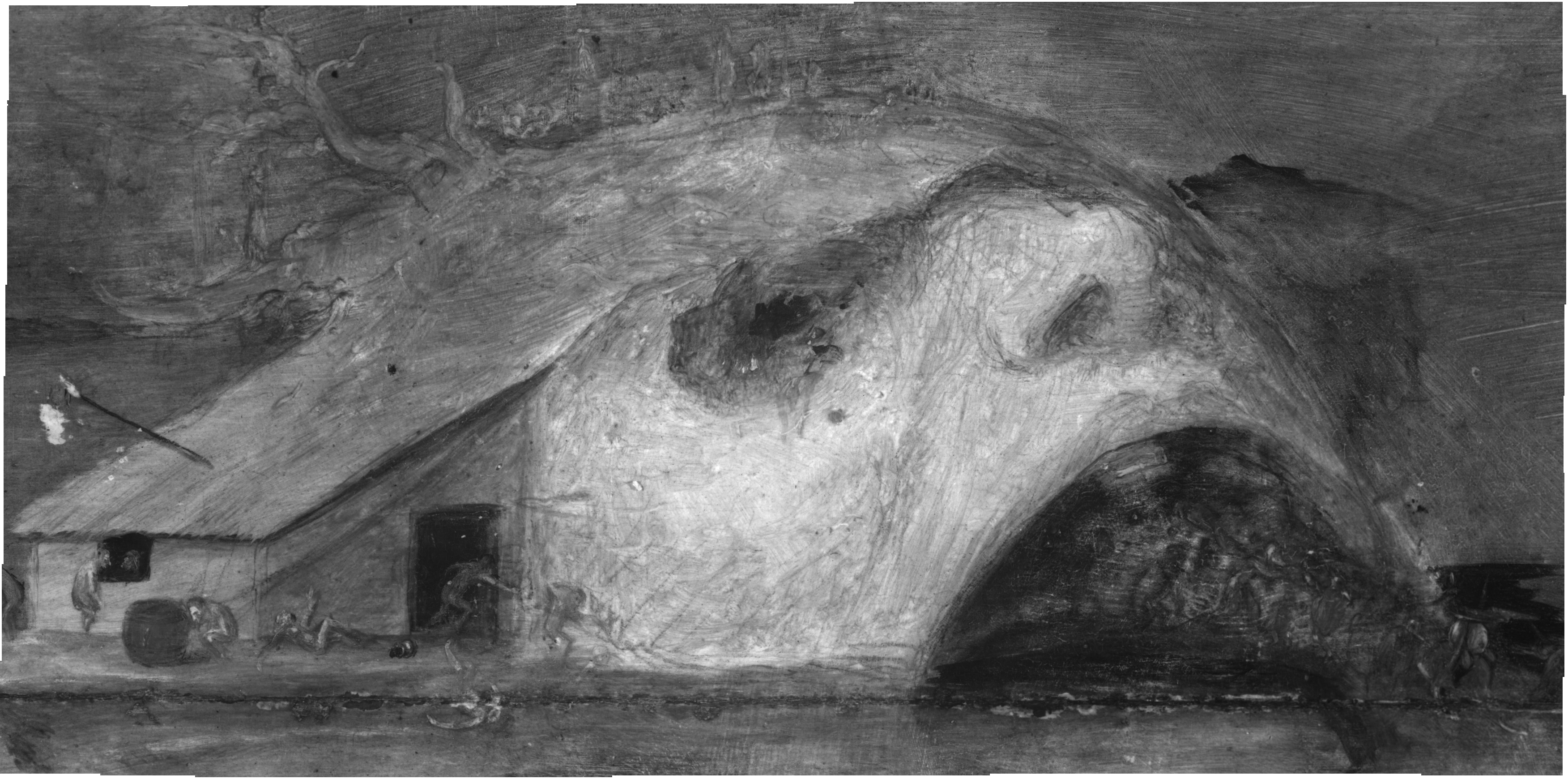
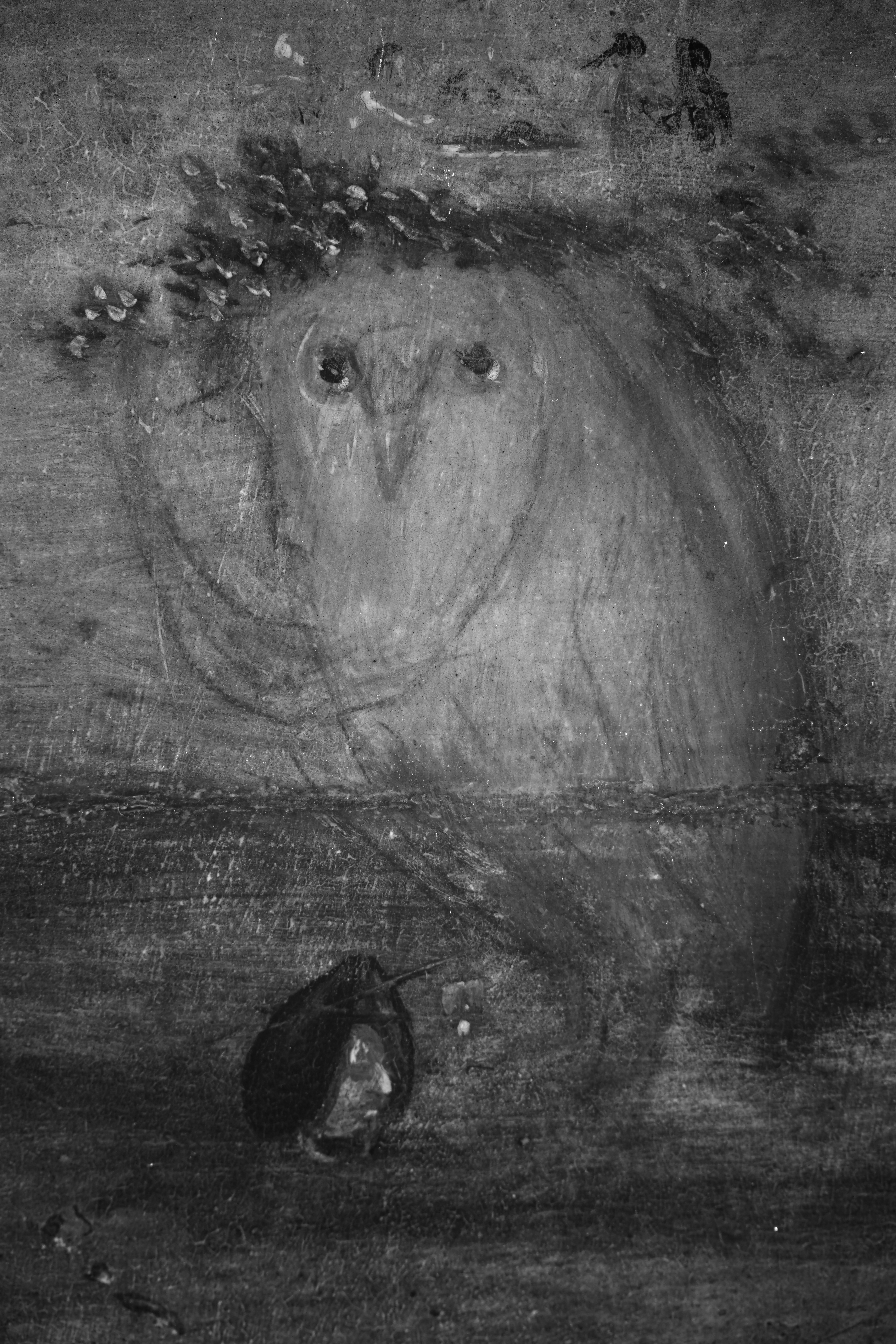
There are two known very close versions of The Met’s panel. The first (formerly in the collection Benedetto Valmarana-Mangilli in Venice; today in a private collection, Milan) is a precise copy of the New York painting (fig. 7). The changes introduced between the underdrawing and painting stages by the artist of The Met’s painting, which were discovered during its technical examination, indicate an original, creative process, rather than the slavish copy of a fixed design (see Technical Notes and figs. 8–9). This provides evidence to suggest that The Met’s painting is the primary version and the Milan painting is a copy. This should be verified by the eventual technical study of the Milan version. The precise repetition of the format, composition, motifs, and characteristics of the painting technique, such as the way highlights are placed, suggest that it was made in the presence of The Met's painting at a very early stage and before the latter had been trimmed at its bottom edge (see Technical Notes). Interestingly, the copyist slightly centered the composition of the New York panel. The varied palette as well as the different technical execution of the Milan copy suggest the hand of another artist. It has been attributed by Frimmel and Bergmans to the South Netherlandish artist Gillis Mostaert I, a pupil of Jan Mandijn (see Theodor von Frimmel,
Kleine Galeriestudien, vol. 1, Leipzig 1899; Bergmans 1963).
The relationship between The Met's painting and a second faithful variation of it (current location unknown; on the London art market in 1928, offered by Matthiesen, according to Unverfehrt; fig. 10) is more complicated due to minor differences in composition and motifs. Unverfehrt (1980) suggested a common model for both paintings, either by Bosch or his workshop. A final conclusion about the relationship must, however, remain open until the painting resurfaces.
All three panels can be associated with related paintings that reflect parts of their compositions and motifs. Whereas a painting with the same subject (Sotheby’s, London, July 8–9, 2015, no. 1, as Leiden School) clearly relates to the London painting (due to the repetition of the details of its tower), a Temptation of Saint Anthony (Christie’s, Amsterdam, September 5–6, 2000, no. 601, as follower of Jan Mandijn), has a closer connection to the New York version and its Milan copy. Giovanni Girolamo Savoldo’s early sixteenth-century Venetian panel
The Tribulations of Saint Anthony Abbot (Timken Museum of Art, San Diego) combines elements of Bosch’s altarpiece in Bruges with the rock and the group around Judas of the New York panel. The genesis and sequence of the paintings remain subject to discussion.
The Attribution and Date: While there never has been doubt about the fine quality of this painting, there has been some scholarly debate about its exact attribution and dating. Dendrochronological analysis revealed that the wood panel probably was not used before 1505 (see Technical Notes), leaving room for speculation on the date thereafter of the painting’s execution.
In 1926 the picture appeared on the Prague art market. That year, based on a black and white photograph, Friedländer stated that it "is a characteristic work by Hieronymus Bosch" (unpublished opinion in departmental files), and included it as an authentic panel by Bosch in his fifth volume of
Die Altniederländische Malerei in 1927. Donath (1926) and Burroughs (1927) also attributed the painting to Bosch, contrasting with Panofsky (1933; verbal opinion in departmental files), who stated that the painting may be by the Flemish Renaissance painter and Bosch follower Pieter Huys (ca. 1519–1584). Michel (1935) considered it a work later than Bosch, deriving from Bosch’s
Last Judgment in Vienna. De Tolnay (1937) listed it with doubtful works and dated it by its "Italianizing nudes" between 1540 and 1550 (which he changed to 1530–50 in 1966). Sterling (1939; verbal opinion in departmental archives) suggested Frans Mostaert, the brother of Gillis Mostaert I, as the author of the painting, before Wehle and Salinger (1947) attributed it to an anonymous follower of Bosch, dating it in the "first quarter of the sixteenth century."
Bergmans (1963) attributed the Milan copy to Gillis Mostaert I, and claimed that the figure of Diogenes with a lantern had not appeared in the North before 1559. Since Mostaert died in 1560, she dated The Met's painting and its Milan copy between 1559 and 1560. Two authors upheld Bergmans’s argument, namely Unverfehrt (1980) and Corwin (1976), of whom the latter attributed the New York painting to a "Bosch revival painter" contemporary to Mostaert, but not necessarily by him. Thürlemann (2015) weakened Bergmans’s argument in showing that the figure, which has been thought to be Diogenes, might represent Zephanias.
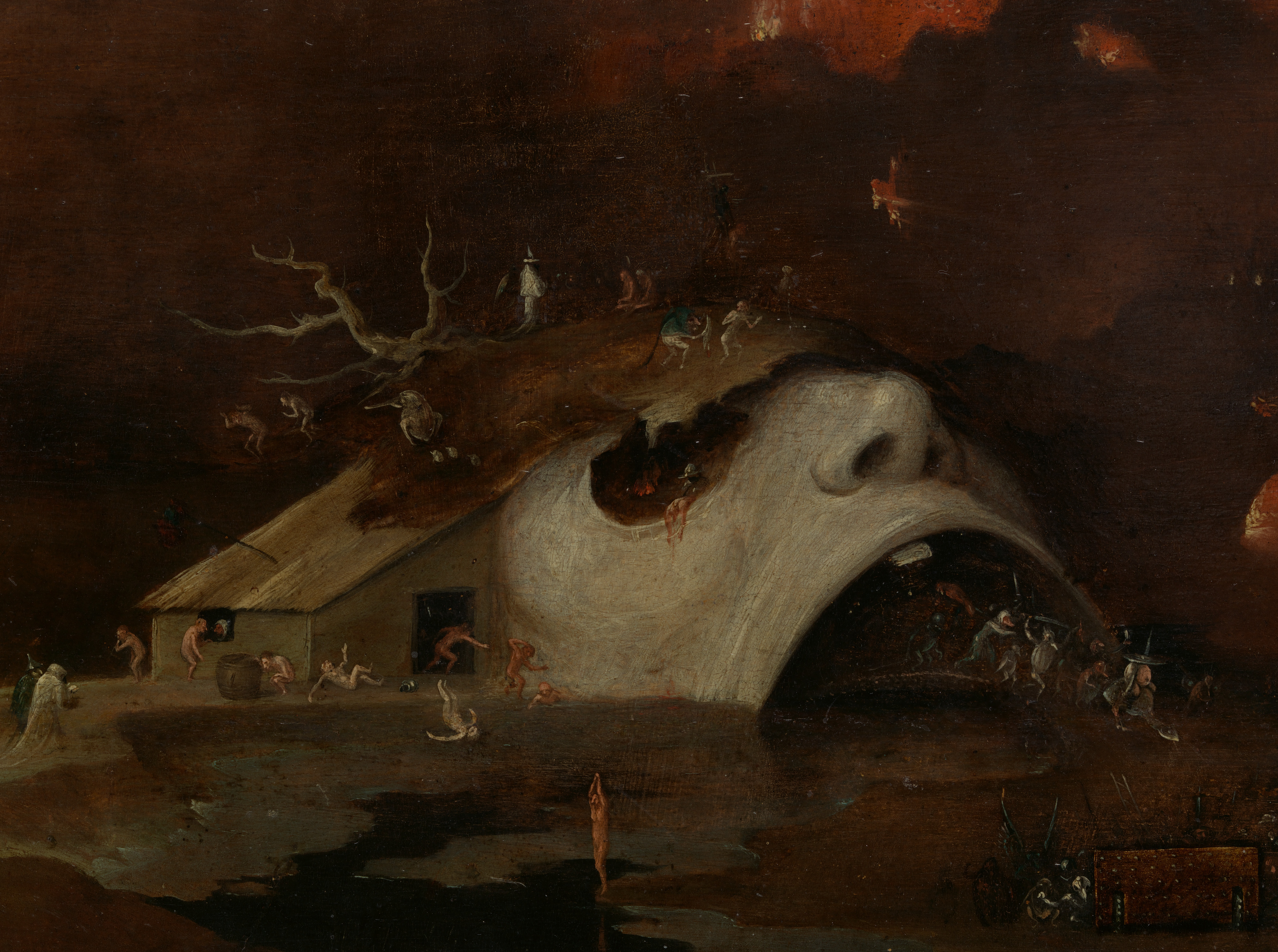
Sintobin (1998) pointed out that the house or passageway in the shape of a head (fig. 11) is a motif that must have derived from Pieter Bruegel the Elder's drawing
The Temptation of Saint Anthony (Ashmolean Museum, Oxford). This drawing dates to 1556, supporting the idea of the New York painting’s execution in the late 1550s or even later, she supposed. This, however, is not convincing for various paintings by Bosch followers, which represent such a head, indicate that the iconography of the head has not been newly introduced by Bruegel but more likely was inspired by a lost painting or drawing by Bosch or his workshop, as Unverfehrt (1980) already had proposed. Against this backdrop, Thürlemann (2015) suggested that the panel is a late work by Matthys Cock (active before 1548), dating around 1540. Future research on the landscape tradition and Bosch’s reception in both the Southern and the Northern Netherlands during the first half of the sixteenth century may help to confirm or deny this new attribution.
Linda M. Müller 2016