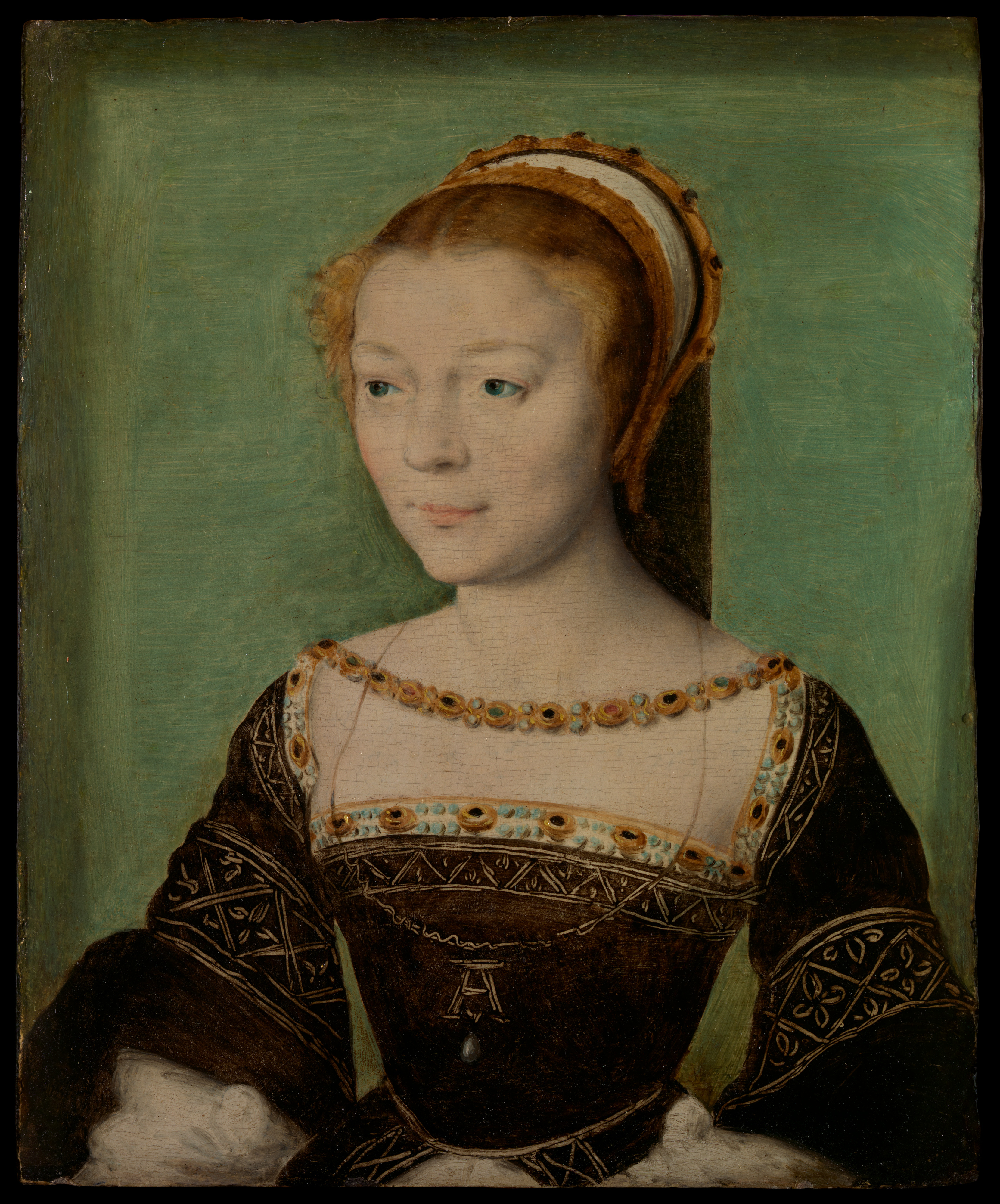
Renowned for her brilliance and beauty, Anne de Pisseleu was the mistress of Francis I. She was introduced to the king at court in 1526 when she was seventeen. After his death in 1547, she was dismissed from court by the mistress of the succeeding king (Henry II) and died in obscurity. Here she wears a gold necklace and a pendant with her initial A and a pearl.
This image cannot be enlarged, viewed at full screen, or downloaded.
Open Access
As part of the Met's Open Access policy, you can freely copy, modify and distribute this image, even for commercial purposes.
API
Public domain data for this object can also be accessed using the Met's Open Access API.
Use your arrow keys to navigate the tabs below, and your tab key to choose an item
Title:Anne de Pisseleu (1508–1576), Duchesse d'Étampes
Artist:Attributed to Corneille de Lyon (Netherlandish, The Hague, active by 1533–died 1575 Lyons)
Date:ca. 1535–40
Medium:Oil on wood
Dimensions:7 x 5 5/8 in. (17.8 x 14.3 cm)
Classification:Paintings
Credit Line:H. O. Havemeyer Collection, Bequest of Mrs. H. O. Havemeyer, 1929
Object Number:29.100.197
James Alexandre, comte de Pourtalès-Gorgier (until d. 1855; his estate sale, Pillet, Paris, March 31–April 1, 1865, no. 234, as a portrait by François Clouet, for Fr 4,020 to Mame); Alfred Mame, Tours (1865–d. 1893); his son, Paul Mame, Tours (1893–d. 1904; his estate sale, Georges Petit, Paris, April 26, 1904, no. 8, as "Portrait de femme," by François Clouet, for Fr 30,000, to Durand-Ruel for Havemeyer); Mr. and Mrs. H. O. Havemeyer, New York (1904–his d. 1907); Mrs. H. O. (Louisine W.) Havemeyer, New York (1907–d. 1929)
Tours. Church of St. François. "Exposition Rétrospective de Tours," 1890, no catalogue? (as "Portrait de Claude de France," about 1520, lent by Alfred Mame) [see Palustre 1891].
New York. The Metropolitan Museum of Art. "The H. O. Havemeyer Collection," March 10–November 2, 1930, no. 10 (as "Portrait of a Lady," by Corneille de Lyon, attributed also to Jean Clouet) [2nd ed., 1958, no. 66].
New York. The Metropolitan Museum of Art. "Splendid Legacy: The Havemeyer Collection," March 27–June 20, 1993, no. A96.
Lyon. Musée des Beaux-Arts de Lyon. "Lyon Renaissance arts et humanisme," October 23, 2015–January 25, 2016, no. 132.
Paris. Musée du Louvre. "François Ier et l'art des Pays-Bas," October 18, 2017–January 15, 2018, no. 107.
Léon Palustre. Album de l'exposition rétrospective de Tours (1890). Tours, 1891, pl. 6, identifies the sitter as Claude de France, painted about 1520; believes it is more likely to be the work of Jean Clouet than of François Clouet, as claimed in the Pourtalès sale.
F. Kenner. Jahrbuch der kunsthistorischen Sammlungen in Wien 19 (1898), pp. 70–71, discusses the portraits of Anne de Pisseleu.
H. O. Havemeyer Collection: Catalogue of Paintings, Prints, Sculpture and Objects of Art. n.p., 1931, pp. 60–61, ill., as "Portrait of a Lady" by Corneille de Lyon, also attributed to Jean Clouet.
Josephine L. Allen and Elizabeth E. Gardner. A Concise Catalogue of the European Paintings in The Metropolitan Museum of Art. New York, 1954, p. 19.
Charles Sterling. The Metropolitan Museum of Art: A Catalogue of French Paintings. Vol. 1, XV–XVIII Centuries. Cambridge, Mass., 1955, pp. 34–36, ill., ascribes it to Corneille de Lyon and notes that the costume is of the period about 1540.
Anne de Groër. "Nouvelles recherches sur Corneille, à la lumière du Portrait de Pierre Aymeric." Revue du Louvre et des musées de France 28, no. 1 (1978), p. 42 n. 32, regards it as superior to the version known by Dimier [Dubois de Groër 1996, no. 28 A].
Louisine W. Havemeyer. Sixteen to Sixty: Memoirs of a Collector. Ed. Susan Alyson Stein. 3rd ed. [1st ed. 1930, repr. 1961]. New York, 1993, pp. 263, 339 n. 393.
Susan Alyson Stein inSplendid Legacy: The Havemeyer Collection. Exh. cat., The Metropolitan Museum of Art. New York, 1993, pp. 237, 285.
Gretchen Wold inSplendid Legacy: The Havemeyer Collection. Exh. cat., The Metropolitan Museum of Art. New York, 1993, p. 306, no. A96, ill., erroneously lists it in the French Primitives exhibition held in Paris in 1904.
Katharine Baetjer. European Paintings in The Metropolitan Museum of Art by Artists Born Before 1865: A Summary Catalogue. New York, 1995, p. 353, ill.
Anne Dubois de Groër. Corneille de La Haye dit Corneille de Lyon. Paris, 1996, pp. 131–33, no. 28, ill., considers this the more animated of Corneille's two known portraits of the Duchesse d'Étampes (the other, 28A, was in the Montbrison collection in 1904 and is now in a private collection); finds the costume consistent with a date between 1535 and 1540; notes that the court made numerous trips to Lyon between 1536-37 and supposes this likeness was made during one of these visits
.
Yassana C. Croizat. "'Living Dolls': François Ier Dresses His Women." Renaissance Quarterly 60 (Spring 2007), p. 120, fig. 8, publishes a payment record in the the account books of Francis I for purple and crimson velvet for the wardrobes of his ladies, including the sitter here; notes that the King saw a court embellished by beautiful and elegantly dressed women as a means to command the respect of both his allies and enemies.
Robert J. Knecht. The French Renaissance Court, 1483–1589. New Haven, 2008, p. 191, fig. 37.
Ludmila Virassamynaïken inLyon Renaissance arts et humanisme. Exh. cat., Musée des Beaux-Arts de Lyon. Lyons, 2015, p. 21.
Cécile Scailliérez inLyon Renaissance arts et humanisme. Exh. cat., Musée des Beaux-Arts de Lyon. Lyons, 2015, pp. 146, 148, 150, 180, no. 132, ill. (color).
Bacri Frères—Antiquaires, Paris: Collection Jacques Bacri. Sotheby's, Paris. March 30, 2017, p. 72, ill. p. 70 (color), under no. 63.
Cécile Scailliérez inFrançois Ier et l'art des Pays-Bas. Exh. cat., Musée du Louvre. Paris, 2017, pp. 204, 267–68, 274–75, no. 107, ill. (color), as by Corneille de Lyon.
The subject is identified as Anne de Pisseleu by inscriptions on several early copies and by the ornament in the shape of an A (for Anne) hanging at her neck; her costume dates from about 1535–40. A replica in a private collection (Dubois de Groër no. 28 A, collection G. de Montbrison, 1904, Exhibition of French Art, London, 1932, no. 96) shows a more elaborate pendant, chain and embroidery. These parts of the costume as well as the sitter's features are painted with a lighter, freer hand in our variant.
A similar portrait of Anne de Pisseleu, in the Museum of Versailles, is illustrated in C. Gavard, Galeries historiques de Versailles, 1838–54, vol. 9, series 10, sect. 2, no. 1835.
Style of Corneille de Lyon (French, second quarter 16th century)
Resources for Research
The Met's Libraries and Research Centers provide unparalleled resources for research and welcome an international community of students and scholars.
The Met Collection API is where all makers, creators, researchers, and dreamers can connect to the most up-to-date data and public domain images for The Met collection. Open Access data and public domain images are available for unrestricted commercial and noncommercial use without permission or fee.
Feedback
We continue to research and examine historical and cultural context for objects in The Met collection. If you have comments or questions about this object record, please complete and submit this form. The Museum looks forward to receiving your comments.