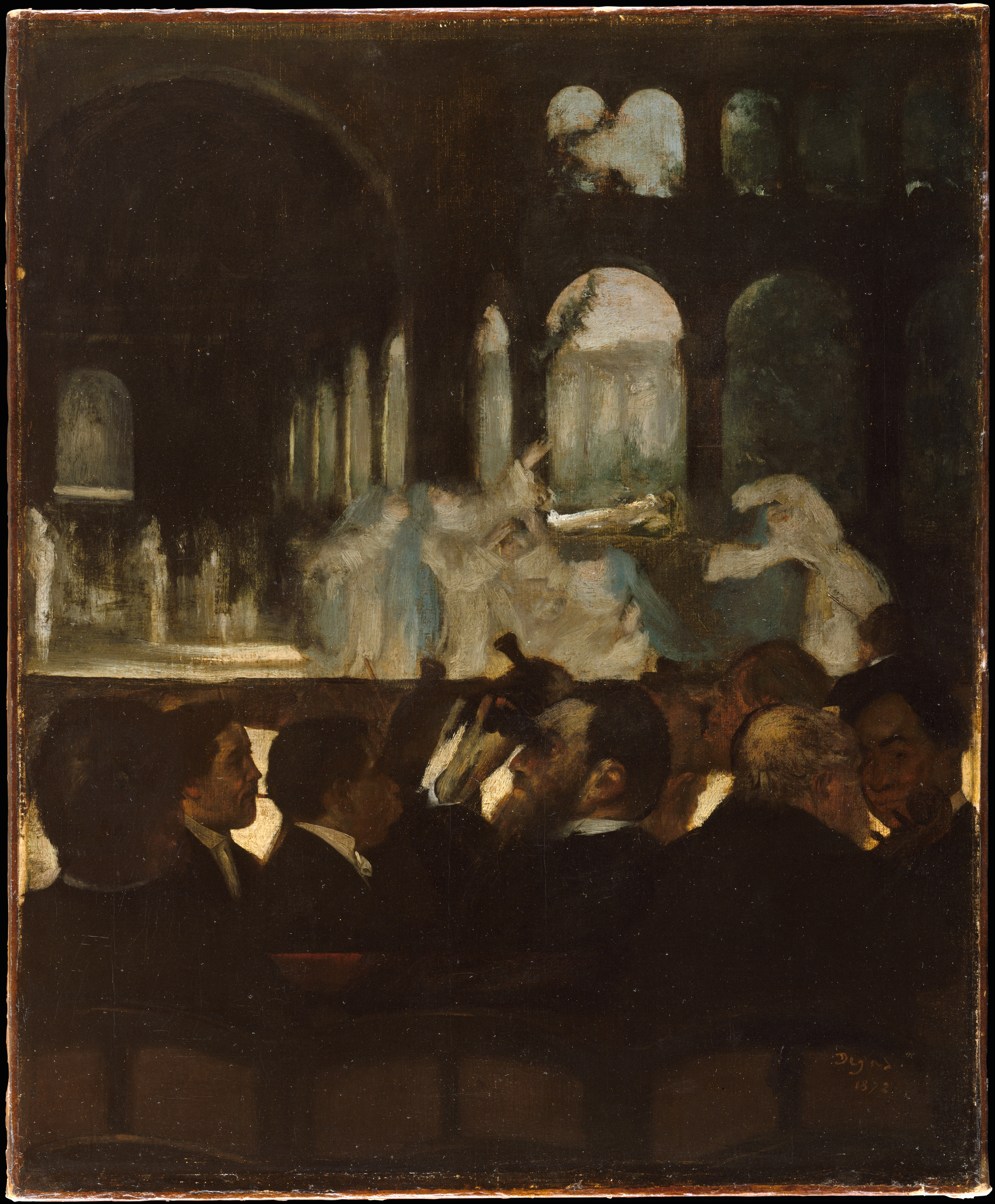
When Degas made this picture in 1871, Giacomo Meyerbeer’s opera Robert le Diable was forty years old and feeling its age—as reflected by the man at center, indifferent to the action and directing his binoculars at the audience. But Degas was fond of the opera, and particularly of the scene depicted here, from the third act, in which nuns arise from the dead and dance seductively amid the ruins of a moonlit monastery. The painting was exhibited in early 1872, the date inscribed on the canvas; Degas later executed a larger version (Victoria and Albert Museum, London) for Jean-Baptiste Faure, who starred in the opera.
This image cannot be enlarged, viewed at full screen, or downloaded.
Open Access
As part of the Met's Open Access policy, you can freely copy, modify and distribute this image, even for commercial purposes.
API
Public domain data for this object can also be accessed using the Met's Open Access API.
Use your arrow keys to navigate the tabs below, and your tab key to choose an item
Title:The Ballet from "Robert le Diable"
Artist:Edgar Degas (French, Paris 1834–1917 Paris)
Date:1871
Medium:Oil on canvas
Dimensions:26 x 21 3/8 in. (66 x 54.3 cm)
Classification:Paintings
Credit Line:H. O. Havemeyer Collection, Bequest of Mrs. H. O. Havemeyer, 1929
Object Number:29.100.552
Inscription: Signed and dated (lower right): Degas / 1872
[Durand-Ruel, Paris, 1872–74; stock no. 978; bought from the artist in January 1872 for Fr 1,500; sold on March 5 or 6, 1874, for Fr 1,500 to Faure for Degas]; the artist, Edgar Degas, Paris (1874–85; sold on August 20, 1885, for Fr 800 to Durand-Ruel); [Durand-Ruel, Paris, 1885; stock no. 732; sold on November 10, 1885, for Fr 3,000 to Rouart]; Rouart, Paris (1885; sold on December 31, 1885, for Fr 3,000 to Durand-Ruel); [Durand-Ruel, Paris, 1885–87; deposited with Robertson, December 24, 1885–January 11, 1886; sold on February 14, 1887, for Fr 2,500 to Faure]; Jean-Baptiste Faure, Paris (1887–94; sold on March 31, 1894, for Fr 10,000 to Durand-Ruel); [Durand-Ruel, Paris, 1894; stock no. 2981 as "Le ballet de Guillaume Tell"; sold on October 4, 1894, for Fr 10,000 to Durand-Ruel, New York]; [Durand-Ruel, New York, 1894–98; stock no. 1205 as "Robert le Diable"; sold on February 14, 1898, for $4,000 to Havemeyer]; Mr. and Mrs. H. O. Havemeyer, New York (1898–his d. 1907); Mrs. H. O. (Louisine W.) Havemeyer, New York (1907–d. 1929; cat., 1931, pp. 106–7, ill.)
London. Durand-Ruel. "Fourth Exhibition of the Society of French Artists," Summer 1872, no. 95 (as "Robert le Diable").
New York. American Art Association. "Works in Oil and Pastel by the Impressionists of Paris," April 10–28, 1886, no. 17 (as "Ballet de Robert le Diable").
New York. National Academy of Design. "Works in Oil and Pastel by the Impressionists of Paris," May 25–June 30, 1886, no. 17.
Pittsburgh. Carnegie Institute. "Second Annual Exhibition," November 4, 1897–January 1, 1898, no. 65.
New York. The Metropolitan Museum of Art. "The H. O. Havemeyer Collection," March 10–November 2, 1930, no. 50 [2nd ed., 1958, no. 101].
Museum of Fine Arts, Boston. "Independent Painters of Nineteenth Century Paris," March 15–April 28, 1935, no. 12.
New York. Wildenstein. "Five Centuries of Ballet, 1575–1944," April 13–May 13, 1944, no. 238.
Huntington, N.Y. Heckschers Art Museum. "European Influence on American Painting of the 19th Century," June 8–29, 1947, no. 28.
Columbus, Ohio. Columbus Gallery of Fine Arts. "The Springtime of Impressionism," April 3–May 2, 1948, no. 8.
New York. Wildenstein. "A Loan Exhibition of Degas," April 7–May 14, 1949, no. 23.
Honolulu Academy of Arts. "Four Centuries of European Painting," December 8, 1949–January 29, 1950, no. 26.
Art Gallery of Toronto. "Fifty Paintings by Old Masters," April 21–May 21, 1950, no. 9.
South Hadley, Mass. Mount Holyoke College Art Museum. "The Eye Listens: Music in the Visual Arts," October 23–November 15, 1950, no. 47.
Kunstmuseum Bern. "Degas," November 25, 1951–January 13, 1952, no. 17.
Utica, N.Y. Munson-Williams-Proctor Arts Institute. "Picture of the Month," November 9–30, 1952, no catalogue?
Binghamton, N.Y. Roberson Memorial Center. December 5, 1954–January 30, 1955, no catalogue?
New York. The Metropolitan Museum of Art. "The Comédie Française and the Theater in France," October 24–November 13, 1955, unnum. checklist (p. 6).
Denver Art Museum. October 1–November 18, 1956, no catalogue.
Pittsburgh. Department of Fine Arts, Carnegie Institute. "Retrospective Exhibition of Paintings from Previous Internationals, 1896–1955," December 5, 1958–February 8, 1959, no. 7.
Hanover, N.H. Hopkins Art Center, Dartmouth College. "Impressionism, 1865–1885," November 1–December 1962, no catalogue?
Little Rock. Arkansas Arts Center. "Five Centuries of European Painting," May 16–October 26, 1963, unnumbered cat. (p. 46).
Nashville. Fisk University. "100 Years of European Painting," April 28–June 10, 1965, unnum. checklist.
Tulsa. Philbrook Art Center. "French and American Impressionism," October 2–November 26, 1967, no. 4.
Fort Worth Art Center. "Spectrum: A Cross Section from the Metropolitan Museum of Art, New York," March 8–April 12, 1970, unnumbered cat.
Sydney. Art Gallery of New South Wales. "Modern Masters: Manet to Matisse," April 10–May 11, 1975, no. 25.
Melbourne. National Gallery of Victoria. "Modern Masters: Manet to Matisse," May 28–June 22, 1975, no. 25.
New York. Museum of Modern Art. "Modern Masters: Manet to Matisse," August 4–September 1, 1975, no. 25.
New York. The Metropolitan Museum of Art. "Degas in the Metropolitan," February 26–September 4, 1977, no. 12 (of paintings).
Washington. National Gallery of Art. "Degas: The Dancers," November 22, 1984–March 10, 1985, no. 2.
Paris. Galeries nationales du Grand Palais. "Degas," February 9–May 16, 1988, no. 103.
Ottawa. National Gallery of Canada. "Degas," June 16–August 28, 1988, no. 103.
New York. The Metropolitan Museum of Art. "Degas," September 27, 1988–January 8, 1989, no. 103.
New York. IBM Gallery of Science and Art. "Pleasures of Paris: Daumier to Picasso," October 15–December 28, 1991, no. 94.
New York. The Metropolitan Museum of Art. "Splendid Legacy: The Havemeyer Collection," March 27–June 20, 1993, no. A202.
Paris. Musée d'Orsay. "La collection Havemeyer: Quand l'Amérique découvrait l'impressionnisme...," October 20, 1997–January 18, 1998, no. 5.
Amsterdam. Van Gogh Museum. "Light! The Industrial Age, 1750–1900: Art & Science, Technology & Society," October 20, 2000–February 12, 2001, unnumbered cat. (p. 245).
Pittsburgh. Carnegie Museum of Art. "Light! The Industrial Age, 1750–1900: Art & Science, Technology & Society," April 4–July 29, 2001, unnumbered cat. (p. 245).
Detroit Institute of Arts. "Degas and the Dance," October 20, 2002–January 12, 2003, unnumbered cat. (pl. 53).
Philadelphia Museum of Art. "Degas and the Dance," February 12–May 11, 2003, unnumbered cat. (pl. 53).
Edinburgh. Royal Scottish Academy Building. "Gauguin's Vision," July 6–October 2, 2005, unnumbered cat. (pl. 62).
Washington. Phillips Collection. "Degas, Sickert and Toulouse-Lautrec: London and Paris, 1870–1910," February 18–May 14, 2006, not in catalogue.
Canberra. National Gallery of Australia. "Degas: Master of French Art," December 12, 2008–March 22, 2009, no. 48.
Paris. Musée d'Orsay. "Degas à l'Opéra," September 24, 2019–January 19, 2020, no. 112.
National Gallery of Art, Washington D.C. "Degas at the Opéra," July 20–October 12, 2020, no. 112.
Edgar Degas. Letter to James Tissot. September 30, [18]71 [published in French and English in Reff 2020, letter no. 23], states that he has exhibited his "orchestre de l'opéra" on rue Laffitte (at Durand-Ruel's gallery), probably this picture.
Edgar Degas. Letter to James Tissot. [May–June 1873] [published in French and English in Reff 2020, letter no. 35], writes "Mon orchestre a des parties trop négligées. Durand-Ruel m'avait promis, sur mes instances, de ne pas l'envoyer et m'a trompé" (My orchestra still has some parts that are overly neglected. Durand-Ruel had promised me, at my request, not to send it, but he deceived me), possibly regarding this picture.
"The Fine Arts: The French Impressionists." Critic 5 (April 17, 1886), p. 195.
Georges Grappe. Edgar Degas. Berlin, [1908], ill. p. 53.
Julius Meier-Graefe. Entwicklungsgeschichte der Modernen Kunst. Vol. 2, 2nd ed. Munich, 1915, pl. 254.
Paul Lafond. Degas. Vol. 1, Paris, 1918, ill. p. 50, erroneously as still in the collection of Durand-Ruel.
Paul Jamot. "Degas (1834–1917)." Gazette des beaux-arts, 4th ser., 14 (April–June 1918), pp. 162–63.
Paul Lafond. Degas. Vol. 2, Paris, 1919, p. 25, refers to the version in the Victoria and Albert Museum, London as one of Degas's first pictures of dancers onstage, calling ours "a less well known variant"; identifies portraits of the collector Helch [sic for Albert Hecht] and the vicomte Lepic in the London picture
.
Henri Hertz. Degas. Paris, 1920, pp. 96–97, discusses the differences in execution between the dancers and the musicians and spectators.
Julius Meier-Graefe. Degas. Munich, 1920, pp. 31–32, pl. 14 [English ed., 1923, pp. 46–47, pl. XIV], confuses it with the London version; criticizes the differences in execution between the upper and lower portions of the composition, asserting that "it would not be unreasonable to suspect the work of two different artists in this picture" and calls the ballet onstage "an arbitrary background"; mentions the influence of Adolf Menzel on Degas's theater scenes.
Royal Cortissoz. "Modern France and Renaissance Italy: A Masterpiece by Degas and a Sienese Ceiling." New York Tribune (January 30, 1921), p. 7.
Iakov Tugendkhol'd. Edgar Degas. Moscow, 1922, ill. p. 44.
Paul Jamot. Degas. Paris, 1924, p. 98 n. 1, p. 138, calls it "less advanced" in execution compared to the London version, which he states was the picture shown in Durand-Ruel's 1872 London exhibition; erroneously locates our picture as having been in the collection of Mme Albert Hecht [see Refs. Callen 1971 and Distel 1981].
Paul Jamot. "Deux tableaux de Degas acquis par les Musées nationaux: l'Orchestre et le portrait de Mademoiselle Dihau." Le Figaro artistique (January 3, 1924), pp. 2–4, ill., as in the collection of Mme Hecht.
Basil S. Long. Catalogue of the Constantine Alexander Ionides Collection. Vol. 1, Paintings in Oil, Tempera and Water-colour together with certain of the Drawings. London, 1925, p. 19, calls it another version of the London picture, belonging to Madame Hecht.
J. B. Manson. The Life and Work of Edgar Degas. London, 1927, p. 19, calls it "slightly different and less satisfactory" than the London version.
Arsène Alexandre. "La collection Havemeyer, 2e Étude: Degas." La Renaissance 12 (October 1929), p. 484, ill. opp. p. 479.
"The H. O. Havemeyer Collection." Parnassus 2 (March 1930), p. 7, calls it Degas's personal interpretation of Daumier.
H. O. Havemeyer Collection: Catalogue of Paintings, Prints, Sculpture and Objects of Art. n.p., 1931, pp. 106–7, ill.
Louise Burroughs. "Degas in the Havemeyer Collection." Metropolitan Museum of Art Bulletin 27 (May 1932), p. 144, notes that Dihau was the inspiration for the London version.
Independent Painters of Nineteenth Century Paris. Exh. cat., Museum of Fine Arts, Boston. Boston, 1935, pp. 15–16, no. 12, identifies portraits of Dihau, Albert Hecht, and Vicomte Lepic in our picture [Lepic appears only in the London version; see Refs. Lafond 1919, Pantazzi 1988].
Camille Mauclair. Degas. London, [1937], pl. 160, confuses it with the London version.
Agnes Mongan. "Degas as Seen in American Collections." Burlington Magazine 72 (June 1938), p. 296.
Hans Huth. "Impressionism Comes to America." Gazette des beaux-arts, 6th ser., 29 (April 1946), p. 239 n. 22, states that either this picture or the London version was included in the American Art Association Impressionist exhibition [Exh. New York 1886].
John Rewald. The History of Impressionism. New York, 1946, ill. p. 231.
P[aul]. A[ndré]. Lemoisne. Degas et son œuvre. [reprint 1984]. Paris, [1946–49], vol. 1, p. 68; vol. 2, pp. 144–45, no. 294, ill., identifies the figure with the opera glasses as Albert Hecht and the figure to his left in the orchestra as Dihau.
Lillian Browse. Degas Dancers. New York, [1949], pp. 22, 28, 52, 66, 337–38, pl. 8, observes that whereas in "The Orchestra of the Opéra" (about 1870; Musée d'Orsay, Paris; L186), the dancers onstage serve as background to the group portrait of the orchestra, in this picture the composition is more evenly divided; states that it depicts the third act, the "Ballet of the Nuns," danced by Laure Fonta in the 1871 production of the opera; reproduces three studies of the dancers (Victoria and Albert Museum, London) and notes that Faure commissioned the second version after seeing this picture.
François Fosca. Degas. Geneva, 1954, p. 43.
Josephine L. Allen and Elizabeth E. Gardner. A Concise Catalogue of the European Paintings in The Metropolitan Museum of Art. New York, 1954, p. 28.
Douglas Cooper. The Courtauld Collection. London, 1954, p. 60, remarks that since this picture is dated 1872, it must be the version exhibited at Durand-Ruel, London during that year, noting that the London variant was not finished until 1876.
Pierre Cabanne. Edgar Degas. Paris, [1957], pp. 31–32, 97, 109, under no. 38 [English ed., 1958, pp. 31–32, 97, 110, under no. 38].
Jean Sutherland Boggs. "Degas Notebooks at the Bibliothèque Nationale III: Group C (1863–1886)." Burlington Magazine 100 (July 1958), pp. 243–44, records studies for this picture as well as notes about the stage set and lighting effects in a notebook dating from about 1872 in the Bibliothèque Nationale, Paris.
Jean S. Boggs. An Exhibition of Works by Edgar Hilaire Germain Degas, 1834–1917. Exh. cat., Los Angeles County Museum. Los Angeles, 1958, p. 14.
Peter A. Wick. "Degas' Violinist." Bulletin of the Museum of Fine Arts, Boston 57, no. 310 (1959), p. 90.
Louisine W. Havemeyer. Sixteen to Sixty: Memoirs of a Collector. New York, 1961, p. 263.
John Rewald. The History of Impressionism. rev., enl. ed. New York, 1961, pp. 273–75, ill., notes that this picture must have been purchased immediately after its completion by Durand-Ruel since he exhibited it in the winter of 1872 [the exhibition was in the summer of 1872].
Ronald Pickvance. "Degas's Dancers: 1872–6." Burlington Magazine 105 (June 1963), p. 258, comments that with this picture, "The Orchestra of the Opéra" (Orsay), and "Orchestra Musicians" (about 1870–71, reworked about 1874–76; Städelsches Kunstinstitut und Städtische Galerie, Frankfurt; L295) Degas began to focus on the grouping of figures in an interior, although he concentrated more on the elements of portraiture and artificial light.
Geoffrey Agnew. "A Ballet Scene by Degas." Listener 72 (December 10, 1964), pp. 944–45.
Jonathan Mayne. "Degas's Ballet Scene from 'Robert le Diable'." Victoria and Albert Museum Bulletin 2 (October 1966), pp. 150–52, 155, fig. 2, states that Hecht was the first owner of this picture after Durand-Ruel; compares it to the London version, noting that in ours the portraits of the orchestra members take precedence over the ballet scene onstage.
Charles Sterling and Margaretta M. Salinger. French Paintings: A Catalogue of the Collection of The Metropolitan Museum of Art. Vol. 3, XIX–XX Centuries. New York, 1967, pp. 66–69, ill., suggest the influence of Menzel's "At the Gymnase Theater" (1856; Nationalgalerie, Berlin), a Daumier lithograph (1852), and the Daumier painting "The Melodrama" (1856–58; Neue Pinakothek, Munich).
Lillian Browse. "Degas's Grand Passion." Apollo 85 (February 1967), p. 105.
Ronald Pickvance. Degas: Pastels and Drawings. Exh. cat., Nottingham University Art Gallery. Nottingham, 1969, unpaginated, under nos. 14, 15.
Fiorella Minervino inL'opera completa di Degas. Milan, 1970, pp. 99, 109, no. 290, ill.
Anthea Callen. "Jean-Baptiste Faure, 1830–1914: A Study of a Patron and Collector of the Impressionists and their Contemporaries." Master's thesis, University of Leicester, 1971, pp. 158–59, 162, no. 192, states that although Hecht has been recorded as the original owner, this picture was owned by Durand-Ruel almost immediately after its completion in 1872 when it was exhibited in London; considers it likely that Faure bought it from Durand-Ruel in 1874, the same year that he commissioned the second version.
Theodore Reff. "Degas's 'Tableau de Genre'." Art Bulletin 54 (September 1972), p. 319 n. 33, p. 329.
C. M. Kauffmann. Catalogue of Foreign Paintings. London, 1973, vol. 2, p. 24, under no. 58, states that it was painted for Hecht.
Theodore Reff. Degas, The Artist's Mind. [New York], 1976, pp. 221, 327 n. 33, p. 329 n. 88.
Theodore Reff. The Notebooks of Edgar Degas: A Catalogue of the Thirty-Eight Notebooks in the Bibliothèque Nationale and Other Collections. Oxford, 1976, vol. 1, p. 7 n. 2, pp. 9, 21, 119–20 (notebook 24, pp. 7, 9–11, 13, 15–17, 19–21), catalogues several studies and notes for this picture (reproduced vol. 1, pl. 29; vol. 2, notebook 24, pp. 9–11, 13, 15–17, 19); annotates Degas's note about the "tête de Georges en silhouette" as a reference to the conductor Georges Hainl.
Theodore Reff. "Degas: A Master among Masters." Metropolitan Museum of Art Bulletin 34 (Spring 1977), p. [26], fig. 46 (color).
Theodore Reff. "Edgar Degas and the Dance." Arts Magazine 53 (November 1978), p. 149, mentions it as Degas's only ballet picture where the dancers are not wearing tutus.
Marc Saul Gerstein. "Impressionist and Post-Impressionist Fans." PhD diss., Harvard University, 1978, p. 27.
Charles S. Moffett. Degas: Paintings in The Metropolitan Museum of Art. New York, 1979, pp. 7, 9–10, colorpl. 13.
Ian Dunlop. Degas. New York, 1979, p. 230 n. 22.
Eugénie de Keyser. Degas: Réalité et métaphore. Louvain-la-Neuve, 1981, p. 60.
Jacques Dufwa. Winds from the East: A Study in the Art of Manet, Degas, Monet and Whistler 1856–86. Stockholm, 1981, pp. 99, 102, 205 n. 48, calls the London version a free copy of ours.
Frances Weitzenhoffer. "The Creation of the Havemeyer Collection, 1875–1900." PhD diss., City University of New York, 1982, p. 315 n. 32.
Anne Distel. "Albert Hecht, collectionneur (1842–1889)." Bulletin de la Société de l'Histoire de l'Art Français, année 1981, (1983), p. 272 n. 5, suggests this picture was inscribed 1872 at the time of its sale to Durand-Ruel in January of that year, but that it may have been included in an 1871 exhibition on rue Lafitte as "Orchestra of the Opéra" [see Ref. Loyrette 1988]; argues that it could not have been owned by Hecht and provides detailed provenance history; identifies the figure with opera glasses as more closely resembling Hecht's brother, Henri and suggests that Albert may have inspired Degas to paint the picture.
Suzanne Folds McCullagh inDegas in The Art Institute of Chicago. Exh. cat., Art Institute of Chicago. Chicago, 1984, p. 72.
George T. M. Shackelford. Degas: The Dancers. Exh. cat., National Gallery of Art. Washington, 1984, pp. 23–24, 26–27, 41 n. 14, pp. 77, 130, no. 2, ill. pp. 23, 150 (overall and detail), discusses it as one of several genre portraits of opera scenes which focus on the musicians and spectators rather than the dancers onstage.
Sue Welsh Reed Barbara Stern Shapiro inEdgar Degas: The Painter as Printmaker. Exh. cat., Museum of Fine Arts, Boston. Boston, 1984, p. 68.
Charles S. Moffett. Impressionist and Post-Impressionist Paintings in The Metropolitan Museum of Art. New York, 1985, pp. 55, 68–69, 250, ill. in color (overall and detail).
Götz Adriani. Degas: Pastels, Oil Sketches, Drawings. Exh. cat., Kunsthalle Tübingen. New York, 1985, pp. 54, 360, under no. 84, ill. p. 359.
Martine Kahane. Robert le Diable. Exh. cat., Théâtre National de l'Opéra de Paris. Paris, 1985, p. 66.
Frances Weitzenhoffer. The Havemeyers: Impressionism Comes to America. New York, 1986, p. 130.
Eunice Lipton. Looking into Degas: Uneasy Images of Women and Modern Life. Berkeley, 1986, p. 76.
Ann Dumas. Degas's 'Mlle. Fiocre' in Context: A Study of 'Portrait de Mlle. E. F. . . ; à propos du ballet "La Source"'. Brooklyn, 1988, p. 43, remarks that in this picture and "The Orchestra of the Opéra" (Orsay) Degas "exposes and even parodies" the illusionism of the theatrical performance.
Gary Tinterow inDegas. Exh. cat., Galeries Nationales du Grand Palais, Paris. New York, 1988, pp. 384, 431.
Michael Pantazzi inDegas. Exh. cat., Galeries Nationales du Grand Palais, Paris. New York, 1988, pp. 221–23, 269–70, 272, suggests that Faure bought it in 1887 because he regretted selling the second version; identifies this picture as the one Degas refers to in an 1872 letter to James Tissot, lamenting that "certain parts of my 'Orchestre' are not done well enough"; remarks that Degas did not rework it because he was able to revise the composition in the second version commissioned by Faure; interprets Degas's notes on the set and lighting effects as having been made after completing our version [see Ref. Reff 1976, Notebooks]; disagrees with comparisons to Menzel's "At the Gymnase Theater" (Nationalgalerie, Berlin).
Henri Loyrette inDegas. Exh. cat., Galeries Nationales du Grand Palais, Paris. New York, 1988, pp. 59, 171–74, no. 103, ill. (color), dates it 1871 since it was bought by Durand-Ruel in January 1872; considers the identification of the figure with opera glasses as Albert Hecht "not without basis," noting that x-rays reveal that his figure was added later to the canvas; remarks that the spectators are not interested in watching the ballet because this opera was so regularly performed that it had become "a well-worn museum piece".
Richard Thomson. "The Degas Exhibition at the Grand Palais." Burlington Magazine 130 (April 1988), p. 296.
Jean Sutherland Boggs inDegas. Exh. cat., Galeries Nationales du Grand Palais, Paris. New York, 1988, p. 487.
Henri Loyrette. "Degas à l'Opéra." Degas inédit: Actes du Colloque Degas. Paris, 1989, p. 57.
Anne Distel. Impressionism: The First Collectors. New York, 1990, pp. 72, 90.
Henri Loyrette. Degas. Paris, 1991, p. 612.
Barbara Stern Shapiro et. al. Pleasures of Paris: Daumier to Picasso. Exh. cat., Museum of Fine Arts, Boston. Boston, 1991, pp. 114–15, 185, no. 94, ill. (color), dates it 1871–72.
John House. "Degas' 'Tableaux de Genre'." Dealing with Degas: Representations of Women and the Politics of Vision. Ed. Richard Kendall and Griselda Pollock. London, 1992, p. 81, asserts that a female figure is implied by the gaze of the man holding opera glasses, commenting that "in a stock situation like this, woman's role as object of this gaze is so passive, so taken for granted that the female figure need not appear at all".
Deborah Bershad. "Looking, Power and Sexuality: Degas' 'Woman with a Lorgnette'." Dealing with Degas: Representations of Women and the Politics of Vision. Ed. Richard Kendall and Griselda Pollock. London, 1992, p. 101, compares the device of the man with opera glasses to that used by Cassatt in "At the Opera" (1878; Museum of Fine Arts, Boston) and Renoir in "The Loge" (1874; Courtauld Institute of Art Gallery, London).
Louisine W. Havemeyer. Sixteen to Sixty: Memoirs of a Collector. Ed. Susan Alyson Stein. 3rd ed. [1st ed. 1930, repr. 1961]. New York, 1993, pp. 257, 263, 337 n. 376, p. 339 n. 394.
Susan Alyson Stein inSplendid Legacy: The Havemeyer Collection. Exh. cat., The Metropolitan Museum of Art. New York, 1993, pp. 222, 286.
Gary Tinterow inSplendid Legacy: The Havemeyer Collection. Exh. cat., The Metropolitan Museum of Art. New York, 1993, pp. 8, 49, 53 n. 68, colorpl. 7.
Gretchen Wold inSplendid Legacy: The Havemeyer Collection. Exh. cat., The Metropolitan Museum of Art. New York, 1993, pp. 326–27, no. A202, ill.
Jean Sutherland Boggs inDegas Portraits. Exh. cat., Kunsthaus Zürich. London, 1994, p. 52 [German ed., "Degas Die Portraits"].
Katharine Baetjer. European Paintings in The Metropolitan Museum of Art by Artists Born Before 1865: A Summary Catalogue. New York, 1995, p. 451, ill., as "The Ballet from "Robert le Diable'".
Gary Tinterow inLa collection Havemeyer: Quand l'Amérique découvrait l'impressionnisme. Exh. cat., Musée d'Orsay. Paris, 1997, pp. 18, 33, 78 n. 97, p. 104, no. 5, ill. p. 34 (color), dates it 1871–72.
Eberhard Roters. Malerei des 19. Jahrhunderts: Themen und Motive. Cologne, 1998, vol. 1, pp. 379–80, ill.
Andreas Blühm and Louise Lippincott. Light! The Industrial Age 1750–1900: Art & Science, Technology & Society. Exh. cat., Van Gogh Museum, Amsterdam. London, 2000, pp. 167, 245, ill. (color), date it 1871 in the caption and 1871–72 in the checklist.
Jill DeVonyar and Richard Kendall. Degas and the Dance. Exh. cat., Detroit Institute of Arts. New York, 2002, pp. 6, 14, 34–35, 52, 54–55, 58, 93, 95, 107, 158, 165, 281 n. 121, p. 285 n. 6, p. 289, colorpl. 53, propose that Degas may have begun this picture as early as 1870; suggest that Elise Parent, who danced the role of the Mother Superior, posed for the figures of the dancers and that Albert Hecht was included in the picture because Degas hoped to cultivate him as a patron; observe that by depicting this frequently produced standard from the Opéra repertory during a time when a new opera house was near completion, Degas instills the picture with the "burden of nostalgia".
Karen Wilkin. "Bodies of Knowledge." Art in America 91 (March 2003), p. 96.
Madeleine Korn. "Exhibitions of Modern French Art and Their Influence on Collectors in Britain 1870–1918: The Davies Sisters in Context." Journal of the History of Collections 16, no. 2 (2004), pp. 193–94, 205 n. 24, p. 207, fig. 1, dates it 1872.
Belinda Thomson et. al. Gauguin's Vision. Exh. cat., Royal Scottish Academy Building. Edinburgh, 2005, pp. 56, 123, colorpl. 62, compares its composition to that of Gauguin's "Vision of the Sermon: Jacob Wrestling with the Angel" (1888; National Gallery of Scotland, Edinburgh).
Jill DeVonyar in Annette Dixon. The Dancer: Degas, Forain, Toulouse-Lautrec. Exh. cat., Portland Art Museum. Portland, Oreg., 2008, pp. 209, 211, 233 n. 36, fig. 9 (color).
Jane Kinsman. Degas: The Uncontested Master. Exh. cat., National Gallery of Australia. Canberra, 2008, pp. 114, 122–23, 267, no. 48, ill. (color), calls it "The Ballet of 'Robert le Diable'".
Michael Pantazzi in Jane Kinsman. Degas: The Uncontested Master. Exh. cat., National Gallery of Australia. Canberra, 2008, pp. 247–48.
Jill DeVonyar and Richard Kendall. Degas & Music. Exh. cat., Hyde Collection. Glens Falls, N. Y., 2009, p. 65.
Ann Dumas inDrama and Desire: Art and Theatre from the French Revolution to the First World War. Ed. Guy Cogeval and Beatrice Avanzi. Exh. cat., Musée Cantini, Marseilles. Milan, 2010, pp. 263, 267, fig. 5 (color).
Richard Kendall and Jill DeVonyar. Degas and the Ballet: Picturing Movement. Exh. cat., Royal Academy of Arts. London, 2011, pp. 53, 56.
Sandra Gianfreda. "The early 'Japonistes'." Monet, Gauguin, Van Gogh . . . "Japanese Inspirations" Museum Folkwang. Exh. cat., Museum Folkwang, Essen. Göttingen, 2014, pp. 63, 338 n. 32.
Amanda T. Zehnder in Kimberly A. Jones. Degas/Cassatt. Exh. cat., National Gallery of Art. Washington, 2014, pp. 9, 11–13, fig. 8 (color), compares the picture to Cassatt's paintings of women in opera loges.
Christian Berger. Wiederholung und Experiment bei Edgar Degas. Berlin, 2014, pp. 24–27, 92, fig. 7, compares it to the London and Frankfurt pictures.
Isabelle Gaëtan and Monique Nonne inInventing Impressionism: Paul Durand-Ruel and the Modern Art Market. Ed. Sylvie Patry. Exh. cat., Musée du Luxembourg, Paris. London, 2015, p. 212 [French ed., "Paul Durand-Ruel : le Pari de l'Impressionnisme," Paris, 2014, p. 197].
Anne Robbins inInventing Impressionism: Paul Durand-Ruel and the Modern Art Market. Ed. Sylvie Patry. Exh. cat., Musée du Luxembourg, Paris. London, 2015, pp. 180, 240, 283 n. 97 [French ed., "Paul Durand-Ruel: le Pari de l'Impressionnisme," Paris, 2014, pp. 141, 165, 224 n. 94].
Colin B. Bailey. "How He Ruled Art." New York Review of Books 62 (December 3, 2015), p. 63.
Roberta Crisci-Richardson. Mapping Degas: Real Spaces, Symbolic Spaces and Invented Spaces in the Life and Work of Edgar Degas (1834–1917). Newcastle upon Tyne, 2015, pp. 223, 232.
Henri Loyrette. Degas: A New Vision. Exh. cat., National Gallery of Victoria. Melbourne, 2016, pp. 27, 88–93, 261 n. 237, p. 281, ill. (color), dates it 1871–72; notes that Degas may have completed the picture quickly to capitalize on a moment in which the imprisoned Courbet's "Louis Gueymard (1822–1880) as Robert le Diable" (1857, The Met 19.84) was at auction at the Hôtel Drouot; identifies the figure to the right of Hecht as the composer Daniel-François-Esprit Auber (d. 1871); discusses this version as an allegory of the Commune and compares it to the later version in London.
Henri Loyrette inDegas à l'Opéra. Ed. Henri Loyrette. Exh. cat., Musée d'Orsay. Paris, 2019, pp. 125–26, 128–36, 138–39, 151, 205, 208, 212, 309, no. 112, ill. p. 124 (color) [English ed., London, 2020, pp. 125–26, 128–36, 138–39, 152, 205, 212, 309, no. 112, ill. p. 124 (color)], dates it 1871–72, noting that the first studies for The Met's picture date from 1871, immediately after "The Orchestra of the Opéra" (1870, Musée d'Orsay, Paris), and that Degas's sketches for the subject were the last drawn from life in the auditorium; includes The Met's and the London version among very few of Degas's paintings that were known and commented upon during his lifetime; states that the opera was performed at the Salle Le Peletier from March 7 until July of 1870 and again from September to December of 1871, and that it was a huge success with a star-studded cast; identifies the conductor depicted with raised baton as George Hainl.
Marine Kisiel inDegas à l'Opéra. Ed. Henri Loyrette. Exh. cat., Musée d'Orsay. Paris, 2019, pp. 144, 149 [English ed., London, 2020, pp. 144, 148].
Kimberly A. Jones inDegas à l'Opéra. Ed. Henri Loyrette. Exh. cat., Musée d'Orsay. Paris, 2019, p. 218 [English ed., London, 2020], calls the audience members indistinguishable from the musicians, both clad in black evening clothes.
Theodore Reff, ed. The Letters of Edgar Degas.. By Edgar Degas. New York, 2020, vol. 1, pp. 152–53 n. 9, p. 161 n. 1, p. 183 n. 7, p. 185 n. 8, pp. 195–96 n. 9, p. 205 n. 5, pp. 370–71 n. 2 (under letter no. 255); vol. 2, p. 449 n. 3; vol. 3, pp. 21, 31, 332, letter nos. 23, 35, dates The Met's picture to 1871–72; publishes Degas 1871 as no. 23 and notes the reference to exhibiting "mon orchestre de l'opéra dans la rue Laffitte" as at Durand-Ruel's gallery but only notes that the gallery's archives do not provide information about "L'Orchestre de l'Opéra," which he associates with L186, as having been exhibited there in 1871, but see Distel 1983; states that the orchestra painting referred to in Degas 1873 has been identified as either The Met's picture or "Musiciens à l'orchestre" (L295) and notes that Durand-Ruel sent The Met's picture to London on April 6, 1873, but that the dealer must have shown the work to Tissot privately, and Degas never reworked it; identifies a passing reference to "la question des tableaux" (the question of the paintings) of the potentially quarrelsome Faure in a letter from Degas to Charles Deschamps of October 23, 1874 as related to those paintings Degas had persuaded Faure to buy back for him from Durand-Ruel in early 1874 for retouching, presumably including this painting; incorrectly states that Albert Hecht had owned the painting.
Leila Jarbouai inDegas: Dance, Politics, and Society. Ed. Adriano Pedrosa and Fernando Oliva. Exh. cat., Museu de Arte de São Paulo Assis Chateaubriand. São Paulo, 2021, p. 47, figs. 22, 199 (color).
Bridget Alsdorf. Gawkers: Art and Audience in Late Nineteenth-Century France. Princeton, 2022, pp. 93–97, 103, 258 nn. 73–75, fig. 2.19 (color), notes the contrast between this picture and some of Daumier's theatrical scenes as well as Degas's focus on the differing genders of the performers (female) and the audience (male); argues that Degas sees theater here as a "social experience" whereby it is more important to be seen in the audience than engage with the performance.
The Ann & Gordon Getty Collection: Volume 1, Important Pictures and Decorative Arts, Evening Sale. Christie's, New York
. October 20, 2022, pp. 23–24, under no. 2.
Paul-Louis Durand-Ruel and Flavie Durand-Ruel, ed. Discovering the Impressionists: Memoirs of Paul Durand-Ruel. Rev. ed. Paris, 2024, pp. 224, 275 n. 5.
Giacomo Meyerbeer's first French opera, Robert le Diable was steadily performed since its premiere in 1831. Browse (1949) suggests that Degas was inspired by the production of 1871 in which Laure Fonta led the ballet of the nuns. He represented the scene in Act III when the spirits of the nuns, who have left their tombs by moonlight, circulate in the cloister. Degas's friend Désiré Dihau, the bassoonist, appears among the musicians in the foreground. The figure with opera glasses has been identified as the collector Albert Hecht, although Distel (1983) finds a greater resemblance to his brother, Henri Hecht.
Degas's notebooks include drawings for the composition and a note about the setting (see Reff 1976, Notebooks). He also made four brush drawings for the figures of the nuns (Victoria and Albert Museum, London). X-rays taken in 1987 reveal that the figure with the opera glasses is painted over another musician, and that another dancing nun was originally included in the recesses of the cloister on the right.
A larger and wider version in oil was bequeathed to the Victoria and Albert Museum by Constantine Ionides (L291). It was commissioned by Jean-Baptiste Faure and has been dated 1876 because that year Degas wrote to Faure that he was sending him "the Robert le Diable." Although Albert Hecht has been traditionally considered the first owner of The Met's picture, it was bought by Durand-Ruel immediately after its completion in January 1872. It was probably inscribed 1872 at the time of this sale, having been executed in 1871 (see Callen 1971, Distel 1981, Loyrette 1988).
The Met's Libraries and Research Centers provide unparalleled resources for research and welcome an international community of students and scholars.
The Met Collection API is where all makers, creators, researchers, and dreamers can connect to the most up-to-date data and public domain images for The Met collection. Open Access data and public domain images are available for unrestricted commercial and noncommercial use without permission or fee.
Feedback
We continue to research and examine historical and cultural context for objects in The Met collection. If you have comments or questions about this object record, please complete and submit this form. The Museum looks forward to receiving your comments.