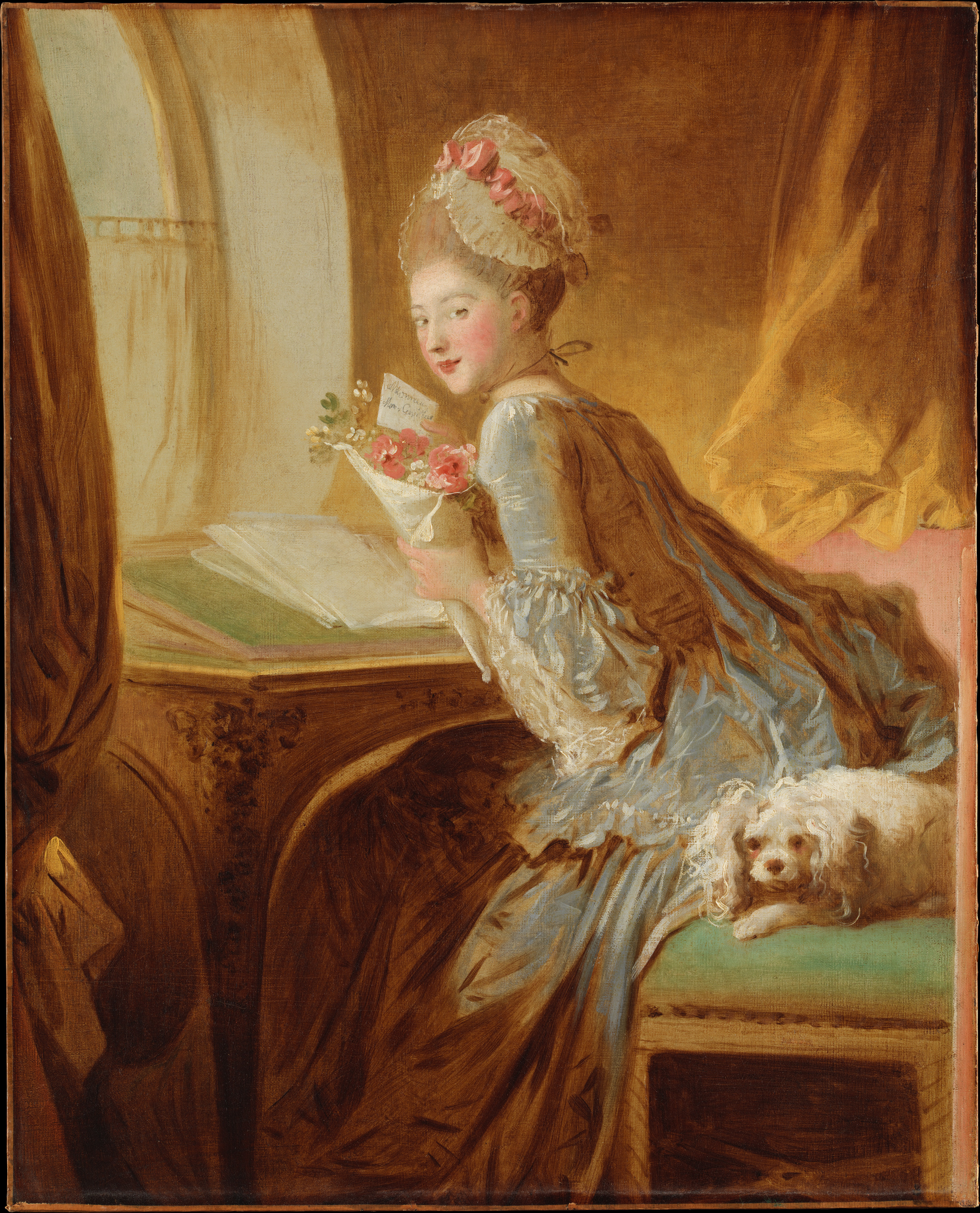
Eighteenth-century artists and collectors valued oil sketches, believing that they attested to painters’ first ideas and their physical presence in each work of art. This finished painting engages with that new aesthetic. Fragonard’s sketch has energetic brushstrokes of varying thickness that capture sunlight as it lands at the center of the canvas along the woman’s cap, powdered face, flowers, dress, and bedraggled dog. This is not a portrait, but a genre scene that implies a narrative that continues outside the frame through a letter accompanied by a bouquet. The simple conceit of love letters had been popular in the previous century with Johannes Vermeer and his contemporaries.
This is a painting without an early history that simply appeared in a mid-nineteenth-century Paris exhibition, as a loan from a private collector, with the title The Love Letter. Occasionally it has been identified as a portrait but probably it is not, as Fragonard makes no attempt to describe the features of an individual but instead, working at speed, presents a scenario. A young woman in a boudoir, seated on a stool at her writing desk before an oculus window, has addressed a card to a gentleman and inserts it into a bouquet of flowers wrapped in a paper cone. The message cannot be read with any degree of certainty but may have been: to monsieur my cavalier . . . . The theatrical aspect of the scene is emphasized by the focused light as well as by the way the intimate view is surrounded by curtains. The lady looks over her shoulder, as if at someone entering. Her hair is dressed smoothly under a muslin cap with pink ribbons. She wears lace cuffs painted in a flurry of white strokes with a robe, or rather a coat, à la française, which is pleated at the back just below the neckline before falling into soft loose folds around her. Her white face is heavily made up. Close beside her is a white dog with fluffy, silky ears.
The painting must date to the 1770s. A lack of finish is characteristic of several works of the same moment. Michael Fried (1996) proposed that Édouard Manet (1832–1883) might have seen the picture in 1860: it shares certain details of the setting with Manet’s famous nude Olympia (Musée d’Orsay, Paris).
Katharine Baetjer 2012
Inscription: Inscribed (on letter): [?] AMonsieur or Monsieur / [?] Mon [?] C[a or u]vallier
baron Félix Sébastien Feuillet de Conches, Paris (by 1860–d. 1887); his daughter, Mme Georges Claude Jagerschmidt, Paris (1887–at least 1897; sold to Cronier); Ernest Cronier, Paris (until d. 1905; his estate sale, Galerie Georges Petit, Paris, December 4, 1905, no. 7, for Fr 420,000, to Gimpel, Wildenstein, and Kraemer); [Gimpel & Wildenstein and Eugène Kraemer, Paris, 1905–7; sold to Bardac]; Joseph Bardac, Paris (1907–19; sold to Gimpel & Wildenstein); [Gimpel & Wildenstein, Paris and New York, 1919; sold for $44,940 to Bache]; Jules S. Bache, New York (1919–d. 1944; his estate, 1944–49; cats., 1929, unnumbered; 1937, no. 50; 1943, no. 49)
Paris. 26, Boulevard des Italiens [Francis Petit]. "Tableaux et dessins de l'école française, principalement du XVIIIe siècle, tirés de collections d'amateurs," 1860, no. 133 (as "Le Billet doux," 79 x 69 cm, lent by M. le baron F. de Conches).
Paris. Palais de la Présidence du Corps Législatif. "Ouvrages de peinture exposés au profit de la colonisation de l'Algérie par les Alsaciens-Lorrains," April 23–?, 1874, no. 160 (as "Portrait de Femme," lent by M. Feuillet de Conches).
Paris. Ecole des Beaux-Arts. "Portraits de femmes et d'enfants," April 30–?, 1897, no. 59 (as "Femme avec un petit chien," 80 x 62 cm, lent by Mme Jagerschmidt).
Paris. Galerie Georges Petit. "Chardin et Fragonard," June–July 1907, no. 146 (as "Le Billet doux," lent by Eugène Kraemer and Wildenstein).
New York. The Metropolitan Museum of Art. "Fiftieth Anniversary Exhibition," May 8–August 1920, unnumbered cat. (p. 10, as "Le Billet Doux," lent by Jules S. Bache).
New York. Reinhardt Galleries. "Paintings from Memling, Holbein and Titian to Renoir and Picasso," February 27–March 17, 1928, no. 15 (lent by Jules S. Bache).
Hartford, Conn. Wadsworth Atheneum. "French Art of the XVIII Century," 1929, no. 10 (lent by Jules S. Bache) [see Sterling 1955].
London. Royal Academy of Arts. "French Art: 1200–1900," January 4–March 12, 1932, no. 215 (lent by J. S. Bache).
San Francisco. California Palace of the Legion of Honor. "French Painting from the Fifteenth Century to the Present Day," June 8–July 8, 1934, no. 30 (lent by Jules S. Bache, New York).
New York. The Metropolitan Museum of Art. "French Painting and Sculpture of the XVIII Century," November 6, 1935–January 5, 1936, no. 46 (lent by Jules S. Bache).
Cleveland Museum of Art. "Twentieth Anniversary Exhibition," June 26–October 4, 1936, no. 60 (lent by Jules S. Bache).
Paris. Palais National des Arts. "Chefs d'œuvre de l'art français," July–September 1937, no. 160 (lent by Jules S. Bache).
New York. World's Fair. "Masterpieces of Art: European & American Paintings, 1500–1900," May–October 1940, no. 117 (lent by the Jules S. Bache Collection).
New York. Parke-Bernet. "French and English Art Treasures of the XVIII Century," December 20–30, 1942, no. 16 (lent by Jules S. Bache).
New York. The Metropolitan Museum of Art. "The Bache Collection," June 16–September 30, 1943, no. 49.
Philadelphia Museum of Art. "Diamond Jubilee Exhibition: Masterpieces of Painting," November 4, 1950–February 11, 1951, no. 48.
New York. The Metropolitan Museum of Art. "Art Treasures of the Metropolitan," November 7, 1952–September 7, 1953, no. 129.
London. Royal Academy of Arts. "France in the Eighteenth Century," January 6–March 3, 1968.
Museum of Fine Arts, Boston. "Masterpieces of Painting in The Metropolitan Museum of Art," September 16–November 1, 1970, unnumbered cat. (p. 71).
New York. The Metropolitan Museum of Art. "Masterpieces of Fifty Centuries," November 14, 1970–June 1, 1971, no. 308.
New York. The Metropolitan Museum of Art. "Fragonard," February 2–May 8, 1988, no. 148A.
Athens. National Gallery Alexandros Soutzos Museum. "From El Greco to Cézanne: Masterpieces of European Painting from the National Gallery of Art, Washington, and The Metropolitan Museum of Art, New York," December 13, 1992–April 11, 1993, no. 29.
Milan. Palazzo Reale. "Il gran teatro del mondo: l'anima e il volto del Settecento," November 13, 2003–April 12, 2004, no. II.67.
Paris. Musée du Luxembourg. "Fragonard amoureux: Galant et libertin," September 16, 2015–January 24, 2016, no. 61.
Roger Portalis. Honoré Fragonard, sa vie et son oeuvre. Paris, 1889, vol. 2, p. 272, as "Le Billet doux", 79 x 69 cm, in the Feuillet de Conches collection, and shown in the Alsaciens-Lorrains exhibition in 1874.
A. Alexandre. "La collection E. Cronier." Les arts no. 47 (November 1905), pp. 6–7, ill.
André Gide. Journal entry. December 2, 1905 [in Gide, André, "Journal: avec un index des noms et des oeuvres cités," Paris, Gallimard, 1948–54, vol. 1, p. 188], finds it delightful but considers Fragonard's reputation exaggerated.
W. Roberts. "The Cronier Sale." Athenæum no. 4076 (December 9, 1905), p. 807, states that Mme Jagerschmidt inherited the picture from her father, baron Feuillet de Conches, and sold it to Cronier for 110,000 francs.
Henry Pannier in Pierre de Nolhac. "Catalogue des oeuvres peintes de Jean-Honoré Fragonard qui ont passé en vente publique depuis 1770 jusqu'en 1905." J.-H. Fragonard, 1732–1806. Paris, 1906, p. 146, ill. opp. p. 148, as purchased at the 1905 Cronier sale for Fr 420,000 by Kraemer and Wildenstein.
L. de Fourcaud. "Honoré Fragonard, VII: Chronologie de l'oeuvre de Frago." Revue de l'art ancien et moderne 21 (January–June 1907), p. 294.
Robert de La Sizeranne. "Le double miroir du XVIIIe siècle: Chardin et Fragonard." Revue des deux mondes, 5th per., 40 (1907), p. 185.
Armand Dayot and Léandre Vaillat. L'oeuvre de J.-B.-S. Chardin et de J.-H. Fragonard. Paris, [1908], p. XII, no. 87 bis, ill. after pl. 88, as engraved by Jacquet in 1907 and sold in 1905 for Fr 625,000.
Georges Grappe. H. Fragonard: Peintre de l'amour au XVIIIe siècle. Paris, 1913, vol. 1, ill. opp. p. 44.
"French, English, and American Paintings." Metropolitan Museum of Art Bulletin 15 (September 1920), p. 203, ill.
"The Museum's Fiftieth Anniversary: A Memorable Exhibition of Old Masterpieces." New York Tribune (May 9, 1920), p. 5, ill., calls it "one of [Fragonard's] most consummate studies of feminine coquetry".
Louis Réau. L'art français aux Etats-Unis. Paris, 1926, p. 142.
Edouard Brandus. "La collection des tableaux anciens de M. Jules S. Bache, à New-York." La Renaissance 11 (May 1928), pp. 186, 188, 195, ill.
Walter Heil. "The Jules Bache Collection." Art News 27 (April 27, 1929), pp. 4, 11, ill. (color).
A Catalogue of Paintings in the Collection of Jules S. Bache. New York, 1929, unpaginated, ill.
Esther Singleton. Old World Masters in New World Collections. New York, 1929, pp. 318–20, ill., notes that the sitter is said to be the daughter of Boucher, who married the painter Baudouin and later M. de Cuviller.
Georges Grappe. La vie e l'oeuvre de J.-H. Fragonard. Paris, 1929, p. 19, pl. XXXI.
"London–New-York–Paris." Pantheon 3 (January–June 1929), pp. 244, 246, ill.
Walter Heil. "The Jules Bache Collection." Art News 27 (April 27, 1929), p. 4, ill. p. 11 (color), as "Le Billet Doux"; notes that "hardly any other French painting of the eighteenth century breathes so fully the sweet and frivolous air of its period as does this one, which undoubtedly belongs to the most outstanding creations of French art altogether".
Georges Wildenstein inUnknown Masterpieces in Public and Private Collections. Ed. Wilhelm R. Valentiner. Vol. 1, London, 1930, unpaginated, no. 82, ill., as Boucher's youngest daughter, Marie Emilie; reads the inscription as "A Monsieur, Monsieur Cuvilier" and notes that she married the architect Charles Étienne Gabriel Cuvilier in 1773.
Georges Wildenstein. "Paintings from America in the French Exhibition." The Fine Arts 18 (January 1932), pp. 23, 54, ill.
Georges Wildenstein. "L'exposition de l'art français à Londres: Le XVIIIe siècle." Gazette des beaux-arts, 6th ser., 7 (1932), ill. p. 69.
Trenchard Cox. "A Last View of the French Exhibition." Connoisseur 89 (March 1932), ill. p. 151.
Royal Academy of Arts. Commemorative Catalogue of the Exhibition of French Art, 1200–1900. London, 1933, p. 47, no. 173, pl. 71.
Hans Tietze. Meisterwerke europäischer Malerei in Amerika. Vienna, 1935, p. 343, pl. 261 [English ed., "Masterpieces of European Painting in America," New York, 1939, p. 327, pl. 261].
A Catalogue of Paintings in the Bache Collection. under revision. New York, 1937, unpaginated, no. 50, ill.
Charles Sterling inChefs d'œuvre de l'art français. Exh. cat., Palais National des Arts. Paris, 1937, p. 83, no. 160.
"La collection Jules Bache a New-York." Mouseion 39–40 (1937), pp. 220–21, ill.
"Bache Donates His Art to Public for a Museum: Home at 814 Fifth Ave. to House $20,000,000 Collection; Donor Sails Before Gift Is Revealed." New York Herald Tribune (April 29, 1937), pp. 1, 13, as "Le Billet-Doux".
"J. S. Bache Gives His Art Collection and 5th Avenue Residence to State." New York Times (April 29, 1937), p. 14, as "Le Billet Doux".
"Bache Art Goes on View Today in His Home Just as He Hung It." New York Herald Tribune (November 16, 1937), p. 3, ill. (installation shot, Bache townhouse salon), as "The Billet Doux".
Royal Cortissoz. "The Great Masters in the Bache Collection." New York Herald Tribune (November 21, 1937), p. E9, as "Le Billet Doux"; states that he "do[es] not know a more beautifully characteristic Fragonard than this".
Regina Shoolman and Charles E. Slatkin. The Enjoyment of Art in America. Philadelphia, 1942, pl. 494.
"Fragonard: 'Le Billet Doux'." Art News 40 (January 15–31, 1942), ill. p. 20 (color).
Harry B. Wehle. "The Bache Collection on Loan." Metropolitan Museum of Art Bulletin 1 (June 1943), p. 286, ill. in color on cover.
Walter Heil. "The Bache Paintings at the Metropolitan." Art News 42 (June–July 1943), pp. 23, 25–26, ill.
A Catalogue of Paintings in the Bache Collection. rev. ed. New York, 1943, unpaginated, no. 49, ill., reads the inscription as "Monsieur de Cuviller".
Carlyle Burrows. "Famous Old Masters at The Metropolitan." New York Herald Tribune (June 20, 1943), p. E6, as "Le Billet Doux"; describes it as "lovely".
"Metropolitan to Get Bache Collection As Permanent Gift: $12,500,000 Paintings To Be Kept in Reconstructed Museum After War." New York Herald Tribune (January 18, 1944), p. 25, as "Le Billet Doux".
Louis Guimbaud. Fragonard. Paris, 1947, p. 53.
Fiske Kimball and Lionello Venturi. Great Paintings in America. New York, 1948, pp. 140–41, no. 63, ill. (color).
"Title to Bache Art Collection Passes to Metropolitan Museum: Some of World's Best-Known Masterpieces Hang in Group Shown as a Loan Since 1944." New York Herald Tribune (April 25, 1949), p. 3, as "Le Billet Doux".
Art Treasures of the Metropolitan: A Selection from the European and Asiatic Collections of The Metropolitan Museum of Art. Exh. cat., The Metropolitan Museum of Art. New York, 1952, p. 231, no. 129, ill. (color).
Josephine L. Allen and Elizabeth E. Gardner. A Concise Catalogue of the European Paintings in The Metropolitan Museum of Art. New York, 1954, p. 37.
Charles Sterling. The Metropolitan Museum of Art: A Catalogue of French Paintings. Vol. 1, XV–XVIII Centuries. Cambridge, Mass., 1955, pp. 157–59, ill., reads the inscription "A Monsieur mon Cavalier (or Cavallier)" and rejects the identification of the sitter as Boucher's daughter; calls the painting "a romantic subject" from the 1770s.
Louis Réau. Fragonard, sa vie et son oeuvre. Brussels, 1956, p. 160, pl. 107, as a genre scene.
Georges Wildenstein. The Paintings of Fragonard, Complete Edition. London, 1960, p. 284, no. 388, colorpl. facing p. 24, as Marie Emilie Cuvillier.
René Gimpel. Diary of an Art Dealer. English ed. New York, 1966, pp. 6, 87, 99, ill. opp. p. 18, claims the picture was purchased at the Cronier sale by his father and Nathan Wildenstein for Fr 500,000, and sold two years later to Bardac; that they bought it back in 1919, but that Bardac retained a 1/3 interest; states that he sold it to Bache.
Adrian Daintrey. Adrian Daintrey on Fragonard's 'Le Billet Doux'. Ed. Carel Weight. London, 1969, pp. 25–31, ill. (color).
Introduction by Kenneth Clark. Masterpieces of Fifty Centuries. Exh. cat., The Metropolitan Museum of Art. New York, 1970, p. 276, no. 308, ill.
Calvin Tomkins. Merchants and Masterpieces: The Story of The Metropolitan Museum of Art. New York, 1970, p. 316 [rev., enl. ed., 1989].
Gabriele Mandel inL'opera completa di Fragonard. Milan, 1972, p. 104, no. 413, ill.
David Wakefield. Fragonard. London, 1976, pp. 54–55, ill. (color).
Howard Hibbard. The Metropolitan Museum of Art. New York, 1980, pp. 364–65, fig. 663.
Jeffery Daniels. "Gainsborough the European." Connoisseur 206 (February 1981), p. 112, ill. (color).
Pierre Cabanne. Fragonard. Paris, 1987, pp. 103–4, ill. (color).
Jean-Pierre Cuzin. Jean-Honoré Fragonard: Vie et oeuvre, catalogue complet des peintures. Fribourg, Switzerland, 1987, pp. 186–88, 324, no. 335, ill. (color), dates it about 1778.
Pierre Rosenberg. Fragonard. Exh. cat., The Metropolitan Museum of Art. New York, 1988, p. 633, no. 148A.
Dore Ashton. Fragonard in the Universe of Painting. Washington, 1988, pp. 190–91, ill., suggests it might have been a commission and probably dates to the later 1770s; comments that Fragonard's "characterization both of the little dog and its inwardly bemused mistress differentiate him from contemporary portrait painters".
Pierre Rosenberg. Tout l'oeuvre peint de Fragonard. Paris, 1989, p. 99, no. 262, ill.
Colnaghi in America: A Survey to Commemorate the First Decade of Colnaghi New York. Ed. Nicholas H. J. Hall. New York, 1992, pp. 22, 25.
Philip Stewart. Engraven Desire: Eros, Image & Text in the French Eighteenth Century. Durham, N.C., 1992, p. 94.
Frederica Harlow. "Pretty as a Picture: French Frames Capture the Lavish Spirit of Rococo." Art & Antiques 17 (December 1994), p. 35, ill. (in frame).
Katharine Baetjer. European Paintings in The Metropolitan Museum of Art by Artists Born Before 1865: A Summary Catalogue. New York, 1995, p. 381, ill.
Michael Kimmelman. "At the Met with Roy Lichtenstein: Disciple of Color and Line, Master of Irony." New York Times (March 31, 1995), p. C27, ill.
Michael Fried. Manet's Modernism: or, The Face of Painting in the 1860s. Chicago, 1996, pp. 147, 149–50, 491 n. 142, p. 513 n. 39, ill., believes that Manet saw it at Martinet's in 1860 and that the "general mise-en-scène, paper-wrapped bouquet, and startled, outward-staring dog all anticipate aspects of 'Olympia'".
Michael Kimmelman. Portraits: Talking with Artists at the Met, the Modern, the Louvre and Elsewhere. New York, 1998, pp. 93, 115, ill. p. 92 [text similar to Kimmelman 1995].
Thérèse Burollet. Les peintures. Paris, 2004, p. 61, under no. 14.
Jean-Pierre Cuzin inJean-Honoré Fragonard (1732–1806), Orígenes e influencias: De Rembrandt al siglo XXI. Exh. cat., CaixaForum. Barcelona, 2006, pp. 150–51, 217, no. 88, ill. (color) [not in exhibition].
Michel Delon, ed. The Libertine: The Art of Love in Eighteenth-Century France. New York, 2013, ill. p. 329 (color).
Melissa Percival. "Fragonard's Reverse Whodunnit and Other Tales of Relocation." Art History 37 (February 2014), p. 171.
Jean M. Goulemot. Le Petit dictionnaire Fragonard en 16 plaisirs. Paris, 2015, ill. p. 53 (color), dates it about 1775.
Guillaume Faroult. Fragonard amoureux. Paris, 2015, ill. p. 27 (color).
Guillaume Faroult inFragonard amoureux: Galant et libertin. Ed. Guillaume Faroult. Exh. cat., Musée du Luxembourg. Paris, 2015, pp. 179, 184–85, no. 61, ill. (color), dates it about 1775.
Paul Lang inÉlisabeth Louise Vigée Le Brun. Ed. Joseph Baillio and Xavier Salmon. Exh. cat., Grand Palais, Galeries nationales. Paris, 2015, p. 174, under no. 58.
Hélène Delalex, Alexandre Maral, and Nicolas Milovanovic. Marie-Antoinette. Los Angeles, 2016, ill. p. 174 (color) [French ed., 2013].
Yuriko Jackall inAmerica Collects Eighteenth-Century French Painting. Exh. cat., National Gallery of Art. Washington, 2017, p. 296.
Diana J. Kostyrko. The Journal of a Transatlantic Art Dealer: René Gimpel 1918–1939. London, 2017, pp. 70, 80, 153, 200 n. 57, pp. 201, 206, 256, states that Gimpel and Wildenstein included this picture among a selection of eighteenth-century French paintings that they displayed in London in 1906.
Neil Jeffares. Minutiae at the Met. March 29, 2019, unpaginated [https://neiljeffares.wordpress.com/2019/03/29/minutiae-at-the-met/].
Katharine Baetjer. French Paintings in The Metropolitan Museum of Art from the Early Eighteenth Century through the Revolution. New York, 2019, pp. 267–70, no. 84, ill. pp. 28, 268 (color, overall and detail).
Satish Padiyar. Fragonard: Painting Out of Time. London, 2020, pp. 66, 68, 206 n. 83, fig. 33 (color).
Guillaume Faroult. "Review of Padiyar 2020." Burlington Magazine 163 (November 2021), p. 1087, fig. 4 (color).
Anne Hilker. "The Art of Rivalry: The Jules S. Bache Collection, Its Formation, and Its Donation to The Metropolitan Museum of Art, 1919–44." Journal of the History of Collections 36, no. 2 (2024), pp. 319–20, 332–33 nn. 10, 13, fig. 2 (Bache townhouse salon), notes that it and "Man in a Red Cloak" by a painter in the style of Rembrandt (49.7.36) were Bache's first purchases.
Jean Honoré Fragonard (French, Grasse 1732–1806 Paris)
ca. 1761
Resources for Research
The Met's Libraries and Research Centers provide unparalleled resources for research and welcome an international community of students and scholars.
The Met Collection API is where all makers, creators, researchers, and dreamers can connect to the most up-to-date data and public domain images for The Met collection. Open Access data and public domain images are available for unrestricted commercial and noncommercial use without permission or fee.
Feedback
We continue to research and examine historical and cultural context for objects in The Met collection. If you have comments or questions about this object record, please complete and submit this form. The Museum looks forward to receiving your comments.