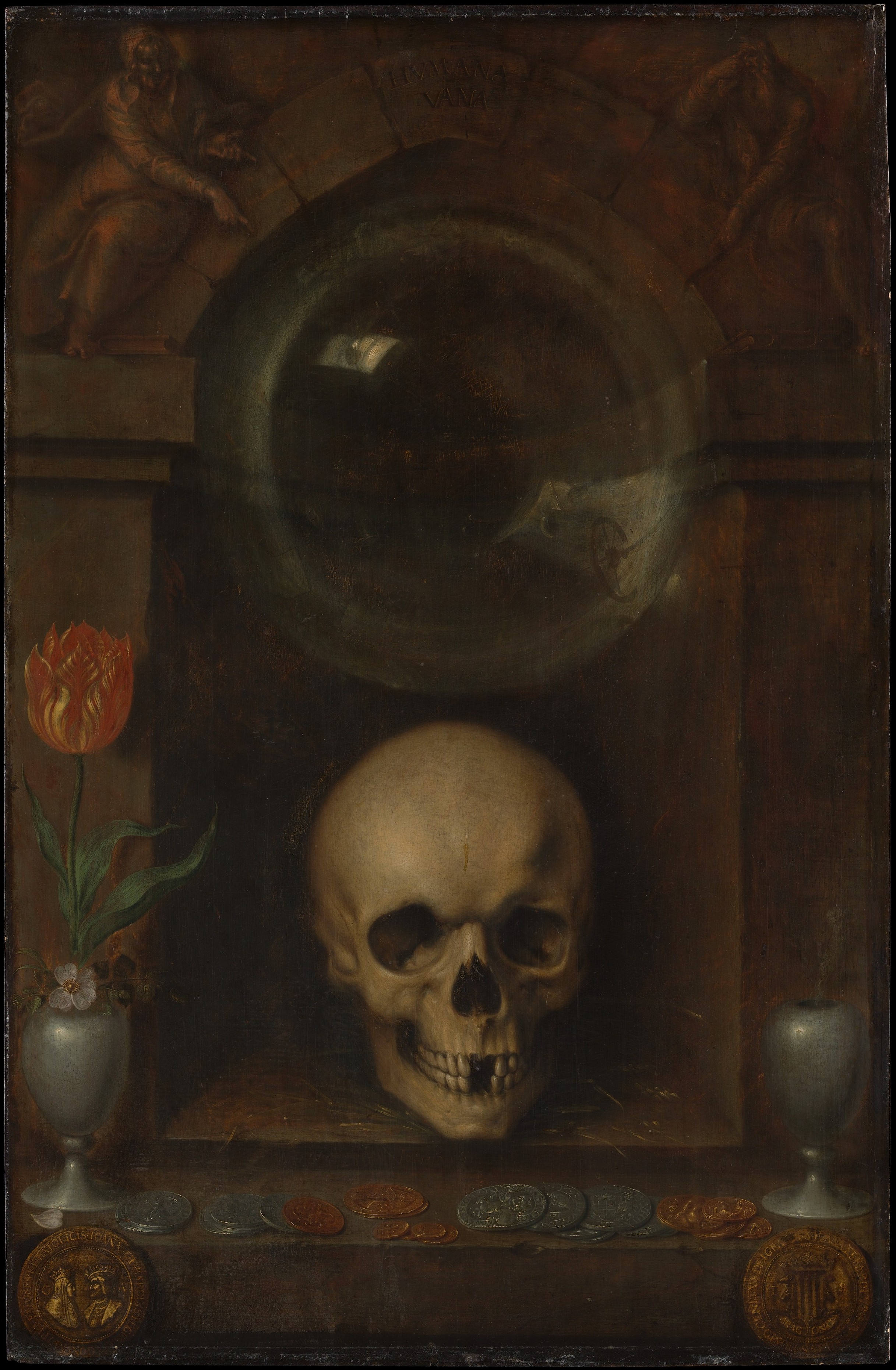
This panel is generally considered to be the earliest known independent still-life painting of a vanitas subject, or symbolic depiction of human vanity. The skull, large bubble, cut flowers, and smoking urn all evoke the brevity of life, while images floating in the bubble—such as a wheel of torture and a leper’s rattle—refer to human folly. The figures flanking the arch above are Democritus and Heraclitus, the laughing and weeping philosophers of ancient Greece.
This image cannot be enlarged, viewed at full screen, or downloaded.
Open Access
As part of the Met's Open Access policy, you can freely copy, modify and distribute this image, even for commercial purposes.
API
Public domain data for this object can also be accessed using the Met's Open Access API.
Use your arrow keys to navigate the tabs below, and your tab key to choose an item
Title:Vanitas Still Life
Artist:Jacques de Gheyn II (Netherlandish, Antwerp 1565–1629 The Hague)
Date:1603
Medium:Oil on wood
Dimensions:32 1/2 x 21 1/4 in. (82.6 x 54 cm)
Classification:Paintings
Credit Line:Charles B. Curtis, Marquand, Victor Wilbour Memorial, and The Alfred N. Punnett Endowment Funds, 1974
Object Number:1974.1
This panel, dated 1603, is generally regarded as the earliest known vanitas still life to have been painted in the Netherlands. The genre flourished from the 1620s onward. The influence of De Gheyn's composition should not be overstated, since it may not have been widely known, and it differs in character from later vanitas still lifes, which find deeper meanings in plausible realities (that is, objects one might actually encounter in everyday life). Here the artist paints a more purely conceptual image, comparable to didactic prints and title pages. (The latter, in this period, were often embellished by architectural frameworks, figures, and symbolic elements.) Nonetheless, the painting was a remarkably original work when it was made. This may reflect not only the special qualities of De Gheyn's imagination, but also his independence from the art market as a wealthy amateur. Furthermore, the possibility that the painting was intended expressly for a particular patron—such as the "Reynier Antonissen" in Amsterdam who, according to Mander (1604) owned a "Death's Head" by De Gheyn—would help to explain its exceptional character.
The dominant motifs in the picture are a human skull and, floating above it, a transparent sphere or bubble. These forms occupy a stone niche with a slightly pointed arch, the keystone of which is inscribed HVMANA VANA (Human Vanity). The spandrels flanking the arch are filled with sculptural figures of philosophers with books at their feet: to the left, Democritus, who gestures toward the globe and laughs; and, to the right, Heraclitus, who points to the sphere and weeps. The laughing and weeping philosophers were especially common in Dutch art of the seventeenth century. The sphere purposefully resembles a soap bubble, the familiar vanitas motif that suggests the emptiness and transience of human life. However, the two philosophers and the images reflected in the sphere identify it as the world, meaning mundane experience.
In De Gheyn's picture, two common vanitas symbols, cut flowers and smoke, rise from urns at either side of the niche. The painted flowers are a red-and-yellow flamed tulip (a luxury item) and a field rose, one petal of which has fallen onto the sill (where chips and cracks also suggest the ravages of time). Contemporary viewers would have recalled biblical passages comparing mortal life with flowers and smoke.
The images on and in the sphere may be described as follows. On top of the sphere, there are wavy, ambiguous forms, with at least one ball-like (or bell-like) object dangling from an appendage. In the upper center of the sphere, just to the right of the reflected window, is an imperial crown with traces of swords at top left and right. Bergström (1970) was probably correct in describing this arrangement as a trophy comprising a crown with one pair (in his reading, two pairs) of swords. The reflected window to the upper left coincides with a grayish heart, apparently stuck through with a blade or an arrow, with a flame at the top. A cascade of much less visible forms, sketched in grays and browns, descends along the highlighted left side of the sphere. They are, from top to bottom: probably a caduceus, now very faint; probably a bellows; two or three drinking vessels; to their left, a few small rectangular forms, plausibly called playing cards by Bergström; and, to the lower left, a backgammon board. On the right side of the sphere, a wagon wheel, mounted on a shaft or pole, and three flasklike shapes float in a large rectangular highlight.
The inventory of symbols that may or may not be discernible in De Gheyn's transparent sphere is, fortunately, not difficult to interpret. All is vanity: earthly possessions, authority, pleasures, and desires. The crown with swords signifies power and glory. The caduceus, if there, probably refers to commerce, the bellows to success or good fortune. Playing cards, a backgammon board, and drinking glasses would be expected attributes of pleasure and idleness. The flaming heart must symbolize earthly love, as Bergström supposed, and his reading of the wheel on the pole as the familiar Flemish instrument of torture and execution is convincing.
Of the money depicted at the bottom of the composition, all the coins shown—except for the largest example—were used as currency in the Netherlands about 1600 (for a detailed description of these, see Liedtke 2007). The exception is the hundred-ducat goldpiece minted in Zaragoza (capital of the kingdom of Aragón) in 1528, illustrated both in obverse (lower left corner) and in reverse (lower right corner). The coin, weighing 350 grams, must have been rare even in De Gheyn's lifetime; very few examples are known today, and why it was made remains a matter of speculation. The reverse bears the crowned crest of Aragón, and the obverse displays bust-length portraits of Joanna the Mad (who nominally ruled Aragón from 1516 until her death in 1555) and her son, Charles I, king of Spain (and, from 1530, Emperor Charles V), who ruled on his mother's behalf. De Gheyn faithfully reproduces the Latin inscriptions on both sides of the coin, though he improves the modeling of the portraits.
The silver medal dated 1602 on the sill at right center commemorates the capture of a Portuguese galleon by two Zeeland merchant ships earlier that year, off Saint Helena in the South Atlantic. This was a victory in the Dutch war of independence, since their enemy, Philip III, king of Spain, ruled Portugal as Philip II, treating the kingdom as a Spanish province. The Zeeland ships and their prize sailed into Middelburg on July 7, 1602. The galleon and its precious cargo (such vanities as porcelain, spices, gold, silver, and pearls) were sold off for 1.5 million guilders, which was divided among numerous entitled parties: the Zeeland chamber of the East India Company (VOC), the States of Zeeland, the Stadholder, Prince Maurits (who received 100,000 guilders), merchants who had invested in the ships, the crew, and so on. The directors of the Zeeland VOC had the medal minted in Middelburg; silver and, reportedly, gold examples (none have been identified) were handed out to members, investors, and friends.
The obverse of the medal, depicted here, shows the Zeeland lion chasing a horse on a globe, with the inscriptions: NON SVFFICIT ORBIS (The world is not enough) and QVO SALTAS INSEQVAR (Where you go, I will follow). These inscriptions are clearly legible in the painting just below De Gheyn's signature and the skull.
“Non sufficit orbis” was a personal device of Philip II, and went back, in Spanish history, to the Treaty of Tordesillas (1494), when the pope declared the world beyond Europe to be the property of Spain and Portugal. The horse must also refer to Philip II and Philip III, since their name, “Philippus” (from the Greek philipos), means “horse lover,” an etymology to which the Spanish court frequently drew attention. Thus the medal of 1602 shows the Dutch Republic (or rather, one Dutch province) chasing Spain and Portugal around the globe, which they had the hubris—or vanity—to imagine as all their own. In De Gheyn's hands the medal takes on additional currency, since he surely knew (from his own reading, his Latinist circle in Leiden, or one of his learned friends) that “non sufficit orbis” is a quote from Juvenal's Satires, specifically no. 10, on the vanity of human desire.
It has been suggested that De Gheyn gave the Zeeland medal a prominent place in the painting because he may have been its designer, but scholars of De Gheyn's oeuvre reject this idea, and historians of numismatics have proposed more plausible candidates. Nonetheless, De Gheyn was keenly interested in coins and medals, and he was the brother-in-law of Caspar Wyntgens, mintmaster of West Friesland, whose brother Melchior Wyntgens, as mintmaster of Zeeland at Middelburg (1601–12), supervised the production of the 1602 medal. The most likely scenario, therefore, is that De Gheyn and his patron (if the picture was commissioned) were quite familiar with the Zeeland medal, knew the source of Philip II's device in Juvenal, and saw that this connection invited the invention of a vanitas allegory. Thus the painting is at once topical and a meditation on the nature of all mankind, with motifs bringing to mind complementary quotations from classical authors and the Bible. The medal and coins, while symbolizing the vanities of wealth and fame, also lend a sharp political edge to the picture, with Philip II's own motto turned against him, revealed on the medal as an idle boast, and on the painting as words by which to live—and by which to die: the world does not suffice.
Mander's (1604) mention of a “death's head” by De Gheyn in the Antonissen collection has generally been connected with The Met’s picture, but could refer to a less complex composition. It has also been suggested that De Gheyn might have painted the picture for Melchior Wyntgens, which is plausible, although Mander, as a friend of Wyntgens, might have known that he owned the work in time to cite it.
If De Gheyn made this unusual work for a particular patron, which seems likely, then a strong candidate would be Prince Maurits. The artist was a member of the Stadholder's social circle in The Hague, and in the same year, 1603, was commissioned by him to paint a life-size portrait of the Spanish horse that was captured at the Battle of Nieuwpoort (Rijksmuseum, Amsterdam; SK-A-4255). Trophies of war, such as captured flags, ships, and so on, were always of keen interest to the prince, and it may be assumed that he received one of the Zeeland medals, or a number of them, in addition to his 100,000-guilder share of the booty seized in 1602.
Unfortunately, not all the circumstantial evidence in favor of Maurits as the first owner of The Met’s painting can be supported or overruled by contemporaneous documents or accounts. At the prince's death in 1625, there was no need for an inventory of his household goods, since his half brother, Prince Frederick Hendrick, was his sole heir. Frederick Hendrick was a major patron and a man of very different tastes, so it is possible that a painting owned by his deceased predecessor could have left the princely collections without leaving a trace. However, there are many other possibilities. In De Gheyn's circle during the early 1600s, and in the Dutch art world as a whole, meditations on the fragility of life and the certainty of death were commonplace, in reflection of the times.
No copies of this painting are known. At least two drawings by De Gheyn relate to the composition (see Regteren Altena 1983). One depicts three flowers, dated 1601, from which the tulip is repeated here, and the other (of about 1603?) represents Democritus and Heraclitus seated to either side of a small sphere. In the latter, the gestures are quite like those in the painting and the poses are similar, but the figures do not lean on a support and the facial types differ.
[2016; adapted from Liedtke 2007]
Inscription: Signed, dated, and inscribed: (on sill) JDGHEYN FE ANo 1603 [now largely illegible]; (on keystone of arch) HVMANA / VANA (human vanity); (lower left, on obverse of coin) IOANA·ET·KAROLVS·REGES·[ARA]GONVM·TRVNFATORES·[ET]·KATHOLICIS / C A (Joanna and Charles triumphant and Catholic kings of Aragon); (lower right, on reverse of coin) IOANA·ET·KAROLVS·[EIVS·FI]LIVS·PRIMO·GENITVS·DEI·GRA[CI]A·R[E]X / ARAGON[VM] / L S (Joanna and Charles her firstborn son by the Grace of God king of Aragon) [from a coin struck in 1528]
?Reynier Antonissen, Amsterdam (in 1604); J. H. Price, London (until 1939; sale, Christie's, London, April 21, 1939, no. 159, as "J Heyn . . . 1607," to Manenti); [Harrison, London, until 1966/67; sold to Larson]; Rolf Larson, Stockholm (1966/67–74; sold to The Met)
Stockholm. Nationalmuseum. "Holländska Mästare i Svensk ägo," March 3–April 30, 1967, no. 53.
Leiden. Stedelijk Museum De Lakenhal. "Idelheid der Ijdelheden: Hollandse Vanitas-voorstellingen uit de zeventiende eeuw," June 26–August 23, 1970, no. 12 (lent by Larson, Stockholm).
New York. The Metropolitan Museum of Art. "The Age of Rembrandt: Dutch Paintings in The Metropolitan Museum of Art," September 18, 2007–January 6, 2008, no catalogue.
New York. The Metropolitan Museum of Art. "Making Marvels: Science and Splendor at the Courts of Europe," November 18, 2019–March 1, 2020.
THIS WORK MAY NOT BE LENT.
Carel van Mander. Het Schilderboeck . . . Haarlem, 1604, fol. 294 v [see "Karel van Mander: The Lives of the Illustrious Netherlandish and German Painters", ed. Hessel Miedema, 6 vols., Doornspijk: Davaco, 1994–99, vol. 1, 1994, pp. 436–37], refers to a painting of "eene doots cop" [skull] in the collection of Reynier Antonissen, Amsterdam, possibly this work.
H[enri]. E[khard]. Greve. De Bronnen van Carel van Mander. The Hague, 1903, p. 225, records the reference in Ref. Mander 1604.
Johan Quiryn van Regteren Altena. Jacques de Gheyn: An Introduction to the Study of his Drawings. Amsterdam, 1935, p. 24, cites the reference in Ref. Mander 1604.
Ingvar Bergström. Dutch Still-Life Painting in the Seventeenth Century. London, 1956, p. 161, mentions the reference in Ref. Mander 1604.
David Oliver Merrill. "The 'Vanitas' of Jacques de Gheyn." Yale University Art Gallery Bulletin 25 (March 1960), p. 9, notes the reference in Ref. Mander 1604.
Ingvar Bergström inHolländska mästare i svensk ägo. Exh. cat., Nationalmuseum. Stockholm, 1967, pp. 47–48, no. 53, ill. p. 50, describes the composition and mentions Van Mander's reference.
Ingvar Bergström. "De Gheyn as a 'Vanitas' Painter." Oud Holland 85, no. 3 (1970), p. 143–56, fig. 1, recalls the circumstances of discovering that the work is by De Gheyn; describes the composition, identifies the symbolic motifs and several of the coins; relates it to earlier prints and drawings by De Gheyn; considers the painting to be the earliest dated independent picture of its kind, and notes the apparent reference to it in Van Mander.
Ingvar Bergström inIjdelheid der Ijdelheden: Hollandse Vanitas-voorstellingen uit de zeventiende eeuw. Exh. cat., Stedelijk Museum De Lakenhal. Leiden, 1970, unpaginated essay and pp. 10–11, no. 12, ill.
Maarten L. Wurfbain. "Over Vanitas-voorstellingen." Ijdelheid der Ijdelheden: Hollandse Vanitas-voorstellingen uit de zeventiende eeuw. Exh. cat., Stedelijk Museum De Lakenhal. Leiden, 1970, unpaginated, briefly discusses the question of whether this is the painting cited by Van Mander.
Ingvar Bergström. "Vanité et Moralité." L'Oeil no. 190 (October 1970), pp. 12, 15, fig. 3 (color), describes it as one of the most interesting paintings in the Leiden exhibition of 1970.
Pieter Fischer. Music in Paintings of the Low Countries in the 16th and 17th Centuries. Amsterdam, 1972, p. 63, mentions the work in a discussion of vanitas imagery.
J. Richard Judson. The Drawings of Jacob de Gheyn II. New York, 1973, pp. 18, 38, 42 n. 17, notes the skull's important role in vanitas paintings; discusses De Gheyn's drawing of Democritus and Heraclitus in relation to the vanitas theme; doubts that this is the picture described by Van Mander, which "must have been executed prior to 1603–1604".
Naomi Popper-Voskuil. "Selfportraiture and vanitas still-life painting in 17th-century Holland in reference to David Bailly's vanitas œuvre." Pantheon 31 (January–March 1973), p. 68, suggests that a painting by David Bailly may have been inspired by this work.
John Walsh Jr. "New Dutch Paintings at The Metropolitan Museum." Apollo 99 (May 1974), pp. 341–42, 349 n. 3, fig. 3, announces the picture's purchase by the Museum; describes it as "the earliest developed Vanitas painting"; compares the niche with Titian's "Entombment"; identifies the straw below the skull with a passage from Isaiah 40: 6-7, and cites two other Biblical sources.
Anthony M. Clark inThe Metropolitan Museum of Art: Notable Acquisitions, 1965–1975. New York, 1975, p. 95, ill., calls it "perhaps the earliest Vanitas still life".
Noémi Voskuil-Popper. "Johan de Cordua. A Forgotten Vanitas Painter [of the] 17th Century." Gazette des beaux-arts, 6th ser., 87 (February 1976), p. 74 n. 28, refers to the images of Democritus and Heraclitus in the picture as representatives of the motto, "Time to laugh and time to weep"; sees the philosophers' diverging views of the world as reflected in the division of the composition into a bright and dark side, with a flower on one side, smoke on the other; and discusses the coins as an attempt to connect vanitas imagery with portraits of Emperor Charles V and Joanna of Castille.
Ingvar Bergström et al. Natura in posa: la grande stagione della natura morta europea. Milan, 1977, p. 31, refers to a print inspired by the iconography of this painting.
Paul Abe Isaacs. "The Immobility of the Self in the Art of Edouard Manet: A Study with Special Emphasis on the Relationship of his Imagery to That of Gustave Flaubert and Stephane Mallarmé." PhD diss., Brown University, 1977, p. 178 n. 66.
André Chastel. Fables, formes, figures. Paris, 1978, vol. 1, p. 26, fig. 8, reflects on man's mortality and relates this painting to a quote from Malraux.
B. A. Heezen-Stoll. "Een vanitasstilleven van Jacques de Gheyn II uit 1621: afspiegeling van neostoïsche denkbeelden." Oud Holland 93, no. 4 (1979), pp. 243–44, 250, fig. 16, sees De Gheyn (not David Bailly) as the originator of vanitas painting in Leiden based on the evidence of this work.
Christian Klemm. "Weltdeutung—Allegorien und Symbole in Stilleben." Stilleben in Europa. Ed. Gerhard Langemeyer and Hans-Albert Peters. Exh. cat., Westfälisches Landesmuseum für Kunst und Kulturgeschichte. Münster, 1979, pp. 194, 196, 202, 206, ill. p. 199, summarizes the symbolism and compares the later use of a "soap bubble or glass sphere" by Jan de Heem.
Jochen Becker. "Das Buch im Stilleben—das Stilleben im Buch." Stilleben in Europa. Ed. Gerhard Langemeyer and Hans-Albert Peters. Exh. cat., Westfälisches Landesmuseum für Kunst und Kulturgeschichte. Münster, 1979, pp. 455, 458, mistakenly describes the painting as by De Gheyn's father, and compares it with a later work by Pieter van Roestraeten.
Alberto Veca. Vanitas: Il simbolismo del tempo. Exh. cat., Galleria Lorenzelli. Bergamo, 1981, pp. 64–65, fig. 75, cites the panel as the first vanitas painting, and compares it to images of skulls on the back of earlier Flemish portraits.
E. de Jongh inStill-Life in the Age of Rembrandt. Exh. cat., Auckland City Art Gallery. Auckland, New Zealand, 1982, p. 206, fig. 41d, mistakenly lists it as in a private collection in Stockholm.
James A. Welu. "Arrangements with Meaning: Dutch and Flemish Still Life." 600 Years of Netherlandish Art: Selected Symposium Lectures. Memphis, 1982, pp. 32, 34, fig. 9, discusses the picture's meaning.
Ingvar Bergström. "Composition in Flower-Pieces of 1605–1609 by Ambrosius Bosschaert the Elder." Tableau 5 (November–December 1982), p. 175, mentions the tulip in this painting as a symbol of transience.
Sam Segal. A Flowery Past: A Survey of Dutch and Flemish Flower Painting from 1600 until the Present. Exh. cat., Gallery P. de Boer. Amsterdam, 1982, p. 31, proposes that Jan Brueghel was inspired by the coins in this painting.
I[ohan]. Q[uirijn]. van Regteren Altena. Jacques De Gheyn: Three Generations. The Hague, 1983, vol. 1, pp. 84–85, 177 n. 14; vol. 2, pp. 15, 38, 130, 142, no. 11; vol. 3, pl. 3, describes the painting's style and slighty refines the iconographic reading proposed by Bergström [Ref. 1970]; considers it the painting cited in Van Mander; argues that three drawings by De Gheyn, one of Heraclitus and Democritus, one of three flowers, and one of a skull, are studies for the painting.
Bob Haak. The Golden Age: Dutch Painters of the Seventeenth Century. New York, 1984, pp. 118, 126–28, fig. 218, cites the tulip as an emblem of mortality; considers it likely to be the painting mentioned by Van Mander.
Onno ter Kuile. Seventeenth-century North Netherlandish Still Lifes. The Hague, 1985, pp. 32–33, 35, fig. 11, calls it "the earliest known 'Vanitas'"; reviews the symbolic motifs and cites the work as a likely influence on David Bailly and other vanitas still life painters in Leiden.
Sam Segal. "Roelant Savery als Blumenmaler." Roelant Savery in seiner Zeit (1576-1639). Exh. cat., Wallraf-Richartz-Museum. Cologne, 1985, pp. 57, 64 n. 13, compares it with a painting by Roelant Savery dated 1603.
Peter C. Sutton. A Guide to Dutch Art in America. Grand Rapids, Mich., 1986, p. 190, cites it as "the earliest 'vanitas' in existence" and as "one of the most important if not best-preserved still lifes in the [Museum's] collection".
A. W. F. M. Meij inJacques de Gheyn II Drawings, 1565–1629. Ed. A. W. F. M. Meij. Exh. cat., Museum Boymans-van Beuningen. Rotterdam, 1986, p. 55, under no. 38.
Jan Briels. Vlaamse Schilders in de Noordelijke Nederlanden in het begin van de Gouden Eeuw 1585-1630. Haarlem, 1987, pp. 260, 262, fig. 328 (color), interprets the image as presenting a choice between material and spiritual values.
Susan Donahue Kuretsky. "Het schilderen van bloemen in de 17de eeuw." Kunstschrift no. 3 (1987), pp. 85–86, fig. 3, sees the vase with a striped tulip and a rose as a symbol of mortality.
Sam Segal. A Prosperous Past: The Sumptuous Still Life in the Netherlands, 1600–1700. Ed. William B. Jordan. Exh. cat., Stedelijk Museum Het Prinsenhof, Delft. The Hague, 1989, pp. 19–20, 65, 207 n. 20, calls it "the oldest isolated vanitas still life in Dutch art" and considers it "the basis of a great tradition"; identifies the figures on the coins as Charles and Johanna of Aragon, arguing that they are evidence of De Gheyn's direct contact with Antwerp.
Walter Liedtke. "Dutch Paintings in America: The Collectors and Their Ideals." Great Dutch Paintings from America. Exh. cat., Mauritshuis, The Hague. Zwolle, The Netherlands, 1990, p. 55.
Peter C. Sutton in Ben Broos. "Recent Patterns of Public and Private Collecting of Dutch Art." Great Dutch Paintings from America. Exh. cat., Mauritshuis. The Hague, 1990, p. 104.
Jacques Foucart. "La peinture hollandaise et flamande de vanité: une réussite dans la diversité." Les Vanités dans la peinture au XVIIe siècle: Méditations sur la richesse, le dénuement et la rédemption. Ed. Alain Tapié. Exh. cat., Musée des Beaux-Arts de Caen. Caen, 1990, p. 56, fig. 1, considers the picture to represent a vanitas-type of the years 1600–30.
Kristine Koozin. The Vanitas Still Lifes of Harmen Steenwyck: Metaphoric Realism. Lewiston, N.Y., 1990, p. 28, fig. 8, interprets the figures of the philosophers, the bubble, and the straw beneath the skull.
Harald Olbrich and Helga Möbius. Holländische Malerei des 17. Jahrhunderts. Leipzig, 1990, p. 246–47, pl. XXIII, use this painting to begin a discussion of Dutch vanitas still lifes.
Ingvar Bergström. "Homo Bulla: La boule transparente dans la peinture hollandaise à la fin du XVIe siècle et au XVIIe siècle." Les Vanités dans la peinture au XVIIe siècle: Méditations sur la richesse, le dénuement et la rédemption. Ed. Alain Tapié. Exh. cat., Musée des Beaux-Arts de Caen. Caen, 1990, pp. 51–52, pl. 6, describes the composition, diagrams the symbols in the bubble, and compares the symmetry of the images with allegorical prints.
Alain Tapié inLes Vanités dans la peinture au XVIIe siècle: Méditations sur la richesse, le dénuement et la rédemption. Ed. Alain Tapié. Exh. cat., Musée des Beaux-Arts de Caen. Caen, 1990, p. 242, mistakes De Heem for De Gheyn as the painting's author.
E. John Walford. Jacob van Ruisdael and the Perception of Landscape. New Haven, 1991, p. 215 n. 21, considers the meaning of the wheel that appears in the sphere.
Serge Alexandre. "La nature morte de 'vanité' en Hollande, 'memento mori' ou ésotérisme?" Art & Fact no. 10 (1991), pp. 54, 59 n. 23, fig. 3, describes the iconography and raises the question of whether this picture can really be described as a still life.
Josefine Leistra. Bredius, Rembrandt en het Mauritshuis!!!. Exh. cat., Mauritshuis, The Hague. Zwolle, The Netherlands, 1991, p. 106, fig. 1, under no. 25, cites it as the earliest independent vanitas painting.
Marcel George Roethlisberger. "Abraham Bloemaert's Vanitas Representations." Delineavit et Sculpsit no. 5 (May 1991), pp. 22, 26 n. 14, mentions the picture as contemporary with a vanitas painting by Abraham Bloemaert.
Bernard Barryte. In Medusa's Gaze: Still Life Paintings from Upstate New York Museums. Exh. cat., Memorial Art Gallery of the University of Rochester. Rochester, N.Y., 1991, unpaginated, under no. 4.
Cynthia Kortenhorst-von Bogendorf Rupprath inJudith Leyster: A Dutch Master and Her World. Exh. cat., Worcester Art Museum. Zwolle, The Netherlands, 1993, p. 216, mentions the tulip as a symbol of human mortality.
Marcel G. Roethlisberger. Abraham Bloemaert and His Sons: Paintings and Prints. Doornspijk, The Netherlands, 1993, vol. 1, p. 102, under no. 55, cites it in connection with Bloemaert's painting of a "skull with other motifs" cited by Van Mander.
Sam Segal in "De symbolick van de Tulp." De Tulp en de Kunst. Exh. cat., Nieuwe Kerk, Amsterdam. Zwolle, The Netherlands, 1994, pp. 15, 114 n. 16, fig. 10, suggests that the coins symbolize the material world of mankind and worldly power.
Seymour Slive. Dutch Painting 1600–1800. New Haven, 1995, p. 282.
Erika Gemar-Koeltzsch. Luca Bild-Lexikon: Holländische Stillebenmaler im 17. Jahrhundert. Ed. Klaus Ertz and Christa Nitze-Ertz. Lingen, Germany, 1995, vol. 2, pp. 376–77, no. 135/1, ill.
Görel Cavalli-Björkman and Bo Nilsson. Still Leben. Exh. cat., Nationalmuseum. Stockholm, 1995, pp. 140, 230, refer to it as the earliest "free-standing" Vanitas composition.
Katharine Baetjer. European Paintings in The Metropolitan Museum of Art by Artists Born Before 1865: A Summary Catalogue. New York, 1995, p. 296, ill., as "Vanitas Still Life".
E. K. J. Reznicek inThe Dictionary of Art. Ed. Jane Turner. Vol. 12, New York, 1996, p. 532, calls it "Allegory of Mortality".
Hans J. van Miegroet inThe Dictionary of Art. Ed. Jane Turner. Vol. 31, New York, 1996, p. 881, fig. 1, calls it one of the earliest vanitas still life paintings.
Víctor I. Stoichita. The Self-Aware Image: An Insight into Early Modern Meta-Painting. Cambridge, 1997, pp. 28–29, 31, 186, 192, fig. 13, compares this painting to the allegorical and vanitas imagery that often appeared on the reverse of panels in earlier centuries, noting that here reverse becomes obverse; adds that "an external reality" appears to be reflected in the large glass sphere over the skull.
Simon Schama. Rembrandt's Eyes. New York, 1999, p. 709 n. 15, refers to the tulip in the painting as an emblem of "mortality and remembrance".
Hessel Miedema, ed. Karel van Mander: The Lives of the Illustrious Netherlandish and German Painters.. By Karel van Mander I. Vol. 6, Doornspijk, The Netherlands, 1999, p. 49, fig. 41, identifies the painting called "eene doots cop" by Van Mander with the Museum's picture; describes its composition and compares it with a painting of a "Skull with other subsidiary elements" (een dootshooft met ander byvoeghselen) by Abraham Bloemaert, which was in the collection of the Amsterdam collector Jacques Razet in 1604.
Alan Chong and Wouter Kloek. Still-Life Paintings from the Netherlands 1550–1720. Exh. cat., Rijksmuseum. Amsterdam, 1999, pp. 140–41, fig. 15a, compares it with a vanitas still life by Pieter Claesz in the MMA (49.107).
Gay van der Meer. "Vergankelijke rijkdom: Een penning, afgebeeld op een Vanitasschilderij, van de verovering van het Portugese galjoen São Jago door twee Zeeuwse schepen nabij Sint-Helena in 1602." Tijdschrift voor Zeegeschiedenis 23 (2004), pp. 17–19, 25–27, fig. 1, identifies the coins and a medal of 1602; considers their possible topical significance and reviews the question of patronage.
Christian Klemm inPieter Claesz: Master of Haarlem Still Life. Ed. Pieter Biesboer. Exh. cat., Frans Halsmuseum, Haarlem. Zwolle, The Netherlands, 2004, pp. 79–80, fig. 4, places the painting in an historical context, comparing it with works by Abraham Bloemaert and Cornelis Ketel; sees it as progressive in its realistic depiction, but also as theatrically emblematic.
Esmée Quodbach. "The Age of Rembrandt: Dutch Paintings in The Metropolitan Museum of Art." Metropolitan Museum of Art Bulletin 65 (Summer 2007), pp. 14, 59, fig. 69 (color).
Walter Liedtke. Dutch Paintings in The Metropolitan Museum of Art. New York, 2007, vol. 1, pp. xi, 112, 128, 213–23, no. 48, colorpl. 48, figs. 56, 58 (color details); vol. 2, pp. 636, 897.
Jacques de Gheyn II (Netherlandish, Antwerp 1565–1629 The Hague)
late 16th–early 17th century
Resources for Research
The Met's Libraries and Research Centers provide unparalleled resources for research and welcome an international community of students and scholars.
The Met Collection API is where all makers, creators, researchers, and dreamers can connect to the most up-to-date data and public domain images for The Met collection. Open Access data and public domain images are available for unrestricted commercial and noncommercial use without permission or fee.
Feedback
We continue to research and examine historical and cultural context for objects in The Met collection. If you have comments or questions about this object record, please complete and submit this form. The Museum looks forward to receiving your comments.