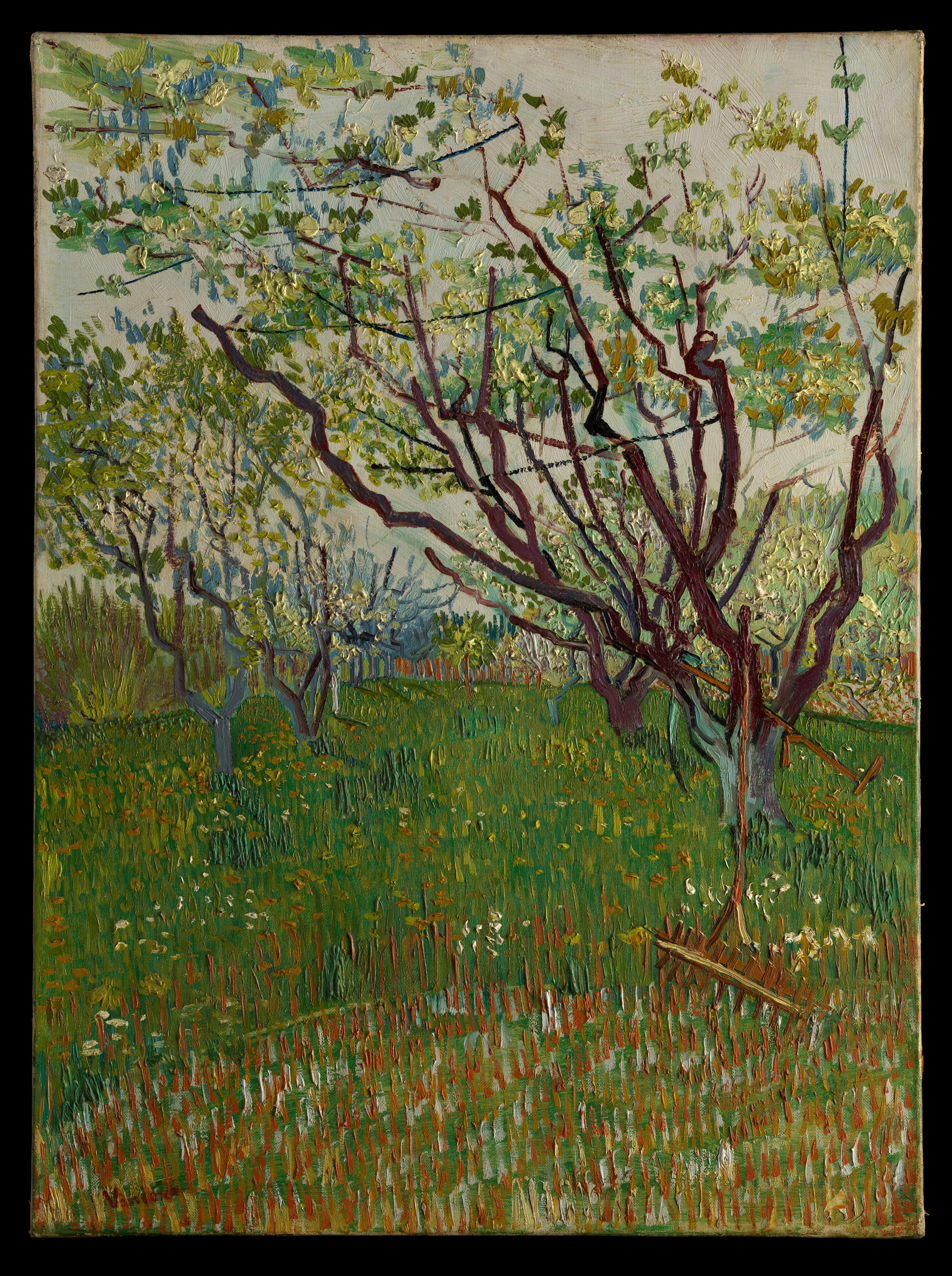
The arrival of spring in Arles in 1888 found Van Gogh "in a fury of work." As he wrote to his brother Theo, "the trees are in blossom and I would like to do a Provençal orchard of tremendous gaiety." Between late March and late April, the artist dedicated fourteen canvases to the subject, working in a range of sizes, formats, and styles. This composition, dominated by the angular, elongated branches of the budding trees, attests to Van Gogh’s admiration for Japanese prints. His inclusion of the scythe and rake makes this one of only two orchard paintings to hint at a human presence.
Use your arrow keys to navigate the tabs below, and your tab key to choose an item
Title:The Flowering Orchard
Artist:Vincent van Gogh (Dutch, Zundert 1853–1890 Auvers-sur-Oise)
Date:1888
Medium:Oil on canvas
Dimensions:28 1/2 x 21 in. (72.4 x 53.3 cm)
Classification:Paintings
Credit Line:The Mr. and Mrs. Henry Ittleson Jr. Purchase Fund, 1956
Object Number:56.13
Inscription: Signed (lower left): Vincent
the artist's brother, Theo van Gogh, Paris (1888–d. 1891; sent to him by the artist on or about May 7, 1888); his widow, Johanna van Gogh-Bonger, Amsterdam (from 1891); [Kunstzalen Oldenzeel, Rotterdam, 1904]; H. P. Bremmer, The Hague (1904–55; on loan to the Gemeentemuseum, The Hague, from 1924; cat., 1935, p. 77, no. 40–24); [E. J. van Wisselingh & Co., Amsterdam, 1955]; [Wildenstein, New York, 1955–56; sold to The Met]
Rotterdam. Kunstzalen Oldenzeel. "Tentoonstelling van Werken, door Vincent van Gogh," November 10–December 15, 1904, no. 65 (as "Boomgaard," property of H. P. Bremmer).
Rotterdamsche Kunstkring. "Tentoonstelling van een aantaal werken van Vincent van Gogh," June 11–July 10, 1910, no. 3 (as "Bloeiende boomgaard," lent by Bremmer) [see Feilchenfeldt 2013].
Cologne. Städtische Ausstellungshalle. "Internationale Kunstausstellung des Sonderbundes Westdeutscher Kunstfreunde und Künstler," May 25–September 30, 1912, no. 20 (as "Obstgarten," lent by H. P. Bremmer, The Hague).
The Hague. Gebouw Lange Voorhout I. "Werken van Vincent van Gogh," July–September 1, 1913, no. 80 (as "Boomgaard," lent by a private collection, The Hague) [see Feilchenfeldt 2013].
The Hague. Gemeentemuseum. "Verzameling H. P. Bremmer," March 9–April 23, 1950, no. 35 (as "Boomgaard").
Milan. Palazzo Reale. "Van Gogh: Dipinti e disegni," February–April 1952, no. 94 (as "Frutteto," lent by Dott. H. P. Bremmer, The Hague).
Amsterdam. E. J. van Wisselingh & Co. "Maîtres français: XIXme et XXme siècles," October 10–November 12, 1955, no. 14 (as "Verger").
New York. The Metropolitan Museum of Art. "The Impressionist Epoch," December 12, 1974–February 10, 1975, not in catalogue.
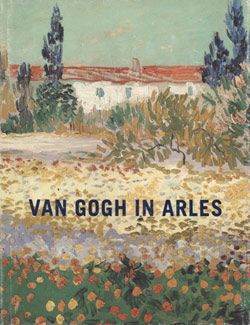
New York. The Metropolitan Museum of Art. "Van Gogh in Arles," October 18–December 30, 1984, no. 9.
Yokohama Museum of Art. "Treasures from The Metropolitan Museum of Art: French Art from the Middle Ages to the Twentieth Century," March 25–June 4, 1989, no. 98.
Fort Lauderdale. Museum of Art. "Corot to Cézanne: 19th Century French Paintings from The Metropolitan Museum of Art," December 22, 1992–April 11, 1993, no catalogue.
Museum of Fine Arts, Houston. "The Masterpieces of French Painting from The Metropolitan Museum of Art: 1800–1920," February 4–May 6, 2007, no. 108.
Berlin. Neue Nationalgalerie. "Französische Meisterwerke des 19. Jahrhunderts aus dem Metropolitan Museum of Art," June 1–October 7, 2007, unnumbered cat.
Marseilles. Centre de la Vieille Charité. "Van Gogh Monticelli," September 16, 2008–January 11, 2009, no. 57.
London. Royal Academy of Arts. "The Real Van Gogh: The Artist and His Letters," January 23–April 18, 2010, no. 114 (as "Flowering Orchard").
Denver Art Museum. "Becoming Van Gogh," October 21, 2012–January 20, 2013, no. 78.
Copenhagen. Ordrupgaard. "Van Gogh, Gauguin, Bernard: Friction of Ideas," February 7–June 22, 2014, unnumbered cat. (colorpl. 72).
Helsinki. Ateneum Art Museum. "Japanomania in the Nordic Countries, 1875–1918," February 18–May 15, 2016, not in catalogue.
Oslo. National Museum of Art, Architecture and Design. "Japanomania in the North 1875–1918," June 17–October 16, 2016, not in catalogue.
Copenhagen. Statens Museum for Kunst. "Japanomania 1875–1918," January 19–April 23, 2017, not in catalogue.
Brisbane. Queensland Art Gallery | Gallery of Modern Art. "European Masterpieces from The Metropolitan Museum of Art, New York," June 12–October 17, 2021, unnumbered cat.
Osaka. Osaka City Museum of Fine Arts. "European Masterpieces from The Metropolitan Museum of Art, New York," November 13, 2021–January 16, 2022, no. 61.
Tokyo. National Art Center. "European Masterpieces from The Metropolitan Museum of Art, New York," February 9–May 30, 2022, no. 61.
Vincent van Gogh. Letter to his brother Theo. [on or about April 13, 1888] [Van Gogh Museum, Amsterdam, inv. no. b517 V/1962; pub. in Van Gogh Letters 1958, letter no. 477; Van Gogh Letters 2009, letter no. 597], mentions a painting, possibly this one, that he is considering as part of a proposed triptych [the side panels of which are F513 (Kröller-Müller Museum, Otterlo) and F551 (private collection)].
Vincent van Gogh. Letter to Émile Bernard. [April 19, 1888] [Thaw Collection, Morgan Library & Museum, New York; pub. in Van Gogh Letters 1958, letter no. B4; Van Gogh Letters 2009, letter no. 599], mentions "nine orchards on the go," possibly including this work.
Vincent van Gogh. Letter to his brother Theo. [on or about April 20, 1888] [Van Gogh Museum, Amsterdam, inv. nos. b518 a-b V/1962; pub. in Van Gogh Letters 1958, letter no. 478; Van Gogh Letters 2009, letter no. 600], writes that he now has ten paintings of orchards, including this work, as well as "three small studies, and a large one of a cherry tree that I worked to death".
Vincent van Gogh. Letter to his brother Theo. [May 1, 1888] [Van Gogh Museum, Amsterdam, inv. nos. b520 a-b V/1962; pub. in Van Gogh Letters 1958, letter no. 480; Van Gogh Letters 2009, letter no. 602], mentions a group of roughly a dozen orchard paintings, including this work among the six paintings with which he is somewhat dissatisfied; says that he will send Theo "ten or so" pictures in the next few days.
Vincent van Gogh. Letter to his brother Theo. [May 7, 1888] [Van Gogh Museum, Amsterdam, inv. no. b524 V/1962; pub. in Van Gogh Letters 1958, letter no. 484; Van Gogh Letters 2009, letter no. 606], states that he is sending Theo "all the studies I have," a shipment of at least 26 paintings, including this picture.
Vincent van Gogh. Letter to his brother Theo. [May 10, 1888] [Van Gogh Museum, Amsterdam, inv. no. b526 V/1962; pub. in Van Gogh Letters 1958, letter no. 486; Van Gogh Letters 2009, letter no. 608], discusses the contents of a crate of paintings that he has sent to Theo, mentioning "the series of orchards".
Moderne Kunstwerken 2, no. 2 (1904), unpaginated, pl. 14, as "Boomgaard," owned by Bremmer.
J.-B. de La Faille. L'Oeuvre de Vincent van Gogh: Catalogue Raisonné. Paris, 1928, vol. 1, p. 157, no. 552; vol. 2, pl. 151, as "Verger".
W. Scherjon and Jos. De Gruyter. Vincent van Gogh's Great Period: Arles, St. Rémy and Auvers sur Oise (complete catalogue). Amsterdam, 1937, p. 54, Arles no. 22, ill., as "Cherry-Tree"; identify it as the work mentioned in letters 478 and B4 [see Refs. 1888].
J.-B. de La Faille. Vincent van Gogh. London, [1939], pp. 401, 565, 578, 588, 591, no. 577, ill., as "The Orchard"; dates it April 1888.
W[ilhelm]. Uhde and Ludwig Goldscheider. Vincent van Gogh. New York, 1941, pl. 19 [German ed., Vienna, 1936], as "Orchard," in the collection of H. P. Bremmer, The Hague; date it April 1888.
Wilhelm Uhde and Ludwig Goldscheider. Vincent van Gogh. 3rd ed. Vienna, [1951], pl. 35, p. 3 of back matter, as "Orchard"; date it 1888.
Van Gogh: Dipinti e disegni. Exh. cat., Palazzo Reale. Milan, 1952, p. 51, no. 94, as "Frutteto".
Theodore Rousseau Jr. "New Accessions of Paintings." Metropolitan Museum of Art Bulletin 14 (April 1956), p. 198, ill. p. 203, dates it April 1888.
August Kuhn-Foelix. Vincent van Gogh: Eine Psychographie. Bergen, Germany, 1958, p. 140, pl. 34, as "Geäst der Gartenbilder".
Frank Elgar. Van Gogh: A Study of His Life and Work. New York, 1958, p. 110, no. 105, ill., as "Orchard," in the collection of H. P. Bremmer, The Hague; dates it April 1888.
Vincent van Gogh. The Complete Letters of Vincent van Gogh with Reproductions of All the Drawings in the Correspondence. Greenwich, Conn., 1958, under letter nos. 477 (possibly this work), 478, 480, 484, 486, B4 (possibly this work).
Charles Sterling and Margaretta M. Salinger. French Paintings: A Catalogue of the Collection of The Metropolitan Museum of Art. Vol. 3, XIX–XX Centuries. New York, 1967, pp. 182–83, ill.
J.-B. de La Faille. The Works of Vincent van Gogh: His Paintings and Drawings. Amsterdam, 1970, pp. 232, 525, 633, no. 552, ill., as "The Orchard: White Blossoms and Violet Branches"; dates it April 1888; identifies it as the spoiled painting of a cherry tree referred to in letter nos. 478 and B4 [see Refs. 1888]; states that it has the same composition as F1516 (The Hyde Collection, Glens Falls, New York), a drawing of an orchard with the towers of Arles in the background.
Paolo Lecaldano. L'opera pittorica completa di Van Gogh e i suoi nessi grafici. Vol. 2, Da Arles a Auvers. repr. [1st ed., 1966]. Milan, 1971–77, p. 205, no. 488, ill., as "Frutteto in fiore"; dates it April 1888.
Matthias Arnold. "Duktus und Bildform bei Vincent van Gogh." PhD diss., Ruprecht-Karl University, Heidelberg, 1973, p. 193 n. 371.
Carl R. Baldwin. The Impressionist Epoch. Exh. brochure, The Metropolitan Museum of Art. [New York], 1974, p. 21.
Jan Hulsker. The Complete Van Gogh: Paintings, Drawings, Sketches. [1st ed., Amsterdam, 1977]. New York, 1980, pp. 310, 313, no. 1381, ill., as "Orchard with White Blossoms"; believes this to be one of five paintings of orchards not mentioned in Van Gogh's letters, and dates this group to the last week of March 1888.
Ronald Pickvance. Van Gogh in Arles. Exh. cat., The Metropolitan Museum of Art. New York, 1984, pp. 45, 48, 61, no. 9, ill. (color), expresses doubt that this is the spoiled painting of a cherry tree referred to in letter nos. 478 and B4 [see Refs. 1888]; believes it to depict the same orchard shown in the drawing "Orchard with Arles in the Background" (F1516; The Hyde Collection, Glens Falls, New York); states that the painting was sent to Theo in early May 1888.
Walter Feilchenfeldt. Vincent van Gogh & Paul Cassirer, Berlin: The Reception of Van Gogh in Germany from 1901 to 1914. Zwolle, The Netherlands, 1988, pp. 103, 149.
Susan Alyson Stein inTreasures from The Metropolitan Museum of Art: French Art from the Middle Ages to the Twentieth Century. Exh. cat., Yokohama Museum of Art. [Tokyo], 1989, p. 153, no. 98, ill. (color), gives early provenance of the picture, stating that it was sent to Theo in early May 1888.
Roger Hurlburt. "Free Spirits." Sun-Sentinel (Fort Lauderdale) (December 20, 1992), p. 4D, ill.
Helen Kohen. "Lasting Impressions." Miami Herald (December 20, 1992), p. 6I.
Matthias Arnold. Vincent van Gogh: Werk und Wirkung. Munich, 1995, p. 408–9.
Katharine Baetjer. European Paintings in The Metropolitan Museum of Art by Artists Born Before 1865: A Summary Catalogue. New York, 1995, p. 494, ill.
Jan Hulsker. The New Complete Van Gogh: Paintings, Drawings, Sketches. rev. ed. Amsterdam, 1996, p. 313, no. 1381, ill.
Hildelies Balk inThe Paintings of Vincent van Gogh in the Collection of the Kröller-Müller Museum. Ed. Toos van Kooten and Mieke Rijnders. Otterlo, 2003, pp. 430, 436.
Walter Feilchenfeldt. By Appointment Only: Cézanne, Van Gogh and Some Secrets of Art Dealing. English ed. London, 2006, p. 298, ill. p. 299 (color), as "The Orchard in Blossom"; dates it to April 1889 and argues that it was one of seven paintings made in Arles that spring; contends that Van Gogh left these paintings behind when he moved to St. Rémy and then retrieved them on 9 July 1889, sending them to Theo on 15 July 1889, along with the first paintings made in St. Rémy.
Marije Vellekoop, and Roelie Zwikker, with the assistance of Monique Hageman. Vincent van Gogh, Drawings. Vol. 4, Arles, Saint-Rémy & Auvers-sur-Oise, 1888–90. Zwolle, The Netherlands, 2007, part 1, p. 56 n. 1.
Susan Alyson Stein inThe Masterpieces of French Painting from The Metropolitan Museum of Art: 1800–1920. Exh. cat., Museum of Fine Arts, Houston. New York, 2007, pp. 147, 218, no. 108, ill. (color and black and white), dates it among the fourteen paintings of flowering fruit trees executed between late March and late April 1888.
Vincent van Gogh. Vincent van Gogh—The Letters. Ed. Leo Jansen, Hans Luijten, and Nienke Bakker. London, 2009, vol. 4, p. 56, under letter no. 597, p. 61, under letter no. 599, pp. 64, 66, fig. 10 (color), under letter no. 600, pp. 72–73, fig. 14 (color), under letter no. 602, p. 79, under letter no. 606; p. 81, under letter no. 608, identify this work as possibly the painting that Van Gogh was considering as part of a proposed triptych; possibly one of the "nine orchards on the go" on April 19, 1888; and as one of the at least 26 works sent to Theo in May 1888.
Teio Meedendorp inThe Real Van Gogh: The Artist and His Letters. Exh. cat., Royal Academy of Arts. London, 2010, p. 207, no. 114, ill. pp. 206, 209 (color, overall and detail), dates it April 1888, calling it perhaps the last of the series of fourteen flowering orchard paintings; suggests that it depicts plum and apple trees; based on the similar drawing (Hyde Collection, Glen Falls, New York; F1516), identifies this site as south of Arles, near the ancient Roman remains of Les Alyscamps.
Nienke Bakker inThe Real Van Gogh: The Artist and His Letters. Exh. cat., Royal Academy of Arts. London, 2010, p. 196.
Richard Shiff inVan Gogh: Up Close. Ed. Cornelia Homburg. Exh. cat., Philadelphia Museum of Art. New Haven, 2012, pp. 134, 274, fig. 102 (color).
Louis van Tilborgh and Evert van Uitert inBecoming van Gogh. Ed. Timothy J. Standring and Louis van Tilborgh. Exh. cat., Denver Art Museum. Denver, 2012, pp. 21, 42, 217, 273, no. 78, ill. (color).
Timothy J. Standring inBecoming Van Gogh. Ed. Timothy J. Standring and Louis van Tilborgh. Exh. cat., Denver Art Museum. Denver, 2012, pp. 129–30, no. 78, ill. on pp. 130, 217 (color).
Alisia Robin Coon inBecoming Van Gogh. Ed. Timothy J. Standring and Louis van Tilborgh. Exh. cat., Denver Art Museum. Denver, 2012, p. 259.
Catherine Restrepo. "Bouquet of Flowers in a Vase: Van Gogh's 'Unexpected' Painting." Providence College Art Journal 2012, no. 1 (2012), p. 30, fig. 5 (color).
Walter Feilchenfeldt. Vincent van Gogh: The Years in France. Complete Paintings 1886–1890. London, 2013, pp. 176, 291, 314, 342, 345, ill. (color) [1st German ed., 2009], as "The Orchard, White Blossoms and Violet Branches," dated April 17, 1889.
Peter Schjeldahl. "A Visit with Vincent." The New Yorker. August 12, 2014, unpaginated, ill. (color) [online only: http://www.newyorker.com/culture/cultural-comment/visit-vincent], notes that it was inspired by Japanese prints.
Anne-Birgitte Fonsmark. Van Gogh Gauguin Bernard: Friction of Ideas. Exh. cat., Ordrupgaard. Copenhagen, 2014, pp. 81, 84, colorpl. 72, notes that the presence of the rake and scythe hint at a human presence not found in the rest of the series; sees the influence of Japanese woodblock prints in the stylised lines and expressivity of the trees.
Griselda Pollock inVan Gogh. London, 2015, p. 39, colorpl. 19.
Katharine Baetjer inEuropean Masterpieces from The Metropolitan Museum of Art, New York. Exh. cat., Queensland Art Gallery | Gallery of Modern Art. South Brisbane, 2021, pp. 217, 233, ill. pp. 6, 216 (color, overall and detail).
This work is part of a series of orchards in bloom that Van Gogh worked on in Arles during spring 1888, and that he described in a letter to his brother Theo (published in The Complete Letters of Vincent van Gogh, 3 vols., Greenwich, Conn., 1958, vol. 2, pp. 545–46, letter no. 477), illustrating his plans with a sketch of a vertical fruit tree flanked on either side by a horizontal orchard. The artist originally contemplated nine canvases, in sets of three, to be followed the next spring by a similar series of larger paintings. In such a scheme, this work, a vertical one, would have been one of the central canvases.
Near the end of his life, Vincent van Gogh moved from Paris to the city of Arles in southeastern France, where he experienced the most productive period of his artistic career.
Vincent van Gogh (Dutch, Zundert 1853–1890 Auvers-sur-Oise)
1885
Resources for Research
The Met's Libraries and Research Centers provide unparalleled resources for research and welcome an international community of students and scholars.
The Met Collection API is where all makers, creators, researchers, and dreamers can connect to the most up-to-date data and public domain images for The Met collection. Open Access data and public domain images are available for unrestricted commercial and noncommercial use without permission or fee.
Feedback
We continue to research and examine historical and cultural context for objects in The Met collection. If you have comments or questions about this object record, please complete and submit this form. The Museum looks forward to receiving your comments.