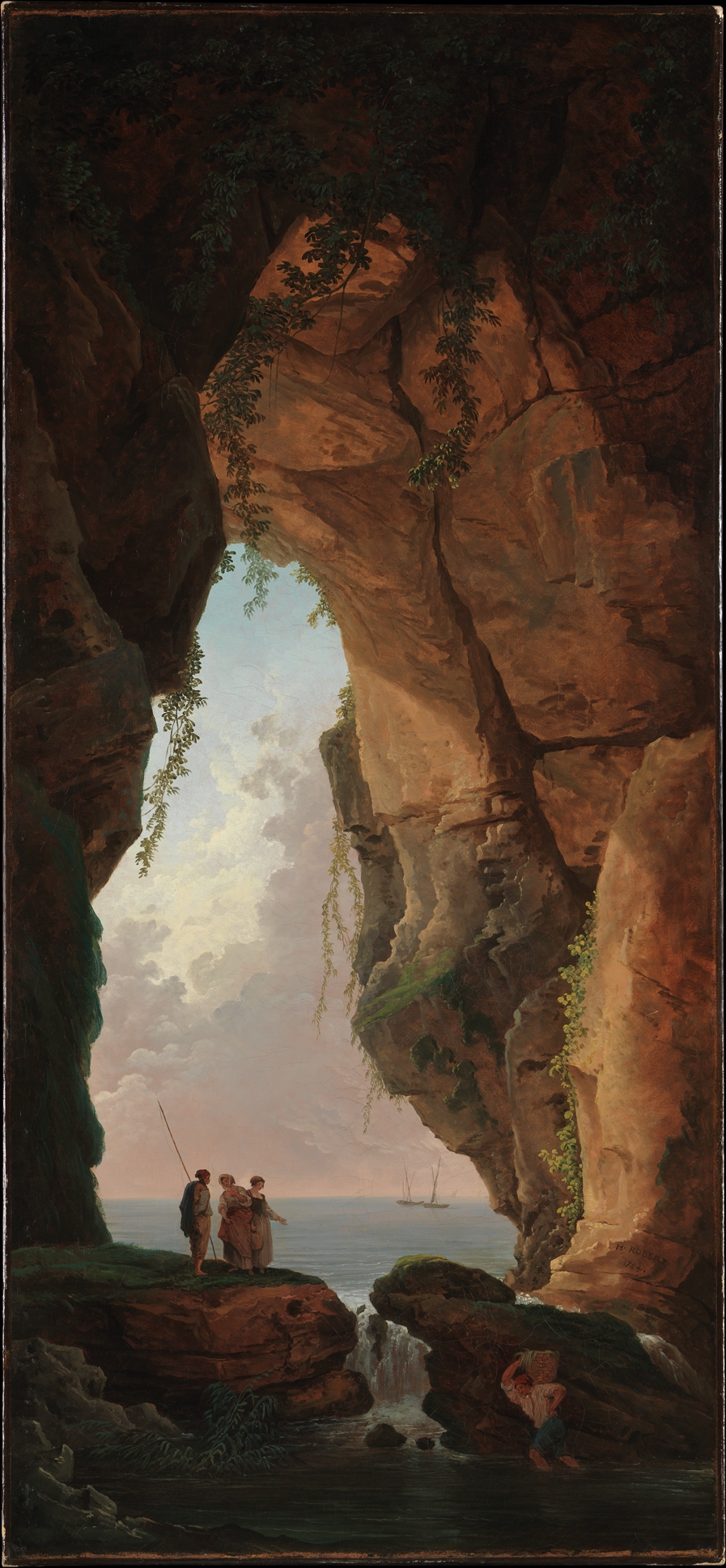
Based on a bet with Queen Marie Antoinette, King Louis XVI’s brother, the comte d’Artois, had a pleasure pavilion built on the outskirts of Paris in a mere sixty-four days through the labor of more than eight hundred craftsmen. Robert’s six paintings of Italian landscapes were installed in an elaborate bathing room, prompting their overarching theme of water. Having spent eleven years in Italy, where he befriended Jean Honoré Fragonard and other French artists abroad, Robert knew ancient architecture and sculpture deeply. In this series, however, instead of antiquarian exactitude, he combined sources freely.
This image cannot be enlarged, viewed at full screen, or downloaded.
Open Access
As part of the Met's Open Access policy, you can freely copy, modify and distribute this image, even for commercial purposes.
API
Public domain data for this object can also be accessed using the Met's Open Access API.
Use your arrow keys to navigate the tabs below, and your tab key to choose an item
Title:The Mouth of a Cave
Artist:Hubert Robert (French, Paris 1733–1808 Paris)
Date:1784
Medium:Oil on canvas
Dimensions:68 3/4 x 31 1/4 in. (174.6 x 79.4 cm)
Classification:Paintings
Credit Line:Gift of J. Pierpont Morgan, 1917
Object Number:17.190.25
In 1777, Charles Philippe, comte d’Artois (1757–1836), the youngest brother of Louis XVI who became Charles X of France, made a wager with Marie Antoinette. He bet that he could cause to be built a small château, or folie, to be called Bagatelle, while the court was absent from Versailles at Fontainebleau. His architect, François Joseph Belanger (1744–1818), reportedly brought eight hundred workers to the task. The Met's collection includes a drawing by Jean Démosthèe Dugourc documenting the garden façade (65.55.17) and Belanger's ceiling design for Bagatelle's dining room (32.85.3). The comte d’Artois was the eventual winner, as the new Bagatelle was completed as required, between September 21 and November 26, 1777. Robert was commissioned to decorate the bathing room and Antoine Callet (1741–1823) was assigned the boudoir, on the opposite side. While Callet’s paintings have disappeared, Robert’s were given to The Met by financier J. Pierpont Morgan.
Robert’s paintings were apparently conceived as three pairs of varying widths. Of the six, Wandering Minstrels was exhibited at the Salon of 1779, while The Swing is signed, and The Mouth of a Cave is signed by the artist and dated 1784. Each of the three belongs to a different pair, and though the arrangement cannot be determined with certainty, it seems likely that the narrowest were on the fireplace wall while the widest flanked the window on the garden. In 1784, Robert was employed to repaint (refaire) the two canvases on the fireplace wall that had been damaged by dampness. It is possible but not certain that The Fountain, which is poorly preserved, was "redone" at the time, while The Mouth of a Cave, which is in good state, was supplied as a replacement, as Joseph Baillio suggested.
The pictures remained at Bagatelle until 1808, when they were sold at auction. It is unlikely that, as has been alleged, they belonged to the empress Josephine: there is no record of them at Malmaison and in any event she died in 1814. In 1911, it was announced that they had been rediscovered by the then curator of the Bois de Boulogne. For some time previously, they had been in the collection of the comtes de Flaux.
Robert was in Naples in 1759 and 1760, and while there drew the entrance to the Grotta di Posillipo, an ancient tunnel on the road from Naples to Pozzuoli. The tunnel was a favorite with artists and Grand Tourists, and the grotto is sometimes thought to have inspired the present imaginary view, but the artist would also have seen various other natural caves and grottos along the coast of the bay of Naples. The figures, typical of his Italian staffage, are a barefoot fisherman accompanied by two peasant women and, in the foreground, a wading man in profile with a basket of reeds. The water flows unrealistically from the sea into a pool below. The sky shows the rosy color of early evening. The Mouth of a Cave has The Fountain (17.190.26) as its pendant.
Katharine Baetjer 2011
Inscription: Signed and dated (lower right): H· ROBERT / 1784·
Charles Philippe, comte d'Artois, château de Bagatelle, near Paris (until 1789); at Bagatelle (abandoned and then nationalized and sold, 1789–96); Lieuthraud, or Leuthraud, called marquis de Beauregard, Bagatelle (1796–97); André Lhéritier and the Société des entrepreneurs de fêtes (1797–1806); at Bagatelle (purchased by Napoleon's Administration des Domaines, 1806); sale, Hôtel de Bullion, Paris, Clisorius and Masson jeune, April 4ff., 1808, no. 151, as "Six Tableaux sous ce numéro; ils représentent des monuments d'Italie et amusements champêtres. Ils ont étés peints pour le ci-devant comte d'Artois, à Bagatelle. Toile."; the lot was in two parts, the first went for Fr 381, the second for Fr 240, both to Brunot; ?[Jacques Nicolas Brunot, from 1808]; Pierre Justin Armand Verdier, comte de Flaux, château de Flaux, near Uzès (until d. 1883); Édouard Henri Roger Verdier, comte de Flaux, château de Flaux (1883–d. 1898); Clémence Pascal Verdier, comtesse douairière de Flaux, château de Flaux (1898–d. 1908; estate under arbitration, 1908–10); Eliane Berger, Roger de Flaux's daughter (1910–11; offered for sale to The Met and J. Pierpont Morgan through Maurice de Verneuil); J. Pierpont Morgan, New York (1911–d. 1913; his estate, 1913–17; on loan to The Met from May 1912)
Paris. Thos. Agnew & Sons. "Hubert Robert (1733–1808)," March 12–30, 1912, one of nos. 1–8 (as "Panneaux Décoratifs pour un salon, provenant de la collection de Madame de Flaux," lent by J. Pierpont Morgan).
Poughkeepsie, N.Y. Vassar College Art Gallery. "Hubert Robert, 1733–1808: Paintings and Drawings," October 9– November 11, 1962, no. 8.
Little Rock. Arkansas Arts Center. "Five Centuries of European Painting," May 16–October 26, 1963, unnumbered cat. (p. 37).
M. [Luc-Vincent] Thiéry. Guide des amateurs et des étrangers voyageurs à Paris. Paris, 1787, vol. 1, pp. 28–29, describes the château de Bagatelle, stating that the bathing room, to the left of the "grand sallon," was ornamented with mirrors and with six charming pictures by Robert, while the boudoir, opposite, was decorated with mirrors and six pictures by Callet.
Friedrich Gilly. Description de Bagatelle. 1797 [published by Edgar Wedepohl in L'Oeil, no. 126, 1965, p. 22], mentions the Robert paintings in the "petit cabinet" to the left.
Annonces, affiches et avis divers 93 (April 2, 1808), p. 1478 [see Ref. Baillio 1995], preview the sale of "six tableaux de place, peints par Hubert Robert représentant des Monuments d'Italie".
Charles Yriarte. "Mémoires de Bagatelle, I." La revue de Paris 4 (July–August 1903), pp. 21, 33, states that Robert was paid 500 livres for each; mentions that by 1784 the pictures, suffering from dampness, were restored by the artist for 500 livres; notes that they appear in the year V [1796–97] inventory, described as damaged by humidity.
Henri-Gaston Duchesne. Le château de Bagatelle (1715–1908). Paris, 1909, pp. 142, 155, 160, cites a document of May 18, 1784, in which the paintings to the right and left of the fireplace are mentioned as requiring restoration; notes that the six damaged paintings were in situ when Bagatelle was leased to entrepreneurs in the year V [1796–97].
L. de Quellern. Le château de Bagatelle. Paris, 1909, pp. 45–46, publishes the document of 1784.
[Jean Claude Nicolas Forestier]. Bagatelle et ses jardins. Paris, 1910, pp. 34–35, ill. opp. p. 32, as in the collection of Mme la Comtesse de F . . . .
"Nouvelles." Chronique des arts et de la curiosité, supplément à la Gazette des beaux-arts no. 31 (October 7, 1911), p. 242, announces the rediscovery of the six panels by M. Forestier, conservator of the Bois de Boulogne; notes that paintings are signed and dated 1777 and 1784; states that they were brought to Malmaison and later given by Empress Josephine to her physician, who left them to his family.
D. F[riedley]. "Decorative Panels by Hubert Robert." Metropolitan Museum of Art Bulletin 7 (July 1912), pp. 130–31, announces J. Pierpont Morgan's loan.
J[ean]. C[laude]. N[icolas]. Forestier Librairie agricole de la maison rustique. Bagatelle et ses jardins. Paris, [1922–23?], pp. 43–44, ill. between pp. 40 and 41.
P[reston]. R[emington]. "Six Paintings by Hubert Robert." Metropolitan Museum of Art Bulletin 19 (January 1924), pp. 9–10, dates them 1777.
Jean Stern. A l'ombre de Sophie Arnould: Francois-Joseph Belanger. Paris, 1930, vol. 1, p. 70.
Georges Pascal. Histoire du château de Bagatelle. Paris, 1938, p. 34, notes that copies have replaced the Robert originals.
Louis Hautecœur. Histoire de l'architecture classique en France. Vol. 4, Seconde moitié du XVIIIe siècle: Le style Louis XVI, 1750–1792. Paris, 1952, p. 493.
Josephine L. Allen and Elizabeth E. Gardner. A Concise Catalogue of the European Paintings in The Metropolitan Museum of Art. New York, 1954, p. 84, as "The Mouth of a Cave".
Robert Joffet. Bagatelle: Histoire et guide. Paris, 1954, pp. 16, 27–28.
Charles Sterling. The Metropolitan Museum of Art: A Catalogue of French Paintings. Vol. 1, XV–XVIII Centuries. Cambridge, Mass., 1955, pp. 163–64, ill. p. 162, accepts the tradition that the paintings were at Malmaison; observes that Robert was recalled to Bagatelle in 1784 to restore the two narrow panels at either side of the fireplace, which had been damaged by dampness, and assumes that at that time the artist must have added the signature and date 1784 to this picture; notes that the form of the cave is thought to have been inspired by the grotto at Pozzuoli, near Naples, which Robert visited in 1759–60.
Ferdinand Boyer. "Jean-Joseph de Laborde protecteur de F.-X. Fabre et sa collection confisquée en 1794." Bulletin de la Société de l'Histoire de l'Art Français, année 1954, (1955), p. 221 n. 1.
Barbara Scott. "Bagatelle: Folie of the comte d'Artois." Apollo (June 1972), pp. 481, 485 n. 8.
Béatrice de Andia et al. De Bagatelle à Monceau, 1778-1978: Les folies au XVIIIe siècle à Paris. Exh. cat., Musée Carnavalet. Paris, 1978–79, p. 16, accepts the tradition that the six paintings were once at the Malmaison.
Gérard Hubert. Letter to Dean Walker. April 28, 1980, says there is no trace of the six panels having ever been in Josephine's collection; identifies her physician as Horeau; concludes that if the paintings belonged to her they were in her possession for only a short time.
Jean de Cayeux. "Jeux d'eau pour une salle de bains." L'Objet d'art 8 (June 1988), pp. 63–66, 68, ill. (color, overall and detail)
, observes that there is no evidence of damage or repair in this painting that would support Sterling's view; suggests that "The Bathing Pool" and "Wandering Minstrels" were installed at Bagatelle shortly before or shortly after the 1779 Salon, and that the narrower panels, including this one, were not completed until 1784.
Annie Jacques and Jean-Pierre Mouilleseaux inLa Folie d'Artois. Exh. cat., château de Bagatelle, Paris. n.p., [1988], pp. 42–43, fig. 27 (color).
Jean de Cayeux with the collaboration of Catherine Boulot. Hubert Robert. Paris, 1989, p. 120.
Paul Bernard Wilson. "Profiles in Royalty: Hubert Robert's 'The Mouth of a Cave' and a Concealed Iconography of Louis XVI." Album Amicorum Kenneth C. Lindsay: Essays on Art and Literature. Ed. Susan Alyson Stein and George D. McKee. Binghamton, 1990, pp. 183–201, fig. 1.
Joseph Baillio. "Hubert Robert's Decorations for the Château de Bagatelle." Metropolitan Museum Journal 27 (1992), pp. 149, 156–57, 161, 169, 171–73, 176–78, 182 nn. 38–39, 51, 53–54, fig. 34, with the exception of this canvas, dates the series 1777–79; notes that the date 1784 on this picture, five years after the commission was completed and payment was made to the artist, may be explained by the fact that by 1783 Robert had been asked to "redo" the panels flanking the mantelpiece, as these had incurred harm from dampness; suggests that the damaged paintings might be two now-lost pendants owned by the comte d'Artois that were shown at the Salon of 1779, and that these were in such poor condition that they had to be replaced ("such a hypothesis would mean that 'The Mouth of a Cave' was actually painted in 1784, and this would account for its pristine, apparently unrestored condition").
Joseph Baillio. "Addendum to 'Hubert Robert's Decorations for the Château de Bagatelle'." Metropolitan Museum Journal 30 (1995), p. 103, notes that these paintings and Callet's were sold in Paris on April 4, 1808, to Brunot.
Katharine Baetjer. European Paintings in The Metropolitan Museum of Art by Artists Born Before 1865: A Summary Catalogue. New York, 1995, p. 383, ill.
Paula Rea Radisich. Hubert Robert: Painted Spaces of the Enlightenment. Cambridge, 1998, pp. 12–13, 78–96, 110–11, 118–19, 171–72 nn. 25, 29, p. 173 n. 35, p. 174 n. 42, p. 176 n. 56, fig. 40.
Jean Strouse. Morgan: American Financier. New York, 1999, p. 559, briefly mentions our Bagatelle paintings (17.190.25–30).
Katie Scott. "Book Reviews. Hubert Robert: Painted Spaces of the Enlightenment." Burlington Magazine 141 (November 1999), p. 690.
Jean Strouse. "J. Pierpont Morgan, Financier and Collector." Metropolitan Museum of Art Bulletin 57 (Winter 2000), p. 27.
Catherine Voiriot inHubert Robert, 1733–1808: Un peintre visionnaire. Ed. Guillaume Faroult and Catherine Voiriot. Exh. cat., Musée du Louvre. Paris, 2016, p. 461.
Katharine Baetjer. French Paintings in The Metropolitan Museum of Art from the Early Eighteenth Century through the Revolution. New York, 2019, pp. 277, 279–81 nn. 2, 3, 5, 6, pp. 282, 291, 294, no. 94, ill. (color).
Colin B. Bailey. "Review of Baetjer 2019." Burlington Magazine 163 (May 2021), p. 470.
The Met's Libraries and Research Centers provide unparalleled resources for research and welcome an international community of students and scholars.
The Met Collection API is where all makers, creators, researchers, and dreamers can connect to the most up-to-date data and public domain images for The Met collection. Open Access data and public domain images are available for unrestricted commercial and noncommercial use without permission or fee.
Feedback
We continue to research and examine historical and cultural context for objects in The Met collection. If you have comments or questions about this object record, please complete and submit this form. The Museum looks forward to receiving your comments.