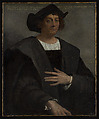
Whether this portrait actually depicts Christopher Columbus is debatable, but from the time it was first engraved around 1590 it became the authoritative likeness of the explorer who launched the Spanish crown’s violent colonization of the Americas. Columbus’s four voyages between 1492 and 1504 literally began to map a project of extracting human and natural resources that ensured the dominance of Spain and Catholicism on a global scale for over two centuries. The date of 1519 on this badly damaged portrait indicates that, if it represents Columbus, it was painted posthumously. An explanation may come, however, from the visit of Columbus’s son to Rome in 1516–17, where the highly regarded artist Sebastiano del Piombo would have been an appropriate choice to memorialize his father.
This image cannot be enlarged, viewed at full screen, or downloaded.
Open Access
As part of the Met's Open Access policy, you can freely copy, modify and distribute this image, even for commercial purposes.
API
Public domain data for this object can also be accessed using the Met's Open Access API.
This artwork is meant to be viewed from right to left. Scroll left to view more.
This image cannot be enlarged, viewed at full screen, or downloaded.
Fig. 1. Painting in frame: overall
This image cannot be enlarged, viewed at full screen, or downloaded.
Fig. 2. Painting in frame: corner
This image cannot be enlarged, viewed at full screen, or downloaded.
Fig. 3. Painting in frame: angled corner
This image cannot be enlarged, viewed at full screen, or downloaded.
Fig. 4. Profile drawing of frame (T. Newbery)
Artwork Details
Use your arrow keys to navigate the tabs below, and your tab key to choose an item
Title:Portrait of a Man, Said to be Christopher Columbus (born about 1446, died 1506)
Artist:Sebastiano del Piombo (Sebastiano Luciani) (Italian, Venice (?) 1485/86–1547 Rome)
Date:1519
Medium:Oil on canvas
Dimensions:42 x 34 3/4 in. (106.7 x 88.3 cm)
Classification:Paintings
Credit Line:Gift of J. Pierpont Morgan, 1900
Object Number:00.18.2
Inscription: Signed, dated, and inscribed: (center right) SEBASTIANVS / VENETVS FACIT; (across top) HÆC.EST.EFFIGIES.LIGVRIS.MIRANDA.COLVMBI.ANTIPODVM.PRIMVS / RATE.QVI.PENETRAVIT.IN.ORBEM. 1519 (This is the admirable portrait of the Ligurian Columbus, the first to enter by ship into the world of the Antipodes, 1519)
?Ottheinrich Wittelsbach, Elector Palatine, Heidelberg (until d. 1559); ?the Wittelsbach family, Electors Palatine, Heidelberg (1559–1680); Karl Ludwig II Wittelsbach, Elector Palatine, Residenzschloss, Heidelberg (possibly from 1680–d. 1685; inv., 1685); Charles Maurice de Talleyrand-Périgord, prince de Bénévent, Paris (by 1814–d. 1838); his heir, Napoléon-Louis, 3rd duc Talleyrand-Périgord, duc de Valençay, prince de Sagan, Château de Valençay, Indre (1838–d. 1898; his estate sale, Galerie Georges Petit, Paris, May 29–June 1, 1899, no. 14, for Fr 30,000 to Lawrie); [T. Lawrie and Co., London, from 1899; sold to Agnew]; [Agnew, London, until 1900; sold for £40,000 to Morgan]; J. Pierpont Morgan, London and New York (1900)
Paris. Palais Royal. 1814, no. 107 (lent by Talleyrand) [see Wehle 1940 and Zeri and Gardner 1973].
Chicago. World's Fair. "World's Columbian Exhibition: Fine Arts," May 1–October 26, 1893, not in catalogue.
New York. The Metropolitan Museum of Art. "Temporary Exhibition," April 1906, no. 18.
Washington. Corcoran Gallery of Art. "American Processional: 1492–1900," July 8–December 17, 1950, no. 1 (as "Christopher Columbus").
New York. R. H. Macy. September 10–26, 1951, no catalogue.
Detroit Institute of Arts. "Thirty-Eight Great Paintings from The Metropolitan Museum of Art," October 2–28, 1951, no catalogue.
Art Gallery of Toronto. "Thirty-Eight Great Paintings from The Metropolitan Museum of Art," November 14–December 12, 1951, no catalogue.
City Art Museum of St. Louis. "Thirty-Eight Great Paintings from The Metropolitan Museum of Art," January 6–February 4, 1952, no catalogue.
Seattle Art Museum. "Thirty-Eight Great Paintings from The Metropolitan Museum of Art," March 1–June 30, 1952, no catalogue.
Milwaukee Art Institute. "5 Centuries of Spanish Art," September 5–October 25, 1952, no catalogue.
Syracuse, N.Y. Syracuse University. "Spanish Art: Fifteenth Century to Modern," November 10–December 1, 1952, no. 4.
New York. The Metropolitan Museum of Art, Junior Museum. "The Age of Discovery—By Caravan and Caravel," October 11, 1957–June 29, 1958, no catalogue?
Montreal. Expo 67. "Terre des Hommes/Man and His World," April 28–October 27, 1967, no. 19.
New York. The Metropolitan Museum of Art. "Venetian Paintings in the Metropolitan Museum," May 1–September 2, 1974, no catalogue.
New-York Historical Society Museum. "Imagining the New World: Columbian Iconography," November 13, 1991–January 26, 1992, no. 19.
Rome. Palazzo di Venezia. "Sebastiano del Piombo, 1485–1547," February 8–May 18, 2008, no. 37 (as "Portrait of Christopher Columbus").
Berlin. Gemäldegalerie. "Sebastiano del Piombo, 1485–1547," June 28–September 28, 2008, no. 37 (as "Portrait of Christopher Columbus").
Swiss National Museum, Landesmuseum Zürich. "Europe in the Renaissance: Metamorphoses 1400–1600," August 1–November 27, 2016, no. 125.
Inventory of the Residenzschloss Heidelberg. 1685 [see Holst 1953], as "Christophori Columbi Contrefeit, ein Original von Sebastian del Piombo venetiano".
Etienne de Jouy. Guillaume le franc-parleur. 3rd ed. Paris, 1815, vol. 1, p. 151 [English ed., "Paris Chit-Chat," Philadelphia, 2 vols., 1816, vol. 1, pp. 136–37], mentions it, in a section dated July 30, 1814, in connection with a wax statue by Zumbo, no. 107 at the Palais Royal; attributes it to Sebastiano del Piombo and considers it the only authentic likeness of Columbus.
C. Maunoir. Compte rendu des séances de la Société de Géographie et de la Commission Centrale (November 6, 1891), pp. 470–71, records the report of comte Louis de Turenne, who recently saw the picture at the château de Valençay, and who accepts the identification of the sitter as Columbus but questions the attribution to Sebastiano del Piombo; adds that the engraving by Mercuri is not after the Valençay version of the portrait, but after the Versailles version [see Notes].
Néstor Ponce de León. The Columbus Gallery. New York, 1893, p. 19, as at the château de Valençay, formerly in the collection of Prince C. M. Talleyrand; erroneously states that it is not dated; having seen neither the painting nor a reproduction of it, supposes that it is an old copy.
Achille Neri. I ritratti di Cristoforo Colombo. Rome, 1893, p. 19, accepts the attribution to Sebastiano but doubts the identification of the sitter as Columbus.
E.-T. Hamy. La nature 21 (March 1893), pp. ?, ill., attributes it to Sebastiano and accepts the identification of the sitter as Columbus; states that the engraving by De Bry [see Notes] seems to be made from this painting.
Catalogue des tableaux anciens . . . dépendant de la succession du duc de Talleyrand, Valençay et Sagan et provenant du chateau de Valençay. Galerie Georges Petit, Paris. May 29–June 1, 1899, pp. 9–10, no. 14, ill., states that it was lent to the 1893 World's Columbian Exposition in Chicago, and that it was engraved by Mercuri.
John Boyd Thacher. Christopher Columbus: His Life, His Work, His Remains. Vol. 3, New York, 1904, pp. 48–50, no. 23, ill., tentatively identifies the MMA painting with the one formerly in the Talleyrand collection, adding that if it is by Sebastiano "it was executed long after the death of Columbus" and "it may have been the original of the De Bry [engraving] or a copy from a common source".
Giorgio Bernardini. Sebastiano del Piombo. Bergamo, 1908, p. 62, ill. opp. p. 16, calls it a late work by Sebastiano and questions the identification of the sitter as Columbus, although suggesting that it might be a copy after an earlier portrait of him.
Morton H. Bernath. New York und Boston. Leipzig, 1912, p. 82, mentions it as the famous portrait of Columbus by Sebastiano.
Tancred Borenius, ed. A History of Painting in North Italy: Venice, Padua, Vicenza, Verona, Ferrara, Milan, Friuli, Brescia, from the Fourteenth to the Sixteenth Century.. By J[oseph]. A[rcher]. Crowe and G[iovanni]. B[attista]. Cavalcaselle. 2nd ed. [1st ed. 1871]. London, 1912, vol. 3, pp. 250–51 n. 3, lists it as by Sebastiano and calls it a supposed portrait of Columbus.
André de Hevesy. Christophe Colomb, ou l'heureux génois. Paris, 1927, pp. 201–2, attributes it to Sebastiano and dates it to his Roman period; questions the identification of the sitter as Columbus; states that this painting was the source for De Bry's engraving.
"Current Art Notes." Connoisseur 82 (November 1928), p. 187, ill. p. 169.
Lionello Venturi. Pitture italiane in America. Milan, 1931, unpaginated, pl. CCCLXXIII, attributes it to Ghirlandaio and dates it 1483, to the time of the frescoes in the Sassetti chapel.
A[dolfo]. Venturi. Storia dell'arte italiana. Vol. 9, part 5, La pittura del Cinquecento. Milan, 1932, p. 82 n. 1, lists it as a portrait of Columbus among works by and attributed to Sebastiano.
Lionello Venturi. Italian Paintings in America. Vol. 3, Sixteenth to Eighteenth Century. New York, 1933, unpaginated, pl. 503, considers it to be derived from another portrait of Columbus; calls the inscriptions later than the painting.
G[eorg]. Gombosi inAllgemeines Lexikon der bildenden Künstler. Ed. Hans Vollmer. Vol. 27, Leipzig, 1933, pp. 72–73, attributes it to Sebastiano and refers to it as the so-called portrait of Columbus.
Hans Tietze. Meisterwerke europäischer Malerei in Amerika. Vienna, 1935, pp. 329–30, pl. 84 [English ed., "Masterpieces of European Painting in America," New York, 1939, p. 314, pl. 86], calls it a posthumous portrait of Columbus by Sebastiano; states that the inscription is not by the artist.
Bernhard Berenson. Pitture italiane del rinascimento. Milan, 1936, p. 449, lists it as by Sebastiano, calling it "Ritratto di 'Cristoforo Colombo'".
Harry B. Wehle. The Metropolitan Museum of Art: A Catalogue of Italian, Spanish, and Byzantine Paintings. New York, 1940, pp. 190–91, ill., notes that it "is considered by some historians to be the most authentic likeness among the many extant" and that "other likenesses of Columbus have been based upon it," although "it must have been painted from another portrait—possibly a drawing—since lost, rather than directly from life, as Columbus left Italy in 1484, before Sebastiano had begun to paint".
Luitpold Dussler. Sebastiano del Piombo. Basel, 1942, p. 137, no. 39, pl. 44, attributes it to Sebastiano and calls it Portrait of a Man, supposedly Columbus; notes the inscribed date of 1519, but dates it about 1520.
Rodolfo Pallucchini. Sebastian Viniziano (Fra Sebastiano del Piombo). [Milan], 1944, pp. 62, 163–64, pl. 46, attributes it to Sebastiano.
Niels v[on]. Holst. "Das Columbus-Bildnis des Metropolitan Museums." Weltkunst 23 (January 15, 1953), p. 7, identifies it with a portrait of Columbus by Sebastiano included in a 1685 inventory of the Residenzschloss Heidelberg; incorrectly reports the inscribed date as 1517.
Josephine L. Allen and Elizabeth E. Gardner. A Concise Catalogue of the European Paintings in The Metropolitan Museum of Art. New York, 1954, p. 90.
Bernard Berenson. Lotto. 3rd ed. Milan, 1955, p. 51 [English ed., "Lorenzo Lotto," New York, 1956, p. 30], mentions it in connection with a portrait by Lotto (formerly Ellsworth collection, New York), accepting that both works depict Columbus and suggesting that they are perhaps based on a likeness the two artists would have known in the Vatican.
Bernard Berenson. Italian Pictures of the Renaissance: Venetian School. London, 1957, vol. 1, p. 163, lists it as the "So-called Portrait of 'Christopher Columbus'".
Niels von Holst. Creators, Collectors, and Connoisseurs: The Anatomy of Artistic Taste from Antiquity to the Present Day. New York, 1967, p. 83, fig. 99, suggests that it may have been acquired by Ottheinrich (1502–1559), Prince Elector of the Palatinate.
Rodolfo Pallucchini. Sebastiano del Piombo. Milan, [1967?], unpaginated.
A[ndor]. Pigler. Katalog der Galerie Alter Meister. Tübingen, 1968, vol. 1, p. 548, under no. 9772, catalogues the version in Budapest as a partial copy after the MMA painting.
Burton B. Fredericksen and Federico Zeri. Census of Pre-Nineteenth-Century Italian Paintings in North American Public Collections. Cambridge, Mass., 1972, pp. 185, 512, 605, as a portrait of Christopher Columbus.
Denys Sutton, ed. Letters of Roger Fry. New York, 1972, vol. 1, p. 255 n. 1 to letter no. 177 (March 2, 1906), lists it among works included in the 1906 exhibition.
Federico Zeri with the assistance of Elizabeth E. Gardner. Italian Paintings: A Catalogue of the Collection of The Metropolitan Museum of Art, Venetian School. New York, 1973, pp. 52–53, pl. 58, believe that the De Bry engraving was based on a copy after the Museum's painting; mention that "the Latin inscription, written in two hexameters, may have been composed for the painter by a poet or man of letters".
Howard Hibbard. The Metropolitan Museum of Art. New York, 1980, p. 256, fig. 455.
Mauro Lucco inL'opera completa di Sebastiano del Piombo. Milan, 1980, pp. 112–13, no. 59, ill. p. 112 and colorpl. XLVIII, notes the existence of a partial copy in the Szépmüvészeti Muzeum, Budapest.
Michael Hirst. Sebastiano del Piombo. Oxford, 1981, p. 110, pl. 136, states that since the inscription is a later addition, there is no reason to accept either the identification of the sitter or the date of 1519; suggests dating it to the mid or late 1520s and adds that "the picture may one day prove to be of one of the clerics present in the winter of 1529–30 at Bologna".
Giovanna Bonasegale. Ritratto di Francesco Arsilli di Sebastiano del Piombo. Exh. cat., Pinacoteca Civica. Ancona, 1985, pp. 35–36, notes that the inscription is not considered original.
Claudio Cerreti inImagining the New World: Columbian Iconography. Exh. cat., New-York Historical Society Museum. Rome, 1991, pp. 73, 75, no. 19, ill. p. 75 and in color between pp. 64 and 65, states that Sebastiano did not use the most reliable sources to create this portrait, which was nevertheless used as a prototype by later artists, and notes that its most original features are the shape of the sitter's face and the richness of his clothing.
Vilmos Tátrai inMuseum of Fine Arts Budapest: Old Masters' Gallery. Ed. Vilmos Tátrai. Vol. 1, A Summary Catalogue of Italian, French, Spanish and Greek Paintings. London, 1991, p. 97.
Massimo Donattini. "Orizzonti geografici dell'editoria italiana (1493–1560)." Il Nuovo Mondo nella coscienza italiana e tedesca del Cinquecento. Ed. Adriano Prosperi and Wolfgang Reinhard. Bologna, 1992, p. 117, as by Sebastiano del Piombo.
Katharine Baetjer. European Paintings in The Metropolitan Museum of Art by Artists Born Before 1865: A Summary Catalogue. New York, 1995, p. 78, ill.
Mauro Lucco inThe Dictionary of Art. Ed. Jane Turner. Vol. 28, New York, 1996, p. 334.
Peter Burke inLa pittura nel Veneto: Il Cinquecento. Ed. Mauro Lucco. Vol. 3, Milan, 1999, p. 1093.
Andrea Bayer. "North of the Apennines: Sixteenth-Century Italian Painting in Venice and the Veneto." Metropolitan Museum of Art Bulletin 63 (Summer 2005), p. 40, ill. (color).
Paul Joannides inSebastiano del Piombo, 1485–1547. Exh. cat., Palazzo di Venezia, Rome. Milan, 2008, p. 282, under no. 80.
Mauro Lucco inSebastiano del Piombo, 1485–1547. Exh. cat., Palazzo di Venezia, Rome. Milan, 2008, pp. 188–89, no. 37, ill. (color), accepts the signature and the date, and believes the inscription to be by Sebastiano.
Claudio Strinati inSebastiano del Piombo, 1485–1547. Exh. cat., Palazzo di Venezia, Rome. Milan, 2008, p. 20, fig. 3 (color).
Piers Baker-Bates. "Antonio Salamanca: A Spanish Friend of Sebastiano del Piombo." Konsthistorisk tidskrift/Journal of Art History 81, no. 4 (2012), pp. 211, 216, taking the inscribed date into consideration, suggests that this portrait might have been commissioned by Columbus's son, Ferdinand, who visited Rome in 1516–17.
Jennifer Tonkovich. "Discovering the Renaissance: Pierpont Morgan's Shift to Collecting Italian Old Masters." A Market for Merchant Princes: Collecting Italian Renaissance Paintings in America. Ed. Inge Reist. University Park, Pa., 2015, pp. 41, 120 n. 8.
Carole Ackermann et al. inEurope in the Renaissance: Metamorphoses 1400–1600. Exh. cat., Swiss National Museum, Landesmuseum Zürich. Berlin, 2016, p. 210, no. 125, ill. (color).
The frame is from the Veneto region and dates to about 1620 (see figs. 1–4 above). This carved giltwood reverse profile frame is likely made of pine and constructed with miter-faced half-lap corners. The sight edge is ornamented in a flat lotus leaf. The other passages of carving emanate from centers and terminate in acanthus leaf corners. Carved fruit and a leaf at the top edge emerge from crossed ribbons. The swollen frieze carving emerges from clasped volutes from which cauliculi roll into sprays of leaves. Serrated acanthus leaves ornament the back edge. Punchwork in the gesso field articulates the lively carving forms. Originally silver leafed, the frame, now gilded, indicates two campaigns of enlargement.
Timothy Newbery with Cynthia Moyer 2020; further information on this frame can be found in the Department of European Paintings files
Théodor De Bry included an engraving of 1595 in his Grands voyages which was made after this painting or a version of it. An engraving by Mercuri, dated 1843 (in Supplément aux Galeries historiques de Versailles, vol. 5, ser. 10, sect. 2, unpaginated), depicts the head and shoulders only.
There is a partial copy in the Szépmüvészeti Muzeum, Budapest. A version formerly in the Ridgefield Library, Ridgefield, Connecticut, was sold at Christie's East, New York, March 26, 1982, no. 127, as Manner of Sebastiano del Piombo.
Giovanni Gerolamo Savoldo (Italian, Brescia 1480/85–after 1548)
Resources for Research
The Met's Libraries and Research Centers provide unparalleled resources for research and welcome an international community of students and scholars.
The Met Collection API is where all makers, creators, researchers, and dreamers can connect to the most up-to-date data and public domain images for The Met collection. Open Access data and public domain images are available for unrestricted commercial and noncommercial use without permission or fee.
Feedback
We continue to research and examine historical and cultural context for objects in The Met collection. If you have comments or questions about this object record, please complete and submit this form. The Museum looks forward to receiving your comments.