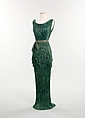
Spanish-born artist and designer Mariano Fortuny was active in Italy, where he established a textile workshop and a commercial silk printing factory--a version of which is still in operation today. Best known for his beautiful textiles and unstructured garments, Fortuny continually referenced historical and non-Western sources, reviving and creating complex fabric treatments and dyeing techniques.Working in the early 20th century, Fortuny's gowns were especially popular among the avant garde women of '20s and '30s who were seeking both freedom of movement and a hint of exoticism in their wardrobe. A rare example of the Peplos, a variation of Fortuny's popular Delphos gown, echoes the shape of that eponymous Greek garment and features several Fortuny trademarks: fine heat-set pleating, which was created by a process never exactly duplicated; luminous color, achieved via multiple dye baths; and minimal decoration that was also functional. Here small Venetian glass beads were not only eye-catching, their added heft improved the silk's drape and created a flowing line.