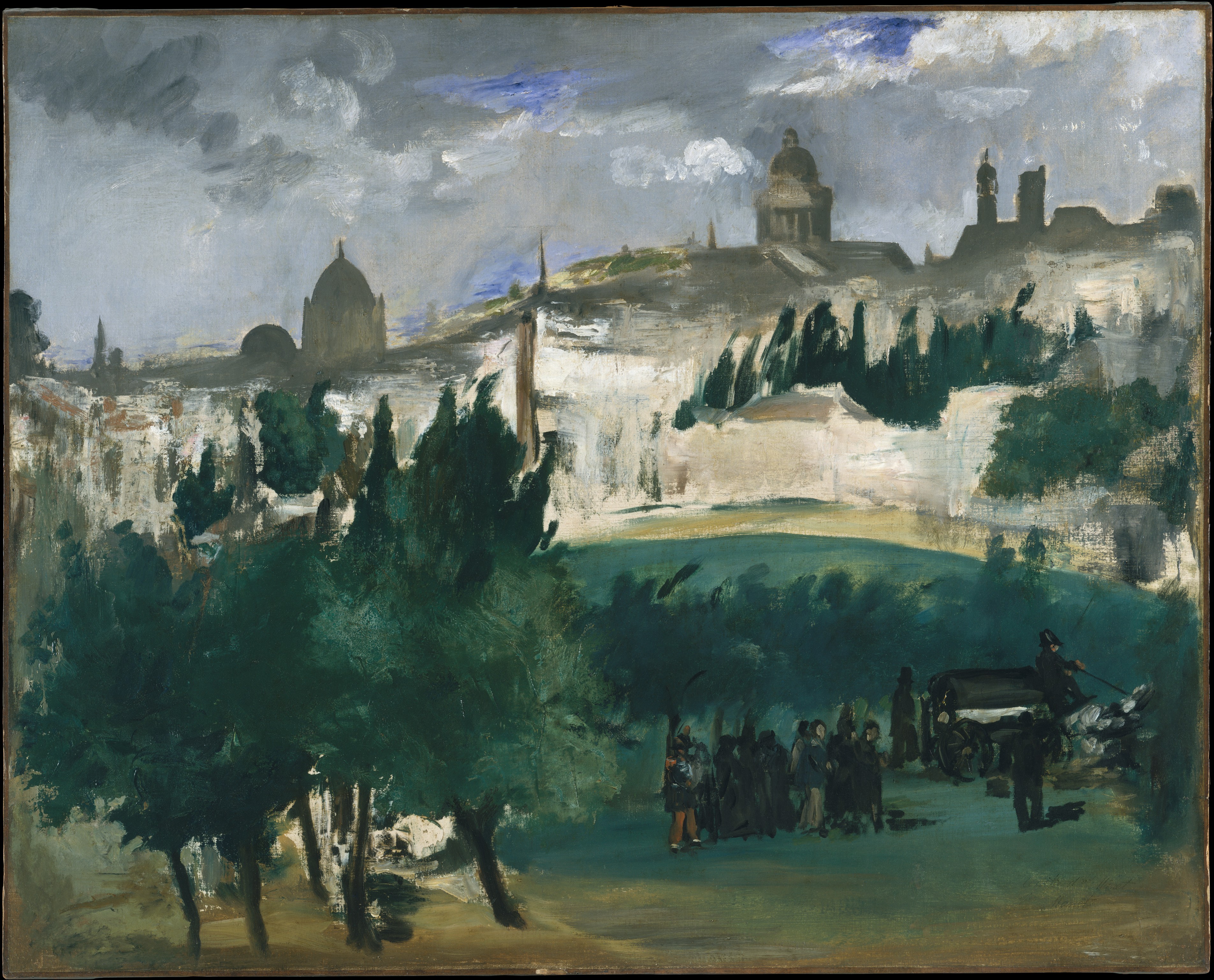
Manet’s unfinished painting is thought to depict the funeral of the writer Charles Baudelaire, which took place on September 2, 1867. The artist, unlike other friends who had yet to return from vacation or stayed away owing to the threatening summer storm, was among the few mourners present. This view of the meager funeral cortège at the foot of the Butte Mouffetard, a hill in southwest Paris, is framed by the silhouettes of the towers and cupolas of the Val de Grâce, the Panthéon, Saint-Etienne-du-Mont, and the Tour de Clovis in the background.
Manet kept the picture until his death. In 1894 Pissarro acquired it in exchange for one of his own landscapes.
This image cannot be enlarged, viewed at full screen, or downloaded.
Open Access
As part of the Met's Open Access policy, you can freely copy, modify and distribute this image, even for commercial purposes.
API
Public domain data for this object can also be accessed using the Met's Open Access API.
Inscription: Inscribed (lower right): Certifié d'Ed. Manet / Vve Manet (Certified as by Ed. Manet / Widow Manet)
the artist's widow, Suzanne Manet, Paris (1883–94; sold on April 10, 1894 for Fr 300 to Portier); [Alphonse Portier, Paris, 1894]; [Ambroise Vollard, Paris, 1894; traded for an “effet de neige, toile de 15" (snow scene, canvas size 15) and probably other works by Pissarro, on November 21, to Pissarro]; Camille Pissarro, Paris (1894–d. 1903); his widow, Mme Camille (Julie Vellay) Pissarro (from 1903; sold with Vincent van Gogh's "L'arbre jaune," for Fr 2,500, possibly to Vollard); [Ambroise Vollard, Paris, until 1909; sold for Fr 12,000 to The Met]
Paris. Galerie A. Vollard. "Dessins & croquis de Manet, provenant de son atelier," November 17–December 20, 1894, no catalogue [see Distel 2006 and Rabinow and Warman 2006].
Pittsburgh. Carnegie Institute. "Exhibition of Paintings: Édouard Manet, Pierre Renoir, Berthe Morisot," October 15–December 1, 1924, no. 41 (as "The Funeral").
New York. The Metropolitan Museum of Art. "Landscape Paintings," May 14–September 30, 1934, no. 46.
Museum of Fine Arts, Boston. "Independent Painters of Nineteenth Century Paris," March 15–April 28, 1935, no. 27.
Montreal Museum of Fine Arts. "Six Centuries of Landscape," March 7–April 13, 1952, no. 49.
Bordeaux. Galerie des Beaux-Arts. "Profil du Metropolitan Museum of Art de New York: de Ramsès à Picasso," May 15–September 1, 1981, no. 119.
Washington. National Gallery of Art. "Manet and Modern Paris," December 5, 1982–March 6, 1983, no. 4.
Paris. Galeries nationales du Grand Palais. "Manet, 1832–1883," April 22–August 1, 1983, no. 98.
New York. The Metropolitan Museum of Art. "Manet, 1832–1883," September 10–November 27, 1983, no. 98.
Amsterdam. Rijksmuseum Vincent van Gogh. "Franse meesters uit het Metropolitan Museum of Art: Realisten en Impressionisten," March 15–May 31, 1987, no. 14.
Leningrad [St. Petersburg]. State Hermitage Museum. "Masterpieces of Western European Painting of the XVIth–XXth Centuries from the Museums of the European Countries and USA," October 2, 1989–January 31, 1990, no. 27.
Paris. Galeries nationales du Grand Palais. "Impressionnisme: Les origines, 1859–1869," April 19–August 8, 1994, no. 105.
New York. The Metropolitan Museum of Art. "Origins of Impressionism," September 27, 1994–January 8, 1995, no. 105.
Copenhagen. Ordrupgaard. "Impressionists in Town," September 6–December 1, 1996, no. 26.
London. National Gallery. "Impression: Painting Quickly in France, 1860–1890," November 1, 2000–January 28, 2001, unnumbered cat. (fig. 38).
Amsterdam. Van Gogh Museum. "Impression: Painting Quickly in France, 1860–1890," March 2–May 20, 2001, unnumbered cat. (fig. 38).
Williamstown, Mass. Sterling and Francine Clark Art Institute. "Impression: Painting Quickly in France, 1860–1890," June 16–September 9, 2001, unnumbered cat. (fig. 38).
Madrid. Museo Nacional del Prado. "Manet en el Prado," October 13, 2003–February 8, 2004, no. 75.
New York. Museum of Modern Art. "Manet and the Execution of Maximilian," November 5, 2006–January 29, 2007, unnumbered cat. (fig. 68).
Essen. Museum Folkwang. "Bilder einer Metropole: Die Impressionisten in Paris," October 2, 2010–January 30, 2011, no. 43.
New York. The Metropolitan Museum of Art [The Met Breuer]. "Unfinished: Thoughts Left Visible," March 18–September 4, 2016, unnumbered cat. (colorpl. 108).
Inventaire après décès. June 18, 1883 [published in Ref. Jamot and Wildenstein 1932, vol. 1, p. 108], lists it as "Enterrement à la glacière" under "Études peintes".
Camille Pissarro. Letter to Georges Pissarro. November 24, 1894 [published in Janine Bailly-Herzberg, ed., "Correspondance de Camille Pissarro 1891–1894," vol. 3, Paris, 1988, p. 515, no. 1075], remarks that he made an exchange with Vollard for a Manet, probably this painting.
Théodore Duret. Histoire d'Édouard Manet et de son œuvre. Paris, 1902, pp. 223–24, no. 126, dates it 1870.
Etienne Moreau-Nélaton. Manuscrit de l'œuvre d'Édouard Manet, peinture et pastels. [1906], unpaginated, no. 139 [Département des Estampes, Bibliothèque Nationale de France, Paris].
B[ryson]. B[urroughs]. "Principal Accessions." Metropolitan Museum of Art Bulletin 5 (May 1910), pp. 123, 127, ill.
Théodore Duret. Manet and the French Impressionists. 2nd ed. [1st ed. 1910]. London, 1912, p. 231, no. 126.
Charles Louis Borgmeyer. The Master Impressionists. Chicago, 1913, pp. 109, 115, 117, ill.
B[ryson]. B[urroughs]. "Nineteenth-Century French Painting." Metropolitan Museum of Art Bulletin 13 (August 1918), pp. 177–78, ill.
A. Tabarant. Manet, histoire catalographique. Paris, 1931, pp. 202–3, comments that the presence of the grenadier of the imperial guard indicates that it was painted before the fall of the Second Empire, but does not believe that it was executed before 1870; identifies the location as the rue de l'Estrapade.
Paul Jamot and Georges Wildenstein. Manet. Paris, 1932, vol. 1, pp. 27, 140–41, no. 184; vol. 2, fig. 288, date it 1870.
Bryson Burroughs. Landscape Paintings. Exh. cat., The Metropolitan Museum of Art. New York, 1934, p. 20, no. 46.
Independent Painters of Nineteenth Century Paris. Exh. cat., Museum of Fine Arts, Boston. Boston, 1935, p. 21, no. 27, dates it about 1870–71.
A. Tabarant. Manet et ses œuvres. 4th ed. (1st. ed. 1942). Paris, 1947, pp. 171, 537, no. 158, dates it January or February 1870.
Josephine L. Allen and Elizabeth E. Gardner. A Concise Catalogue of the European Paintings in The Metropolitan Museum of Art. New York, 1954, p. 63.
Georges Bataille. Manet: Biographical and Critical Study. New York, 1955, pp. 55, 87, ill. (color), dates it to the early 1870s and mentions that it is the funeral of a child.
John Richardson. Édouard Manet: Paintings and Drawings. London, 1958, p. 124, no. 37, fig. 37, remarks that this painting belongs with two snow scenes [JW185 and JW187], done in late 1870, during the siege, which "would account for the atmosphere of gloom and desolation which is so untypical of Manet's art".
John Richardson. Letter to M. Salinger. January 5, 1960, remarks that the figure at the back of the cortège is a grenadier of the Imperial guard, dating the painting probably to the summer of 1870.
Charles Sterling and Margaretta M. Salinger. French Paintings: A Catalogue of the Collection of The Metropolitan Museum of Art. Vol. 3, XIX–XX Centuries. New York, 1967, pp. 44–45, ill., note that it was probably painted in 1870 on the eve of the Franco-Prussian War; remark that it was left unfinished and call it a sketch; mention that it has been suggested that the scene depicts the funeral of Daumier, but that he died in 1879 and by then Manet's style was very different; conclude that the white pall over the coffin and the white horse could indicate the funeral of a child or a young girl.
Sandra Orienti inThe Complete Paintings of Manet. New York, 1967, pp. 98–99, no. 135, ill.
George Mauner. Manet, Peintre-Philosophe: A Study of the Painter's Themes. University Park, Pa., 1975, pp. 111, 120, fig. 64, states that "the threatening summer storm and the small cortège moving toward the cemetery of Montparnasse" are reminiscent of accounts of Baudelaire's funeral, which Manet attended on September 2, 1867.
Denis Rouart and Daniel Wildenstein. Édouard Manet, catalogue raisonné. Paris, 1975, vol. 1, pp. 27, 148–49, no. 162, ill.
Theodore Reff. "Review of Rouart and Wildenstein 1975." Art Bulletin 58 (December 1976), p. 636, identifies the towers at the right as the belfry of St.-Etienne-du-Mont and the Tour de Clovis.
William Hauptman. "Manet's Portrait of Baudelaire: An Emblem of Melancholy." Art Quarterly 1 (1978), p. 214, agrees that it documents Baudelaire's funeral.
John Pope-Hennessy inProfil du Metropolitan Museum of Art de New York: de Ramsès à Picasso. Exh. cat., Galerie des Beaux-Arts. Bordeaux, 1981, p. 100, no. 119, dates it about 1870–71.
Mina Curtiss. "Letters of Édouard Manet to his Wife during the Siege of Paris 1870–71." Apollo 113 (June 1981), p. 383, fig. 5, dates it possibly 1870–71.
Denys Sutton. Letter to Charles S. Moffett. February 5, 1981, notes that stylistically it relates to the painting in Cardiff (RW 159).
Theodore Reff. Manet and Modern Paris. Exh. cat., National Gallery of Art. Washington, 1982, pp. 23, 26–27, 34, 40–41, no. 4, ill. (color), dates it about 1867; accepts the identifications of the Pantheon, the belfry of Saint-Etienne-du-Mont, and the Tour de Clovis, but argues that "the small cupola could belong to many buildings, both sacred and secular, besides the Observatoire, and [that] the large dome near it could be that of the Sorbonne rather than the Val-de-Grace," and tentaviely accepts Mauner's [Ref. 1975] suggestion that the picture may represent Baudelaire's funeral.
Charles S. Moffett inManet, 1832–1883. Ed. Françoise Cachin and Charles S. Moffett. Exh. cat., The Metropolitan Museum of Art. New York, 1983, pp. 260–61, no. 98, ill. (color) [French ed., Paris], dates it "1867–70?".
Jean-Jacques Lévêque. Manet. Paris, 1983, p. 112, identifies the Observatoire among the cupolas depicted.
Kathleen Adler. Manet. Oxford, 1986, p. 28, fig. 15, dates it "1867–70(?)" and notes that it likely depicts the funeral of Baudelaire.
Sjraar van Heutgen et al. inFranse meesters uit het Metropolitan Museum of Art: Realisten en Impressionisten. Exh. cat., Rijksmuseum Vincent van Gogh, Amsterdam. Zwolle, The Netherlands, 1987, pp. 17, 54–55, no. 14, ill. (color).
Éric Darragon. "Recherches sur la conception du sujet dans l'œuvre d'Édouard Manet (1832–1883)." PhD diss., Université de Paris IV/Sorbonne, 1987 [see Ref. Locke 2000].
Janine Bailly-Herzberg. Correspondance de Camille Pissarro, 1891–1894. Vol. 3, Paris, 1988, pp. 515–16 n. 1, p. 271 n. 1, remarks that Pissarro got this picture directly from Vollard in an exchange and not through Portier, as was believed before; mentions that it was sold after Pissarro's death as one lot with a Van Gogh, "L'arbre jaune," for Fr 2,500.
Françoise Cachin. Manet. [Paris], 1990, pp. 72–73, colorpl. 3.
Éric Darragon. Manet. Paris, 1991, p. 177, fig. 102 (color).
Vivien Perutz. Edouard Manet. Lewisburg, Pa., 1993, pp. 125–26, colorpl. 22, dates it "1867?".
Laurent Manœuvre. Manet: Paris. Paris, 1993, pp. 22–23, ill. (color).
Henri Loyrette inOrigins of Impressionism. Exh. cat., The Metropolitan Museum of Art. New York, 1994, pp. 296, 319, 407, 411–12, no. 105, ill. p. 411 and fig. 336 (color) [French ed., Paris, pp. 273, 296, 320, 404, 408–9, no. 105, ill. p. 408 and fig. 336 (color)], dates it about 1867 for stylistic as much as iconographic reasons; emphasizes its close relationship with "Races at Longchamp" (Art Institute of Chicago) and "L'exposition universelle de 1867" (Nasjonalgalleriet, Oslo); agrees that the scene may be identified as the burial of Baudelaire.
Katharine Baetjer. European Paintings in The Metropolitan Museum of Art by Artists Born Before 1865: A Summary Catalogue. New York, 1995, p. 444, ill.
Beth Archer Brombert. Edouard Manet: Rebel in a Frock Coat. Boston, 1996, pp. 205, 471 n. 13, dates it 1867 and notes that it depicts the funeral of Baudelaire.
Mikael Wivel. Impressionists in Town. Exh. cat., Ordrupgaard. Copenhagen, 1996, pp. 24, 104, no. 26, fig. 9 (color).
Richard R. Brettell. Impression: Painting Quickly in France, 1860–1890. Exh. cat., National Gallery, London. New Haven, 2000, pp. 18, 70, 78–79, 92–93, 237, fig. 38 (color), dates it 1870 and remarks that the inscription at the lower right is in the hand of Mme Manet, thus making it hard to know whether the picture was considered to be finished by the artist.
Nancy Locke. "Unfinished Homage: Manet's 'Burial' and Baudelaire." Art Bulletin 82 (March 2000), pp. 68–82, figs. 1, 5, 7, 15 (black and white and color, overall and details), dates it late 1867 or early 1868 and compares it to "A View of the Universal Exposition" (Nasjonalgalleriet, Oslo); discusses the location and the buildings shown in the work and tries to decipher Manet's vantage point, noting that the Gobelins tapestry works are represented in the center of the composition; believes that Manet could have been inspired by Goya's "Meadow of San Isidro" (Prado, Madrid), which he could have seen in a woodcut engraving; mentions Haussmann's plan to move the cemeteries out of the city and proposes that Manet's depiction of Baudelaire's funeral is a comment on the Haussmannization of Paris; suggests that Manet intended for the picture to look "unfinished".
Rebecca A. Rabinow. "Modern Art Comes to the Metropolitan: The 1921 Exhibition of 'Impressionist and Post-Impressionist Paintings'." Apollo 152 (October 2000), pp. 4, 9 n. 13.
John House. "London, Amsterdam and Williamstown: Impression." Burlington Magazine 143 (February 2001), p. 105, comments that both the provenance and the present state of the painting strongly suggest that Manet did not view it as a finished work.
Manuela B. Mena Marqués inManet en el Prado. Ed. Manuela B. Mena Marqués. Exh. cat., Museo Nacional del Prado. Madrid, 2003, pp. 257–59, 465, no. 75, ill., and colorpl. 75, dates it about 1867, noting that it could not have been painted later than 1870; suggests that the change in Manet's scenery was due to his discovering El Greco's landscapes of Toledo.
Rebecca A. Rabinow and Jayne S. Warman inCézanne to Picasso: Ambroise Vollard, Patron of the Avant-Garde. Ed. Rebecca A. Rabinow. Exh. cat., The Metropolitan Museum of Art. New York, 2006, pp. 276, 285, 301 n. 206, fig. 281 (color), state that Pissarro gave Vollard his own "effet de neige, toile de 15" and possibly other works in exchange for this picture, citing Vollard's archives.
Robert Jensen inCézanne to Picasso: Ambroise Vollard, Patron of the Avant-Garde. Ed. Rebecca A. Rabinow. Exh. cat., The Metropolitan Museum of Art. New York, 2006, p. 45 n. 11 [French ed., "De Cézanne à Picasso: Chefs-d'oeuvre de la galerie Vollard," Paris, 2007, p. 55 n. 11], states that Pissarro exchanged some paintings with Vollard to acquire this picture.
Ann Dumas inCézanne to Picasso: Ambroise Vollard, Patron of the Avant-Garde. Ed. Rebecca A. Rabinow. Exh. cat., The Metropolitan Museum of Art. New York, 2006, pp. 14, 26 n. 92 [French ed., "De Cézanne à Picasso: Chefs-d'oeuvre de la galerie Vollard," Paris, 2007, pp. 28, 36 n. 92], states that Pissarro traded his own paintings to obtain this picture from Vollard.
Anne Distel inCézanne to Picasso: Ambroise Vollard, Patron of the Avant-Garde. Ed. Rebecca A. Rabinow. Exh. cat., The Metropolitan Museum of Art. New York, 2006, pp. 143, 149 n. 5 [French ed., "De Cézanne à Picasso: Chefs-d'oeuvre de la galerie Vollard," Paris, 2007, pp. 153, 161 n. 5], states that it was exhibited in Paris 1894 and sold for one thousand francs to Pissarro, who paid Vollard with his own works.
Paul Smith in Philip Conisbee and Denis Coutagne. Cézanne in Provence. Exh. cat., National Gallery of Art. Washington, 2006, p. 63, fig. 6 (color) [French ed., Paris, p. 85, fig. 6 (color)], compares it to Cézanne's "Montagne Sainte-Victoire with Large Pine" (about 1887; Courtauld Gallery, London), in the context of both paintings' allusions to Poussin's "Landscape with the Body of Phocion Carried out of Athens (1648; Earl of Plymouth, on loan to the National Museum Cardiff).
John Elderfield. Manet and the Execution of Maximilian. Exh. cat., Museum of Modern Art. New York, 2006, p. 138, fig. 68 (color), notes that the cemetery shown in one of the Maximilian paintings (Kunsthalle, Mannheim) is based on this picture.
Gary Tinterow inThe Masterpieces of French Painting from The Metropolitan Museum of Art: 1800–1920. Exh. cat., Museum of Fine Arts, Houston. New York, 2007, p. 7.
Rebecca A. Rabinow inMasterpieces of European Painting, 1800–1920, in The Metropolitan Museum of Art. New York, 2007, pp. 93, 272, no. 87, ill. (color and black and white).
Javier Barón inEl Greco & la pintura moderna. Ed. Javier Barón. Exh. cat., Museo Nacional del Prado. Madrid, 2014, p. 115.
Asher Ethan Miller inUnfinished: Thoughts Left Visible. Exh. cat., The Metropolitan Museum of Art [The Met Breuer]. New York, 2016, pp. 137, 139, 270 n. 29, p. 298, colorpl. 108, states that its continued presence in Manet's studio after so many years indicates that the artist did not intend to return to it but that Manet never would have exhibited it in this state; notes that its first title "Enterrement à la glacière" (Burial at La Glacière) refers to the rue de la Glacière in Paris.
Susan Stewart inUnfinished: Thoughts Left Visible. Exh. cat., The Metropolitan Museum of Art [The Met Breuer]. New York, 2016, p. 147, fig. 4 (color detail).
Bridget Alsdorf inManet and Modern Beauty: The Artist's Last Years. Ed. Scott Allan, Emily A. Beeny, and Gloria Groom. Exh. cat., Art Institute of Chicago. Los Angeles, 2019, p. 131.
Colin Harrison inCamille Pissarro: The Studio of Modernism. Ed. Christophe Duvivier and Josef Helfenstein. Exh. cat., Kunstmuseum Basel. Munich, 2021, p. 154, fig. 2 (color), states that Pissarro exchanged “more than one of his own paintings worth 100 francs” to obtain this picture from Vollard.
Stephan Wolohojian and Ashley E. Dunn. Manet/Degas. Exh. cat., Musée d'Orsay, Paris. New York, 2023, p. 15, fig. 3 (color).
Adam Eaker in Ian Alteveer. Cecily Brown: Death and the Maid. Exh. cat., The Metropolitan Museum of Art. New York, 2023, pp. 112–13, fig. 22 (color).
This picture was listed as "Enterrement à la glacière," under "Étude peintes" in the posthumous inventory of Manet's studio. The painting depicts a funeral cortège at the foot of the Butte Mouffetard, a hill in southwest Paris, behind which appear silhouettes of the towers and cupolas of the Val de Grâce, the Panthéon, Saint Etienne-du-Mont, and the Tour de Clovis. This picture was probably painted before the Second Empire ended in early September 1870. It might represent the funeral of Baudelaire on September 2, 1867; a contemporary description of the event is very similar to this work, including the threat of a summer storm. Manet was one of the few mourners present at the funeral. He held the poet in high regard and could have painted this in his honor (see Locke 2000).
Paul Rosenberg noted in February 1953 that there is a small version in Lyons with "Enterrement de Daumier" inscribed on the back in Manet's handwriting; however, according to the Musée des Beaux-Arts there, they do not have this work (see correspondence of 1956 in archive file).
The Met's Libraries and Research Centers provide unparalleled resources for research and welcome an international community of students and scholars.
The Met Collection API is where all makers, creators, researchers, and dreamers can connect to the most up-to-date data and public domain images for The Met collection. Open Access data and public domain images are available for unrestricted commercial and noncommercial use without permission or fee.
Feedback
We continue to research and examine historical and cultural context for objects in The Met collection. If you have comments or questions about this object record, please complete and submit this form. The Museum looks forward to receiving your comments.