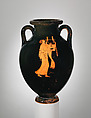
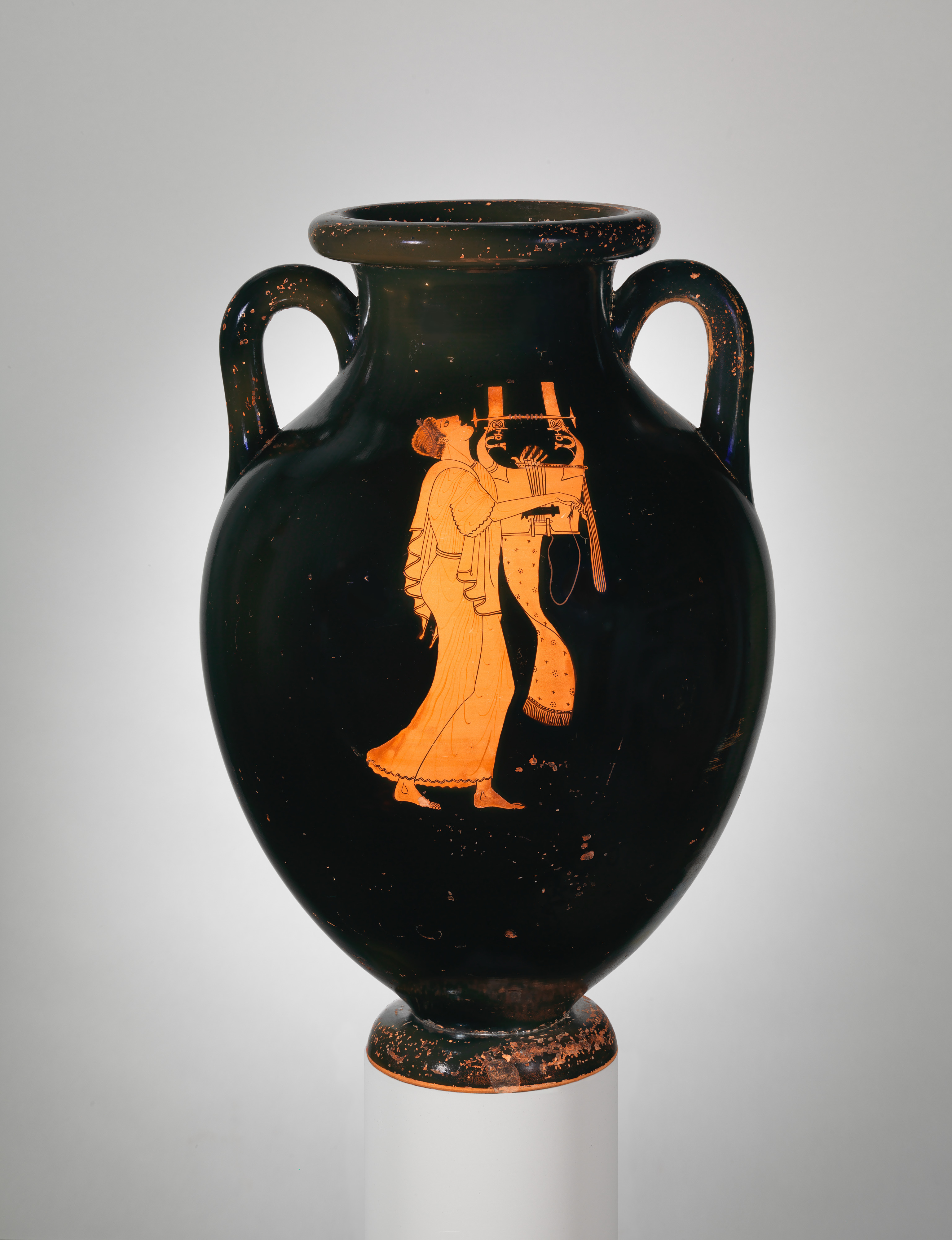
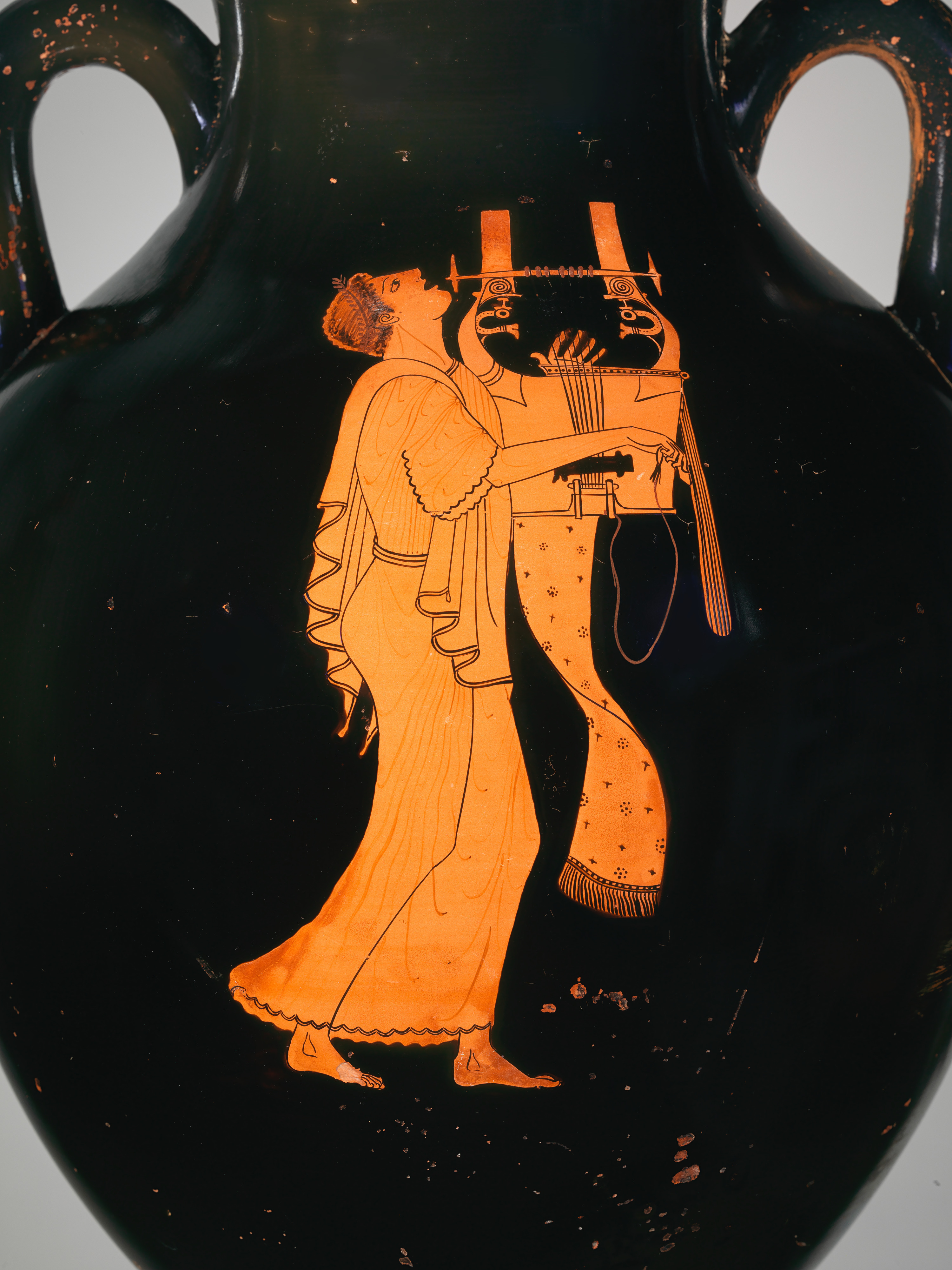
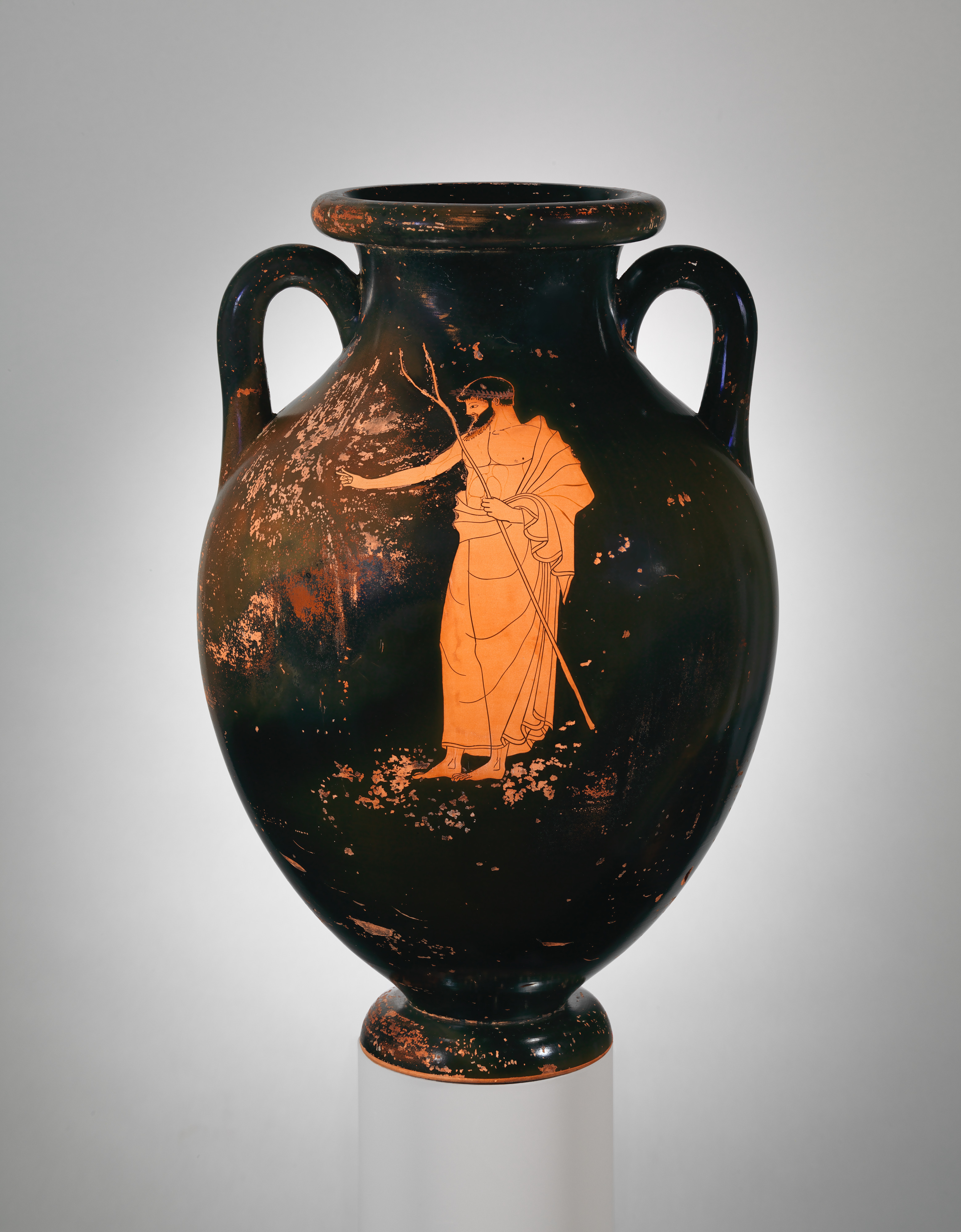
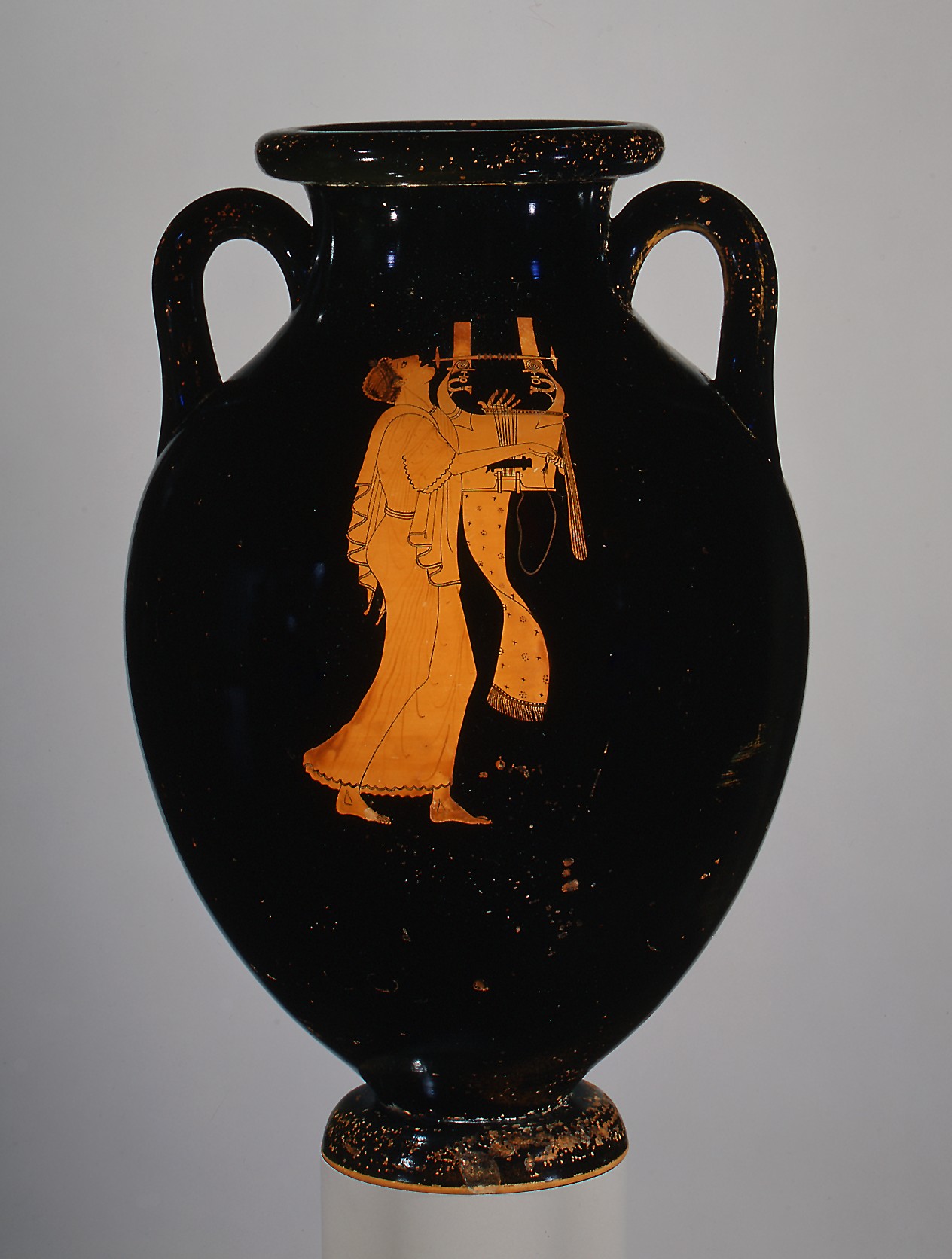
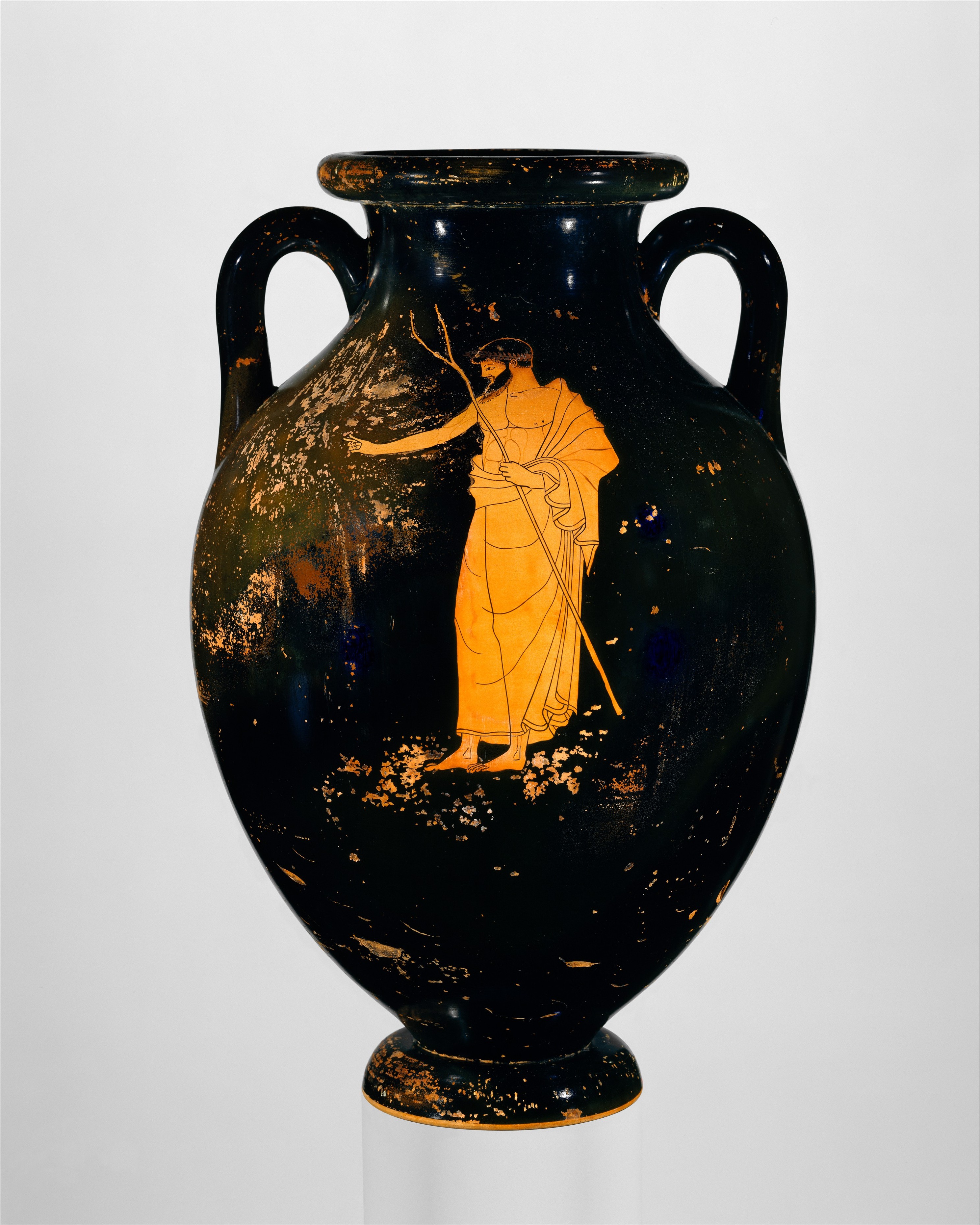
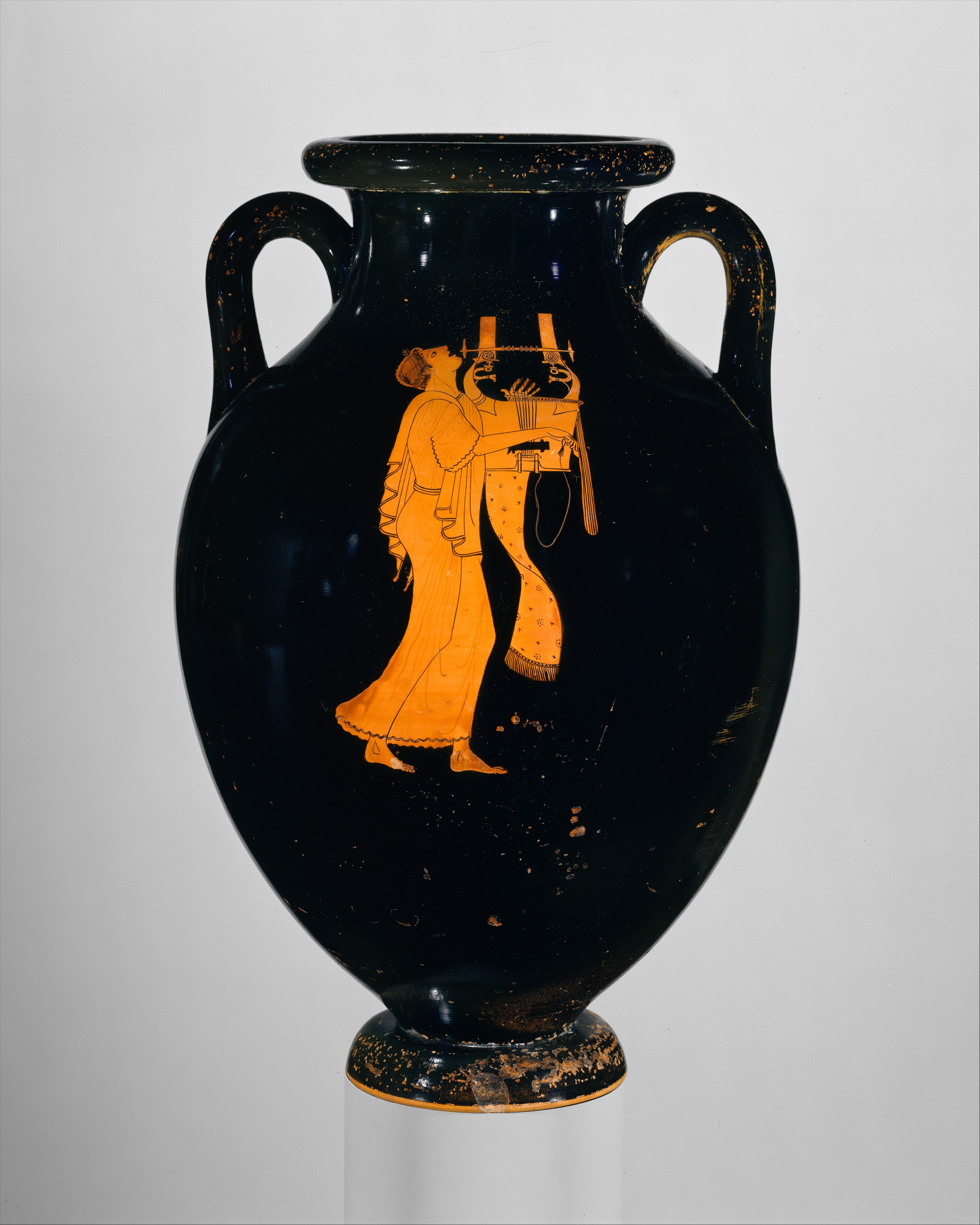
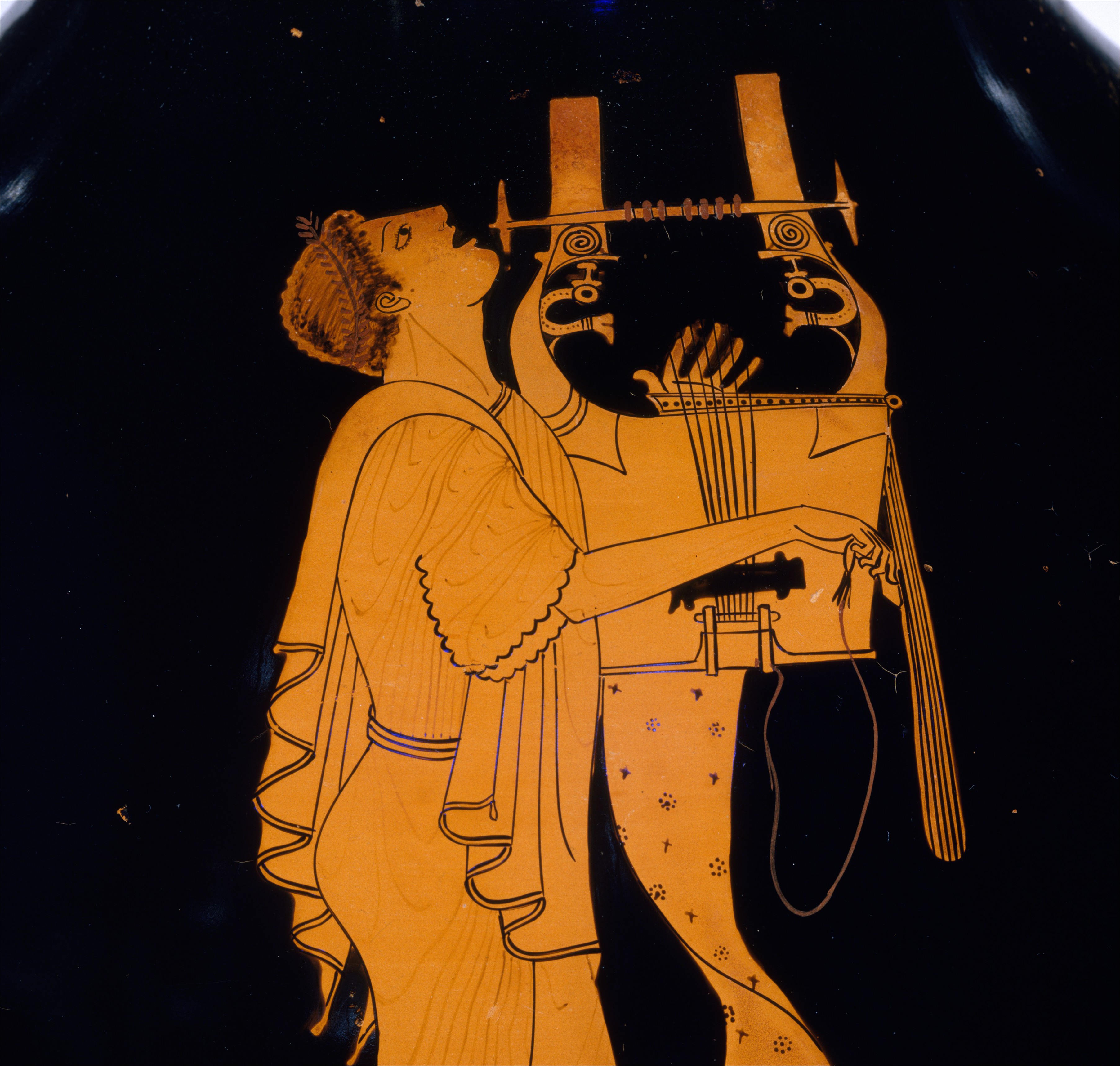
Obverse, young man singing and playing the kithara Reverse, judge
This work is a masterpiece of Greek vase-painting because it brings together many features of Athenian culture in an artistic expression of the highest quality. The shape itself is central to the effect. Through the symmetry, scale, and luminously glossy glaze on the obverse, it offers a carefully composed three-dimensional surface that endows the subject with volume. The identity of the singer is given by his instrument, the kithara, which was a type of lyre used in public performances, including recitations of epic poetry. The figure on the reverse is identified by his garb and wand. While the situation is probably a competition, the subject is the music itself. It transports the performer, determines his pose, and causes the cloth below the instrument to sway gently.
This artwork is meant to be viewed from right to left. Scroll left to view more.
Artwork Details
Use your arrow keys to navigate the tabs below, and your tab key to choose an item
Title:Terracotta amphora (jar)
Artist:Attributed to the Berlin Painter
Period:Late Archaic
Date:ca. 490 BCE
Culture:Greek, Attic
Medium:Terracotta; red-figure
Dimensions:H. 16 5/16 in. (41.50 cm)
Classification:Vases
Credit Line:Fletcher Fund, 1956
Accession Number:56.171.38
Said to be from Nola (Beazley 1963, p. 197, no. 3).
Until 1919, private collection, UK; May 22-23, 1919, purchased by William Randolph Hearst through Sotheby, Wilkinson and Hodge, London; 1919-1951, collection of William Randolph Hearst, New York and San Simeon; 1951-1956, with the William Randolph Hearst Foundation, New York; acquired in 1956, purchased from the W. R. Hearst Corporation.
Sotheby, Wilkinson & Hodge. 1919. Greek, Roman and Egyptian Antiquities formed by the late Sir Hermann Weber..., and Other Properties. May 22–23, 1919. lot 270, p. 33, pl. XI.
Beazley, John D. 1922. "Citharoedus." The Journal of Hellenic Studies, 42(1): pp. 70–98, figs. 1–2, pl. II.
Beazley, John D. 1930. Der Berliner Maler: Bilder griechischer vasen, Vol. 2, John D. Beazley and Paul Jacobsthal, eds. pl. 21, Berlin: H. Keller.
von Bothmer, Dietrich. 1957. "Greek Vases from the Hearst Collection." Bulletin of the Metropolitan Museum of Art, 15(7): pp. 166, 176, Bulletin Cover.
Noble, Joseph V. 1960. "The Technique of Attic Vase-Painting." American Journal of Archaeology, 64(4): pp. 307–18, fig. 2, pl. 85.
Beazley, John D. 1961. "An Amphora by the Berlin Painter." Antike Kunst, 4(2): p. 50 n. 3.
Beazley, John D. 1963[1942]. Attic Red-figure Vase-painters, Vols. 1 and 2, 2nd ed. pp. 197, 1633, no. 3, Add. 1, pp. 196–214, Oxford: Clarendon Press.
Cole, Nancy. 1968. Greek Athletic Games. no. 5, New York: The Metropolitan Museum of Art.
Metropolitan Museum of Art. 1970. Masterpieces of Fifty Centuries. New York: Dutton.
Richter, Gisela M. A. 1970. "The Department of Greek and Roman Art: Triumphs and Tribulations." Metropolitan Museum Journal, 3: pp. 85, 87, fig. 31.
Beazley, John D. 1971. Paralipomena: Additions to Attic Black-Figure Vase-Painters and to Attic Red-Figure Vase-Painters [2nd edition]. p. 342, no. 3, Oxford: Clarendon Press.
von Bothmer, Dietrich. 1972. Greek Vase Painting: An Introduction. no. 21, pp. 6, 42–43, 70, New York: The Metropolitan Museum of Art.
von Bothmer, Dietrich. 1972. "Greek Vase Painting." Bulletin of the Metropolitan Museum of Art, 31(1): no. 17, pp. 6, 42–43, 68.
Beck, Frederick A. G. 1975. Album of Greek Education: The Greeks at School and at Play. p. 25, figs. 102–3, Sydney: Cheiron Press.
Levy, Kenneth. 1982. Music: A Listener's Introduction. Cover, New York: Harper & Row.
Kurtz, Donna C. 1982. The Berlin Painter. pp. 18, 22, 49, 61ff., 80, 104, 107, pls. I, XXXVI, a, b, Oxford: Clarendon Press.
Kurtz, Donna C. 1985. "Beazley and the Connoisseurship of Greek Vases." Greek Vases in the J. Paul Getty Museum, 2, Jiri Frel and Marion True, eds. p. 244, fig. 5, Malibu: J. Paul Getty Museum.
Metropolitan Museum of Art. 1987. Greece and Rome. no. 36, pp. 54–55, New York: The Metropolitan Museum of Art.
Carpenter, Thomas H., Thomas Mannack, and Melanie Mendonça. 1989. Beazley Addenda: Additional References to ABV, ARV² & Paralipomena. p. 190, Oxford.
Maas, Martha and Jane McIntosh Snyder. 1989. Stringed Instruments of Ancient Greece. pp. 64–65, 76, fig. 13, New Haven: Yale University Press.
Howard Kathleen. 1994. Metropolitan Museum of Art Guide: Works of Art Selected by Philippe De Montebello. New York: The Metropolitan Museum of Art.
Anderson, Warren D. 1994. Music and Musicians in Ancient Greece. pp. 177, 195, pl. IV, Ithaca, NY: Cornell University Press.
Hornblower, Simon and Antony Spawforth. 1998. The Oxford Companion to Classical Civilization. p. 478, Oxford: Oxford University Press.
Sparkes, Brian. 2000. "Greek Painted Pottery." Making Classical Art: Process and Practice, Roger Ling, ed. p. 72, fig. 40, Charleston, South Carolina: Arcadia.
Neer, Richard T. 2002. Style and Politics in Athenian Vase Painting: The Craft of Democracy ca. 530-460 B.C.E.. pp. 72–73, figs. 33–34, Cambridge: Cambridge University Press.
Roccos, Linda Jones. 2002. "The Citharode Apollo in Villa Contexts: A Roman Theme with Variations." The Ancient Art of Emulation: Studies in Artistic Originality and Tradition from the Present to Classical Antiquity, Dr. Elaine K. Gazda, ed. pp. 277–78, Ann Arbor, MI: University of Michigan Press.
Bundrick, Sheramy. 2005. Music and Image in Fifth-century Athens. pp. 2–3, 6, 18, 20, 164–65, 166, 203 n. 17, figs. 3–4, Cambridge: Cambridge University Press.
Picón, Carlos A. 2007. Art of the Classical World in the Metropolitan Museum of Art: Greece, Cyprus, Etruria, Rome no. 118, pp. 108, 428–29, New York: The Metropolitan Museum of Art.
Levkoff, Mary. 2008. Hearst the Collector. p. 24, Los Angeles: Los Angeles County Museum of Art.
Pérez, Diana Rodríguez. 2016. "Part II: Sir John Beazley." 250 Years of Scholarship on Greek Vases. pp. 41–43, 70–71, figs. 16, 31, Great Britain: Christ Church.
Galitz, Kathryn. 2016. The Metropolitan Museum of Art: Masterpiece Paintings. no. 17, p. 25, New York: Skira.
Padgett, J. Michael. 2017. The Berlin Painter and His World : Athenian Vase-Painting in the Early Fifth Century B.C. no. 15, pp. 2, 26, 48, 62 n. 55, 99, 139, 239, 242–43, 376, New Haven: Yale University Press.
Marconi, Clemente. 2017. "The Frames of Greek Painted Pottery." The Frame in Classical Art : A Cultural History, Verity Platt and Michael Squire, eds. pp. 151–52, fig. 2.16, Cambridge: Cambridge University Press.
Platt, Verity. 2017. "Introduction." The Frame in Classical Art : A Cultural History, Michael Squire, ed. pp. 151–52, fig. 2.16, Cambridge: Cambridge University Press.
Plantzos, Dimitris. 2018. The Art of Painting in Ancient Greece. pp. 118–19, figs. 114–16, Atlanta: Lockwood Press.
Oakley, John H. 2020. A Guide to Scenes of Daily Life on Athenian Vases. pp. 125, 153, fig. 7.26a–b, Madison, WI: University of Wisconsin Press.
Metropolitan Museum of Art. 2020. ART = Discovering Infinite Connections in Art History. pp. 196, 269, New York: Phaidon Press.
Publishing and Marketing Assistant Rachel High discusses the breadth of the Museum's collection of musical instruments with J. Kenneth Moore, Frederick P. Rose Curator in Charge of the Department of Musical Instruments.
The Met's Libraries and Research Centers provide unparalleled resources for research and welcome an international community of students and scholars.
The Met Collection API is where all makers, creators, researchers, and dreamers can connect to the most up-to-date data and public domain images for The Met collection. Open Access data and public domain images are available for unrestricted commercial and noncommercial use without permission or fee.
Feedback
We continue to research and examine historical and cultural context for objects in The Met collection. If you have comments or questions about this object record, please complete and submit this form. The Museum looks forward to receiving your comments.
The Museum's collection of Greek and Roman art comprises more than 30,000 works ranging in date from the Neolithic period to the time of the Roman emperor Constantine's conversion to Christianity in A.D. 312.