The Backgammon Players
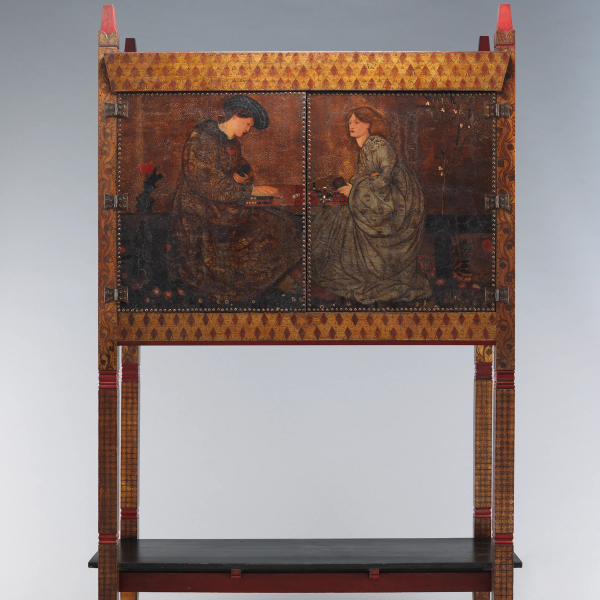
Although the cabinet is usually described as in the "medieval style," it is actually a vivid example of the ability of the Morris firm to convert the eclecticism that marked much of the art of the late nineteenth century into an original and modern style. Although Burne-Jones's painted figures are in medieval costume much of the decoration is equally Oriental in inspiration. Philip Webb's straightforward design, however, which boldly displays the casework skeleton on the exterior, anticipated the emphasis on structural elements that would inform the design revolution of the next century.
Artwork Details
- Title: The Backgammon Players
- Designer: Philip Webb (British, Oxford 1831–1915 West Sussex)
- Manufacturer: Morris, Marshall, Faulkner & Co. (1861–75)
- Artist: Painted by Sir Edward Burne-Jones (British, Birmingham 1833–1898 Fulham)
- Date: 1861
- Culture: British
- Medium: Painted pine, oil paint on leather, brass, copper
- Dimensions: Overall: 73 × 45 × 21 in. (185.4 × 114.3 × 53.3 cm)
- Classifications: Woodwork-Furniture, Paintings
- Credit Line: Rogers Fund, 1926
- Object Number: 26.54
- Curatorial Department: European Sculpture and Decorative Arts
Audio
419. The Arts and Crafts Movement
Gallery 516
NARRATOR: There’s a diverse array of objects in front of you: cabinets, chairs, tapestries, and paintings and they have one thing in common: nostalgia for a simpler time—Many include images of the natural world (flora and fauna), and romantic medieval scenes (such as castles and gardens, lovers and angels). Their older, traditional construction techniques are often left visible, in places like the joints.
The “Backgammon Players” cabinet, for example, features lovers playing a board game with flowers at their feet, and is crafted in fine punched-leather: a medieval specialty.
But why would 19th century artists “go backwards” like this—hundreds of years—to feature Medieval imagery and production methods? To express a clear and even revolutionary intention in what came to be known as the arts and crafts movement. Meet the movement's guru, William Morris.
WILLIAM MORRIS: I determined to do no less than to transform the world with beauty.
NARRATOR: Morris was a designer and writer, but also a social activist–He was passionate about reviving traditional designs and handicrafts, in whose simplicity he saw integrity. He believed industrialization had brought little but cold, mechanical production.
WILLIAM MORRIS: If you want a golden rule that will fit everything, this is it: have nothing in your houses that you do not know to be useful or believe to be beautiful.
NARRATOR: Morris was also a powerful political voice in socialist circles, strongly opposed to the tidal wave of cheaply manufactured goods flooding England, and the dangerous working conditions that mistreated unskilled laborers—many of them children.
WILLIAM MORRIS: If I have succeeded in some small way, if only in one small corner of the world, amongst the men and women I love, then I shall count myself blessed, and blessed, and blessed, and the work goes on.
NARRATOR: Impracticality ultimately killed the Arts and Crafts movement: hand-made high-end objects were just too expensive for a wider audience. His romantic ideals and design influence, however, are still with us: witness today’s renewed interest in artisanal goods and furniture and the continued popularity of many of his designs.
More Artwork
Related Content
 Free to download
Research Resources
The Met provides unparalleled resources for research and welcomes an international community of students and scholars. The Met's Open Access API is where creators and researchers can connect to the The Met collection. Open Access data and public domain images are available for unrestricted commercial and noncommercial use without permission or fee.
To request images under copyright and other restrictions, please use this Image Request form.
Feedback
We continue to research and examine historical and cultural context for objects in The Met collection. If you have comments or questions about this object record, please contact us using the form below. The Museum looks forward to receiving your comments.
Content Notice
The Metropolitan Museum of Art presents over 5,000 years of art from around the world, and our online collection reflects ongoing work conducted over the course of our more than 150-year history. You may encounter objects or images that may be inappropriate for some viewers or information that may be outdated.