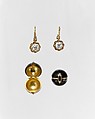
Earrings
Artwork Details
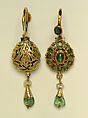
- Title: Earrings
- Maker: Edward Burr (active 1838–68)
- Date: ca. 1836–50
- Geography: Made in New York, New York, United States
- Culture: American
- Medium: Gold, pearls, diamonds, and enamel
- Dimensions: Earrings: 1 1/16 x 5/8 x 1 1/2 in. (2.7 x 1.6 x 3.8 cm)
- Credit Line: Purchase, Susan and Jon Rotenstreich Gift, 2000
- Object Number: 2000.549.2a, b
- Curatorial Department: The American Wing
Audio
4529. Overview: American Jewelry
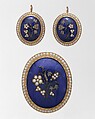
MORRISON HECKSCHER: Displayed here are glorious examples of the Met’s collection of American jewelry. Take a look around while I tell you more. The earliest pieces, often small forms like little lockets, date from the early eighteenth century. American silversmiths, who also served as jewelers, often typically made them. But as the country prospered, small workshops gradually grew into large factories, where increasingly mechanized production replaced handcraftsmanship. By the mid-nineteenth century, jewelry included gold and silver medals, brooch-and earring sets modeled after European designs, or and elaborate hair jewelry created as a memento of a loved one. Cameos were especially prized, as were imported seed pearls, particularly as gifts to brides. The jewelry also represented a variety of techniques, such as enameling, engraving and casting. And materials ranged from precious and semi-precious gems to wood, imported tortoiseshell, or its less costly substitute of Vulcanite, which was invented in 1836. Exotic materials – such as coral and diamonds –were always imported. But a watershed for the history of American jewelry occurred in 1849 when gold was discovered in California. And with the 1859 discovery of the Comstock Lode in Nevada, silver also became more available. By the late nineteenth century, such well-known manufactories as Tiffany & Company and Gorham were joined by lesser known but highly regarded firms and designers. These included Marcus & Company, Riker Brothers and Florence Kohler. Designs reflected a range of historical revival styles – as well as the asymmetrical forms of Art Nouveau and the handcraftsmanship of the Arts and Crafts movement.
More Artwork
Research Resources
The Met provides unparalleled resources for research and welcomes an international community of students and scholars. The Met's Open Access API is where creators and researchers can connect to the The Met collection. Open Access data and public domain images are available for unrestricted commercial and noncommercial use without permission or fee.
To request images under copyright and other restrictions, please use this Image Request form.
Feedback
We continue to research and examine historical and cultural context for objects in The Met collection. If you have comments or questions about this object record, please contact us using the form below. The Museum looks forward to receiving your comments.
Content Notice
The Metropolitan Museum of Art presents over 5,000 years of art from around the world, and our online collection reflects ongoing work conducted over the course of our more than 150-year history. You may encounter objects or images that may be inappropriate for some viewers or information that may be outdated.