English

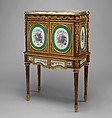
Drop-front desk (secrétaire à abattant or secrétaire en cabinet)

Attributed to Martin Carlin French
Manufactory Sèvres Manufactory French
Decorator Central plaque decorated by Edme François Bouillat père French
ca. 1776
On view at The Met Fifth Avenue in Gallery 529
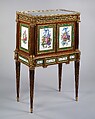
Attributed to the cabinetmaker Martin Carlin, who was known for his graceful furniture mounted with Sevres porcelain, this exquisite two-piece desk was made about 1776. A date letter for that year is painted on the back of the central porcelain plaque, together with the mark of Edme-Francois Bouillat (1739/40–1810), a painter at the Sevres manufactory. A specialist in different kinds of floral ornament, Bouillat decorated the main plaque with a flower basket suspended from a large bowknot. The history of this secretary is well documented. During the eighteenth century it graced the collections of two remarkably different women. Its first owner was the popular soprano Marie-Josephine Laguerre (1755–1783), who as a fille d'Opera enjoyed a luxurious and dissolute existence made possible by her wealthy lovers. Her personal property was publicly sold in April 1782, less than a year before her untimely death. The catalogue indicates that she owned this secretary as well as two other pieces of furniture embellished with porcelain plaques. Some of the Sevres decorative wares in her collection may have been displayed on the marble shelves of the secretary. It is likely that Dominique Daguerre, who with his partner, Simon-Philippe Poirier, had a virtual monopoly on the purchase of Sèvres plaques, supplied the piece of furniture to Laguerre and bought it back at the 1782 sale, but this is not documented. In May of that same year, Maria Feodorovna, grand duchess of Russia, and her husband, Paul (1754–1801), visited Paris incognito as the comte and comtesse du Nord. The future empress was described by Jeanne-Louise-Henriette Campan (1752–1822), first lady-in-waiting to Marie-Antoinette, as being “of a fine height, very fat for her age, with all the stiffness of the German demeanour.” In Paris, Maria Feodorovna frequented the shops of the fashionable dealers, where she is likely to have acquired the porcelain-mounted secretary and other furnishings for her country residence at Pavlovsk.

According to a detailed description of her private rooms written in 1795 by Maria Feodorovna herself, the secretary was placed in her boudoir. It remained at the imperial palace until the Soviet government, which had taken possession of Pavlovsk after the Revolution of 1917, offered works of art for sale to the dealer Joseph Duveen (1869–1939), who had traveled to the Soviet Union in 1931.

Artwork Details

Object Information
  • Title: Drop-front desk (secrétaire à abattant or secrétaire en cabinet)
  • Maker: Attributed to Martin Carlin (French, near Freiburg im Breisgau ca. 1730–1785 Paris)
  • Manufactory: Sèvres Manufactory (French, 1740–present)
  • Decorator: Central plaque decorated by Edme François Bouillat père (French,1739/40–1810, active 1758–1800)
  • Date: ca. 1776
  • Culture: French, Paris and Sèvres
  • Medium: Oak veneered with tulipwood, amaranth, holly, and sycamore; six Sèvres soft-paste porcelain plaques and two painted tin plaques; gilt-bronze mounts; marble shelves; moiré silk
  • Dimensions: 43 3/8 x 40 1/2 x 12 7/8 in. (110.1 x 102.9 x 32.7cm)
  • Classification: Woodwork-Furniture
  • Credit Line: Gift of Mr. and Mrs. Charles Wrightsman, 1976
  • Object Number: 1976.155.110
  • Curatorial Department: European Sculpture and Decorative Arts

Audio

Cover Image for 2258. Drop-Front Secretary on Stand

2258. Drop-Front Secretary on Stand

0:00
0:00

NARRATOR: The beauty and refinement of French eighteenth-century furniture attracted an international clientele. Among them were the future empress and emperor of Russia, Paul and Maria Feodorovna. They stopped in Paris on a Grand Tour of Europe, while traveling incognito as the count and countess du Nord. Daniëlle Kisluk-Grosheide.

DANIËLLE KISLUK-GROSHEIDE: And we know that they visited, in 1782, the luxury shop of the marchand-mercier Daguerre. And it is very likely that, at that occasion, Maria selected this piece, which she then had sent to Russia and used in Pavlosk, this wonderful jewel box country house that they were building outside St. Petersburg.

NARRATOR: Paris was also a magnet for foreign-born cabinetmakers. This secretary is attributed to the German-born Martin Carlin. He specialized in fashionable Sèvres-mounted pieces, and you can see a number of them here.

More Artwork
Research Resources

The Met provides unparalleled resources for research and welcomes an international community of students and scholars. The Met's Open Access API is where creators and researchers can connect to the The Met collection. Open Access data and public domain images are available for unrestricted commercial and noncommercial use without permission or fee.

To request images under copyright and other restrictions, please use this Image Request form.

Feedback

We continue to research and examine historical and cultural context for objects in The Met collection. If you have comments or questions about this object record, please contact us using the form below. The Museum looks forward to receiving your comments.

Send feedback