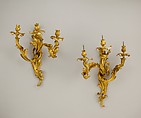
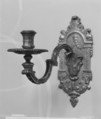
Three-light wall brackets (set of four)
The original model of these so-called « lovebirds » wall lights, was made in 1787 by the bronzier Pierre-François Feuchère for the bedchamber of Marc-Antoine Thierry de Ville d'Avray, Intendant Général du Garde-Meuble. The workshop of Pierre-François Feuchère, who worked with his son Lucien-François, was one of the most important for the production of luxurious gilt bronze at the end of the eighteenth century. Because of its success, the Feuchères produced different variants of this wall light. One year later, two pairs were made for Marie-Antoinette’s cabinet de toilette at the Château de Saint-Cloud (now in the collection of the Musée du Louvre, Paris) and two others for the private Cabinet of the King at Saint-Cloud (now in the Elysée Palace) where the doves were replaced by a bouquet of fruits and flowers.
Emblematic of the neoclassical style, these wall lights have been repeated many times during the late eighteenth century and nineteenth century, making a precise dating of the MMA models very difficult.
Artwork Details
- Title: Three-light wall brackets (set of four)
- Modeler: After a model by F. L. Feuchère père (French, died 1828)
- Date: late 18th or early 19th century
- Culture: French
- Medium: Gilt bronze
- Dimensions: Each: H. 27 1/4 x W. 15 1/4 x D. 9 1/4 in. (69.2 x 38.7 x 23.5 cm)
- Classification: Metalwork-Gilt Bronze
- Credit Line: Gift of Mr. and Mrs. Charles Wrightsman, 1977
- Object Number: 1977.1.6–.9
- Curatorial Department: European Sculpture and Decorative Arts
More Artwork
Related Content

Research Resources
The Met provides unparalleled resources for research and welcomes an international community of students and scholars. The Met's Open Access API is where creators and researchers can connect to the The Met collection. Open Access data and public domain images are available for unrestricted commercial and noncommercial use without permission or fee.
To request images under copyright and other restrictions, please use this Image Request form.
Feedback
We continue to research and examine historical and cultural context for objects in The Met collection. If you have comments or questions about this object record, please contact us using the form below. The Museum looks forward to receiving your comments.
Content Notice
The Metropolitan Museum of Art presents over 5,000 years of art from around the world, and our online collection reflects ongoing work conducted over the course of our more than 150-year history. You may encounter objects or images that may be inappropriate for some viewers or information that may be outdated.