Pietà
Artwork Details
- Title: Pietà
- Artist: Jean-Baptiste Carpeaux (French, Valenciennes 1827–1875 Courbevoie)
- Date: 1864
- Culture: French, Paris
- Medium: Terracotta
- Dimensions: Overall: 11 7/16 x 7 1/16 x 5 15/16 in. (29.1 x 17.9 x 15.1 cm)
- Classification: Sculpture
- Credit Line: Purchase, Assunta Sommella Peluso, Ada Peluso, and Romano I. Peluso Gift, in memory of Ignazio Peluso, 2001
- Object Number: 2001.199
- Curatorial Department: European Sculpture and Decorative Arts
Audio
79. Pietà
Jean-Baptiste Carpeaux
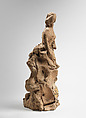
NARRATOR: Carpeaux was not a regular church-goer, but he was intensely religious. At trying times he drew strength and inspiration from his Christian faith, as seen in this Pietá, showing the Virgin Mary mourning her dead son. Curator Jim Draper.
JAMES DRAPER: This particular model, was never realized in greater size or a different material. I think you could call this a model for himself. I believe that he identified his own approaching end with Christ’s Passion. And the two just become intermingled in his head.
NARRATOR: Carpeaux certainly knew Michelangelo’s famous marble Pietá in St. Peter’s in Rome. But another influence would have been the cheap crucifixes that he collected in Parisian flea markets, with their distorted limbs and agonized faces.
JAMES DRAPER: It's one of the most wonderful expressions of his own expressivity with clay: the spiraling forms that run throughout the composition, and the economy of means. He’ll just stab the clay for the eyes or the mouth. Or in the case of Christ’s nose, it's just a little slash. Lots of the clay has fallen away during the modeling, I believe, or when it was fired. But that didn't bother him.
NARRATOR: In what can be seen as an anticipation of Rodin and later modernists, Carpeaux is concerned only with distilling the essence of the composition—here, a divine love that outfaces death itself.
More Artwork
Related Content

 Free to download
Research Resources
The Met provides unparalleled resources for research and welcomes an international community of students and scholars. The Met's Open Access API is where creators and researchers can connect to the The Met collection. Open Access data and public domain images are available for unrestricted commercial and noncommercial use without permission or fee.
To request images under copyright and other restrictions, please use this Image Request form.
Feedback
We continue to research and examine historical and cultural context for objects in The Met collection. If you have comments or questions about this object record, please contact us using the form below. The Museum looks forward to receiving your comments.
Content Notice
The Metropolitan Museum of Art presents over 5,000 years of art from around the world, and our online collection reflects ongoing work conducted over the course of our more than 150-year history. You may encounter objects or images that may be inappropriate for some viewers or information that may be outdated.