Backplate and Hoguine (Rump Defense) from a Costume Armor
Artwork Details
- Title: Backplate and Hoguine (Rump Defense) from a Costume Armor
- Armorer: Kolman Helmschmid (German, Augsburg 1471–1532)
- Date: ca. 1525
- Geography: Augsburg
- Culture: German, Augsburg
- Medium: Steel, gold
- Dimensions: H. 27 in. (68.6 cm); W. 18 in. (45.7 cm); Wt. 9 lb. 11.88 oz. (4419 g); backplate: H. 16 1/4 in. (41.3 cm); W. 14 5/8 in. (37.1 cm); D. 7 15/16 in. (20.2 cm); D. with shoulder straps extended 11 5/8 in. (29.5 cm); Wt. 4 lb. (14.6 oz. (2229 g); rump defense: H. 13 1/8 in. (33.4 cm); W. 16 3/4 in. (42.6 cm); D. 8 1/8 in. (20.7 cm); Wt. 4 lb. 13.25 oz. (2190 g)
- Classification: Armor Parts
- Credit Line: Gift of Bashford Dean, 1924
- Object Number: 24.179
- Curatorial Department: Arms and Armor
Audio
2209. Backplate and Hoguine (Rump Defense), Part 1
Costume: The Art of Dress
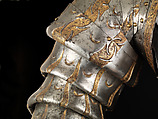
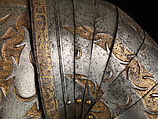
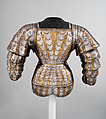
SARAH JESSICA PARKER: Armor has always followed fashion. These splendid sixteenth-century elements, however, also display wit and incredible virtuosity. Notice how the artist—probably the German master Kolman Helmschmid—was able to reproduce the properties of soft fabric in hard steel. The pieces here are defenses for the wearer’s upper and lower back and arms. They follow the fashionable silhouette of the period: the billowing sleeves, slender waist, and buttock-hugging garment known as upper hose.
The etched and gilded decoration covering the surface represents slashing. This was a peculiar style of dress in which the fabric was cut to reveal another textile underneath. The two fabrics were often of different colors, for maximum effect. The armor maker achieved this effect by contrasting plain and decorated surfaces.
Beginning in the 1500s, the Renaissance ideal of nobility required a display of magnificence, what we might call conspicuous consumption. This costly suit would have been worn only for processions and other courtly ceremonies. Nevertheless, it retains practical details as part of the design. For example, the edge of the neckline is roped and turned outward. This would have prevented an enemy's weapon from sliding off the backplate and into the neck. Every element of a person’s costume—including armor—expressed the wearer’s social status. For example, slashing was a hugely significant fashion all across Europe.
To hear Chris Paulocik, conservator, talk about this peculiar and long-lived style, please press PLAY.
Listen to more about this artwork
More Artwork
Research Resources
The Met provides unparalleled resources for research and welcomes an international community of students and scholars. The Met's Open Access API is where creators and researchers can connect to the The Met collection. Open Access data and public domain images are available for unrestricted commercial and noncommercial use without permission or fee.
To request images under copyright and other restrictions, please use this Image Request form.
Feedback
We continue to research and examine historical and cultural context for objects in The Met collection. If you have comments or questions about this object record, please contact us using the form below. The Museum looks forward to receiving your comments.
Content Notice
The Metropolitan Museum of Art presents over 5,000 years of art from around the world, and our online collection reflects ongoing work conducted over the course of our more than 150-year history. You may encounter objects or images that may be inappropriate for some viewers or information that may be outdated.