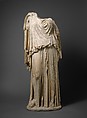
Marble statue of Aphrodite
The lower legs have been restored with casts taken from the Roman copy in Florence known as the Medici Venus.
The goddess of love is shown as though surprised at her bath. Originally, her arms reached forward to shield her breasts and pubis in a gesture that both concealed and accentuated her sexuality.
Statues of Aphrodite in the nude proliferated during the Hellenistic period. All were inspired to some degree by the Aphrodite of Knidos, created in the fourth century B.C. by the famous Greek sculptor Praxiteles. That statue, the first major Greek work to show the goddess nude, was celebrated throughout antiquity. This work has the same gesture of modesty and is similar to another Roman copy, the so-called Medici Venus, which has stood in the Tribuna of the Uffizi Gallery in Florence since 1688.
Artwork Details
- Title: Marble statue of Aphrodite
- Period: Imperial
- Date: 1st or 2nd century CE
- Culture: Roman
- Medium: Marble
- Dimensions: H. with plinth 62 1/2 in. (158.8 cm)
- Classification: Stone Sculpture
- Credit Line: Purchase, 1952
- Object Number: 52.11.5
- Curatorial Department: Greek and Roman Art
Audio
1277. Marble statue of Aphrodite, Part 1
Aphrodite, the goddess of love, is depicted here nude, and as if surprised at her bath. In the reconstruction drawing below, you can see that her arms reached forward to cover herself. The modest gesture, however, also draws us to her sexuality.
This statue is a Roman copy of a Greek original made in the Hellenistic period, sometime in the third or second century B.C. Statues of Aphrodite in the nude proliferated in the Hellenistic period, and, to some degree, all of them were inspired by the Aphrodite of Knidos—a fourth-century masterpiece by the Greek sculptor Praxiteles. The Knidian Aphrodite was the first major Greek work to show the goddess without clothing. The statue before you had the same modest gesture as Praxitele’s famous sculpture.
Take a moment to appreciate the delicate, yet voluptuous proportions of this figure from all angles. In the second century A.D., the Roman rhetorician, Lucian of Samosata, wrote a first-hand account of the famous Knidian Aphrodite. To hear a description based on his report, press the PLAY button now.
Listen to more about this artwork
More Artwork
Related Content



Research Resources
The Met provides unparalleled resources for research and welcomes an international community of students and scholars. The Met's Open Access API is where creators and researchers can connect to the The Met collection. Open Access data and public domain images are available for unrestricted commercial and noncommercial use without permission or fee.
To request images under copyright and other restrictions, please use this Image Request form.
Feedback
We continue to research and examine historical and cultural context for objects in The Met collection. If you have comments or questions about this object record, please contact us using the form below. The Museum looks forward to receiving your comments.
Content Notice
The Metropolitan Museum of Art presents over 5,000 years of art from around the world, and our online collection reflects ongoing work conducted over the course of our more than 150-year history. You may encounter objects or images that may be inappropriate for some viewers or information that may be outdated.